We are walking in the direction of Warenzo.
The world changes when you are thirsty. It shrinks. It loses depth. The horizon draws close. (In northern Ethiopia, the Earth butts against the sky, hard and pale as the surface of a skull.) The desert tightens around you like a noose. This is the thirsty brain compressing the distances of the Rift, sucking in the miles through the eyes, magnifying them, probing them for any hint of water. Little else matters.
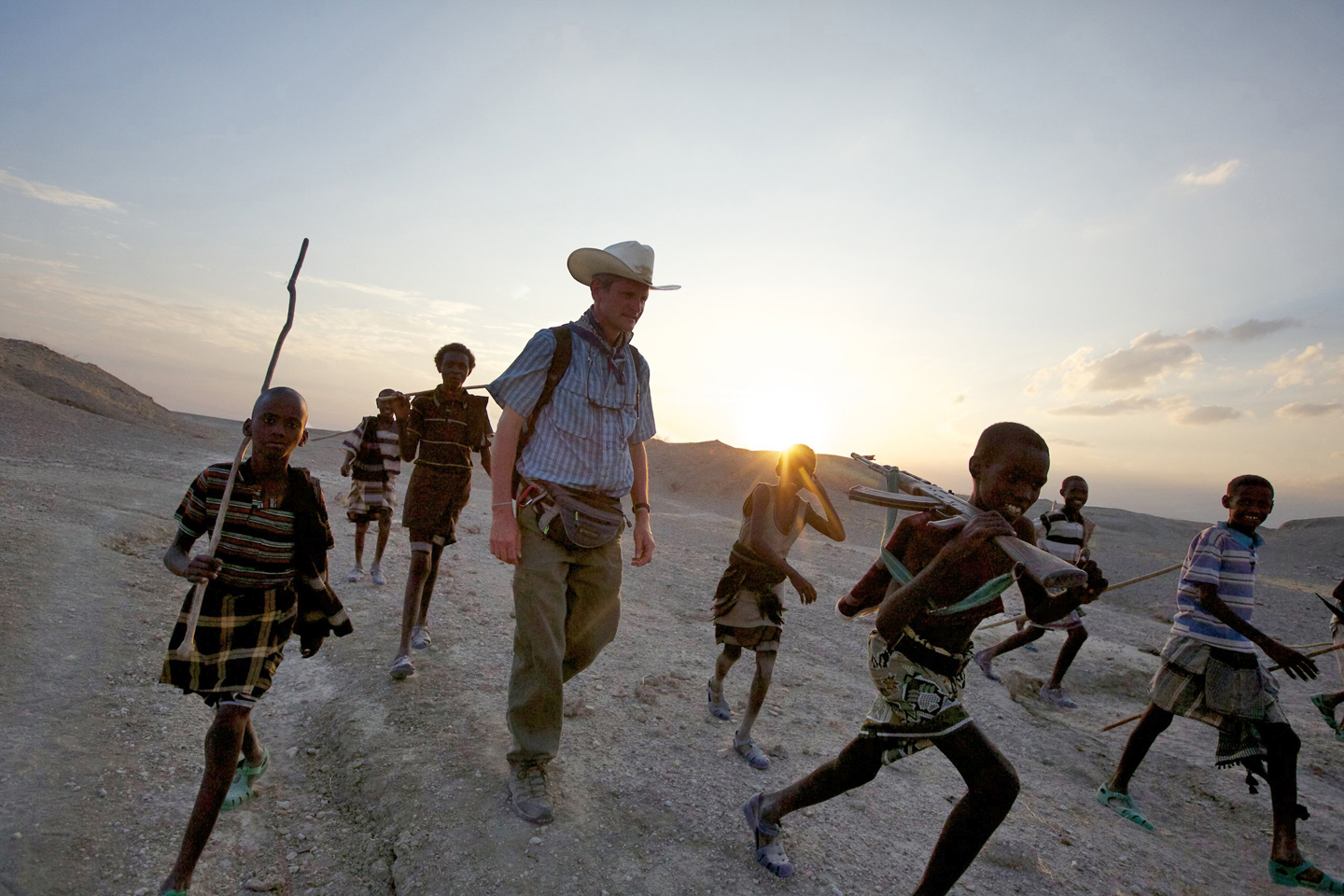
Ahmed Alema Hessan and I have trudged more than 20 miles through the crushing heat. We have separated from the cargo camels to visit an archaeological site folded into a rumpled badland: Gona, the location of the oldest stone tools in the world. Our water bottles are empty. We are thirsty, uncomfortable, anxious. We speak little. (What can be said? Why dry the tongue?) The sun’s rays corkscrew into our heads. An Afar proverb: It is best, when you are lost or thirsty, to keep walking under the sun, because eventually someone will see you. To be tempted into shade, to drop under one of ten thousand thorn bushes, is deadly: No one will find you. So we stagger into the blinding afternoon—until we hear the faint bleating of goats. Then we smile. We can begin to relax. Goats mean people.
Our hosts: an Afar family camped on a hill. Two strong, smiling young women. Eight children in thin rags that once may have been clothing. And an old woman—she doesn’t know her age—who hunches like a gnome in the shade of a reed mat. Her name is Hasna. She has been sitting there, weaving with spidery fingers, since the beginning of time. She invites us to join her, to rest our bones, to remove our shoes. She pours us water—chalky and warm, so salty, so alkaline it oozes down the throat like oil, but precious nonetheless—from a battered jerry can. She offers us a fistful of yellow berries from a wild tree. She is our mother.
When our ancestors wandered out of Africa about 60,000 years ago, they encountered other species of hominids. The world was crowded then with strange cousins: Homo neanderthalensis, Homo denisovans, Homo floresiensis, and perhaps other varieties of people who weren’t quite people.
How did they live? How did they love? The answers to these questions are unknowable.
When we met them, perhaps like this, on some remote hilltop, did we share water, or even interbreed peacefully, as some geneticists suggest? (Outside of Africa, modern human populations seem to contain as much as 2 percent of Neanderthal DNA.) Or did we rape and kill, launching our species’ long and terrible history of genocides? (In a cave occupied by modern humans, Fernando Rozzi, of Paris’s Centre National de la Récherche Scientifique, has found a Neanderthal jawbone mutilated by the cutmarks of butchery, perhaps cannibalism.) Scientists still debate this puzzle. All that is certain is that we alone survived to claim the Earth. We won the planet. But at a cost: We are without close family. We are the lonely ape.
Hasna’s gentle voice lulls me to sleep.
When I awake, Alema is hunkered in low conversation with the men of the nomad camp. They have returned from tending their flocks. We shake hands. We thank them. We leave packets of crackers for grinning Hasna, and walk on. We are hurrying to meet the camels, walking toward Warenzo. That night, while sipping our gift of salty water about a red fire that saws back and forth in the wind, Alema says the men of Hasna’s camp had threatened him. He was not of their clan. He nearly hit them on the head with his walking stick.