“If you want to walk fast, walk alone. If you want to walk far, walk together. “ — African proverb

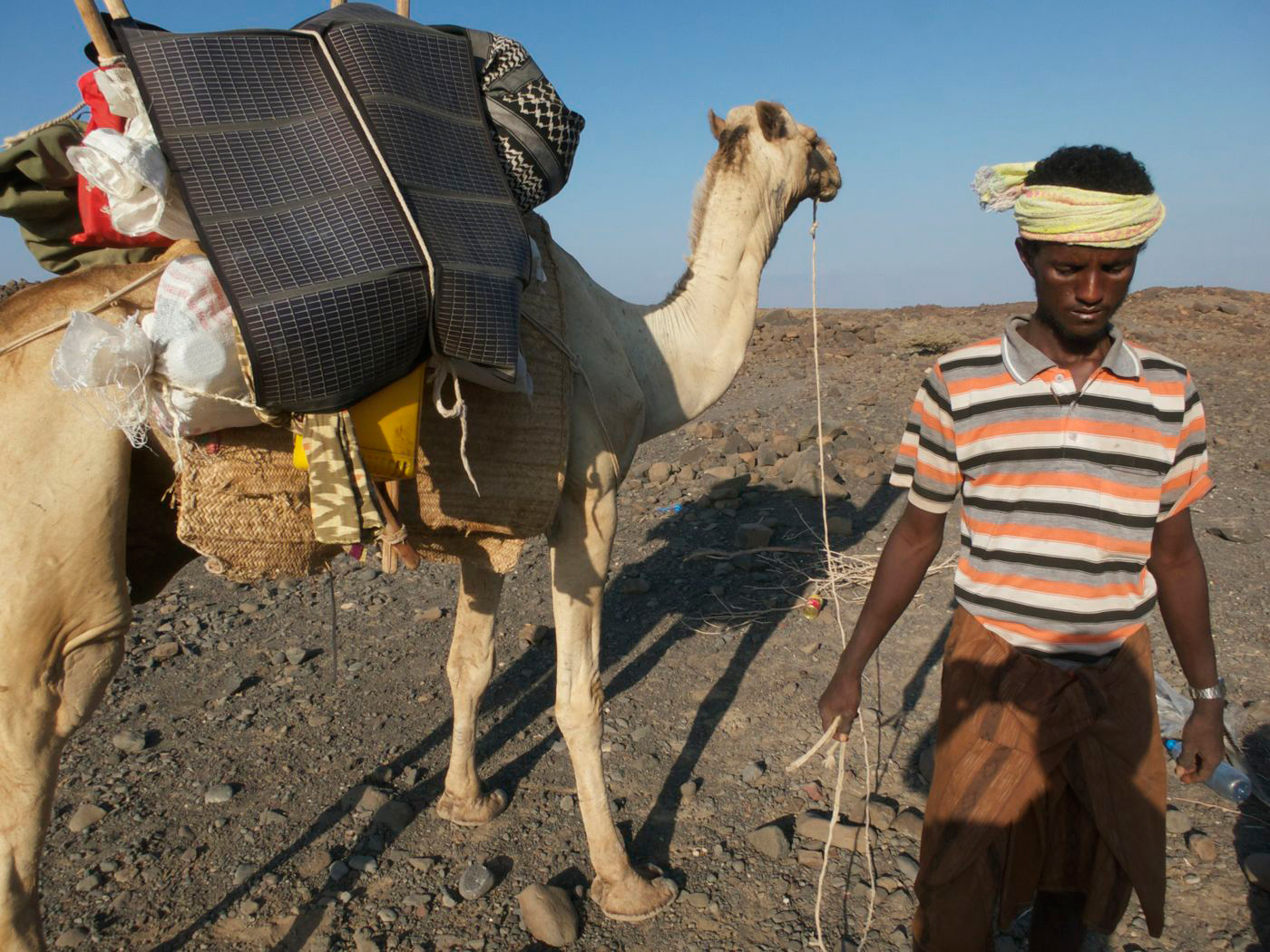
Breaking camp near Dubti after a night of walking in circles in the sugarcane fields.
Paul Salopek
We camp on the flank of Asa Fatma mountain, a basalt sentinel overlooking the caravan trails that braid eastward to the old Sultanate of Tadjourah, a distant port where ivory, salt, and slaves were once shipped by dhow to Arabia. The tiny Republic of Djibouti sprawls below us: a waterless plain, hotter and drier than the Ethiopian desert, sere lake beds of blinding white salt, scarps of gunmetal grey, and, doubtless, huddled somewhere in the shade of a doum palm, more Afar nomads—herders cleaved from their Ethiopian brethren by a colonial border, speaking in halting French.
This is where I begin to say goodbye to my walking companions, the Afar camel men from Herto Bouri.
The Ethiopians declare themselves ready to push on. They are ready, they insist, to walk with me to the beaches of the Red Sea. But this is impossible. My two cameleers, Kader Yarri and Mohamed Aidahis, possess no documents, no scraps of paper attesting to their physical existence, no passport. (“This is all Afar land!” they say.) And Ahmed Alema Hessan, my guide and camel-driving mentor, has relapsed beneath his mosquito net into a mysterious illness. He issues his camel-loading orders lying down, from under his shire, his sarong, which he drapes like a sheet over his head. In a few hours, we will part ways in the grim border town of Howle.
What is it like to walk through the world?
It is mornings like these: Opening your eyes to nothing but seamless sky for day after day; a pale, numinous void that for one fleeting instant when you first awake, seems to suck you upward, out of yourself, out of your body. It is the clean hollowness of hunger, a lightness that seems blown through by the wind, the way an empty pipe is blown, to make it whistle. (We trekked 18 miles yesterday on short rations, on a single bowl of noodles and a handful of biscuits each. My wedding ring, once tight, jiggles loosely along my finger.) It is learning to interrogate landscapes with your eyes for camel fodder, for wind direction (dust), for wood, and of course for water—an antique power resides in this. And it is watching the vastness of Africa slip by at a walking pace, and coming to realize dimly that, even at three miles per hour, you are still moving too fast. It is the journey shared.

Mohamed Aidahis crosses the tamed Awash.
Paul Salopek
Mohamed Aidahis:
A powerful, ant-stomping gait—he plants his feet with force, with vigor, as if to correct the path of the Earth along its orbit. We call him the Third Camel. His appetite is bottomless. One night he gorged himself on bread intended for all. While I fumed, the others laughed. He laughed, too. This is the Afar way: to live (and eat) in the moment. We must disarm him in the towns—his jile dagger is long and sharp—before the police do. At dawn we hear his blade’s tok-tok-tok as he prepares the camels’ thorny breakfasts, chopping branches high up in an acacia tree.

Kader Yarri, the quiet one.
Paul Salopek
Kader Yarri:
The marionette looseness of a skinny man’s step, light, tireless, eternal, the continent-spanning gait of the ancestors. He is the quiet one, and thus listened to. Early on, I mistook his silences for aloofness: to the pastoralist, to the nomad, sedentary people who own no livestock are inferior beings. But this man’s silence is generous. A watchful steadiness. Without comment he always shoulders more than his share of work. “What will the camels eat?” he asked one day, worried about the cauterized deserts near the Djibouti border. I shrugged: I had no idea. I picked up a stone, held it out. It was the only time I saw him laugh.

Paul Salopek and his Ethiopian guide, Ahmed Alema, arrive in Haramfaf village to a welcoming song.
John Stanmeyer-VII
Ahmed Alema Hessan, balabat, or leader, of the Bouri Modaitu clan (and, only incidentally, my guide):
Bandy-legged, energetic, with a spring-loaded step. In another place—in the tumbleweed towns of West Texas, say—Alema might have made a fine square dancer. He is the “road boss” of our shambolic little caravan: a human knot, complex, tough, a nexus of murky connections who plays all the angles, as one must on a lean desert margin. At first, his bawdy locker-room English made me doubt his seriousness: He seemed to consider the walk a cosmic joke, a windfall by which to add an executive wing to the shack of his third and youngest wife in the truck stop town of Mile. But Alema is beyond serious. In truth, he has taken possession of this journey, located himself fully within it. He rallies us when we are tired. He presses on. The walk now belongs to him. (“I don’t care about the money, man. It’s the history.”)
On our best days, we four ramblers recognize our good luck. We ricochet down raw mountain trails, almost running, with the whole shining desert of Ethiopia at our feet. We bounce our voices off the walls of black-rock canyons in whooping contests. Then we catch each other’s eye, three Afars and a man from the opposite longitude of the Earth, and grin like children. The cameleers catch the spark, and sing.
What is it like to walk through the world?
It is like this. It is like serious play. I will miss these men.

End of the trail in Ethiopia: the descent into boiling Djibouti.
Paul Salopek