“In a sense the car has become a prosthetic, and though prosthetics are usually for injured or missing limbs, the auto-prosthetic is for a conceptually impaired body or a body impaired by the creation of a world that is no longer human in scale.” ― Rebecca Solnit, Wanderlust: A History of Walking
Mohamad Banounah is in pain.
He lies jackknifed under his mosquito net, clutching at his sides. It is past 1:00 a.m. The sun stokes its boilers with hydrogen on the far side of the Earth. Overhead, the constellations burn cool like blue-green undersea things.
“Go back to sleep,” Banounah wheezes. He waves me off, feebly. “I am fine.”
But my Saudi walking partner is not fine. His eyes are glazed in my flashlight beam. He feels, he says, like he has been knifed. He can barely stand. So our logistician, Farhan Shaybani, fires up the support vehicle. We roust Awad Omran, our camel handler, from his blanket. (He must guard the camp.) And Farhan and I speed Banounah to hospital.
From the front seat I peer back at my friend: a bulldog of a man with a shaved skull sprawled atop hundreds of pounds of excess camping gear. There is a big rolled-up Persian carpet jammed in the car. There are extra sleeping bags. There are four or five folding safari chairs, a complete tea set, two superfluous tents, four mismatched camp stoves, a battery-powered fan that clamps to anything, and two large and mysterious trunks that might contain lead ingots or God-knows-what—in short, a Himalaya of kit that Banounah lugs with him everywhere in the desert. I catch him grinning even in his misery. (His face appears and disappears beneath the fireballs of orange highway lights.) Because he knows how much his baggage train irks me. Because I have argued hotly against using a support car at all. (This is a walk—I lectured him in Riyadh—not the Paris-to-Dakar rally.) And because now, his dinged-up GMC Yukon, which I deem an insult to the skill of my camels, ordering it to leave us alone for days, is whisking him to safety. To relief. To rescue. It might even be saving his life. Banounah is vindicated.

In Riyadh, Banounah prepares to load his gear into his support vehicle. The gilt frame stayed behind, but only just.
Paul Salopek
We enter a night town. Empty streets. Closed shops. Banounah vomits beside the road. At the Red Crescent station I climb with him into an ambulance. Banounah bounces in the stretcher. Farhan’s headlights follow.
Why am I doing this? Why walk poor Banounah into grief?
For the usual knot of reasons. To transport my brain into the Pleistocene. (The mind-frame of the primordial African hunters whose footsteps I am retracing.) To tell stories. To see, to listen, to think, etc. But also, it must be conceded, because of peccadillos: odd notions absorbed from 19th-century Transcendentalists (Thoreau: “We should go forth on the shortest walk, perchance, in the spirit of undying adventure, never to return; prepared to send back our embalmed hearts only, as relics to our desolate kingdoms.”) Or from dead walking poets. (Bashō: “With a young leaf/I would wipe the tears/from your eyes.”) Or from half-forgotten dreams rooted in childhood mornings spent under the glassy blue volcanoes of the central Mexican plateau. Stocked by happenstance, crammed with found objects, a ragbag of comforting junk, my head differs little from Banounah’s car.
The Sudanese doctor in the hospital ER squirts saline solution into Banounah’s veins. “Your friend,” he informs me reassuringly, “is only suffering from dehydration.” But I disagree. The problem is dissonant walking.
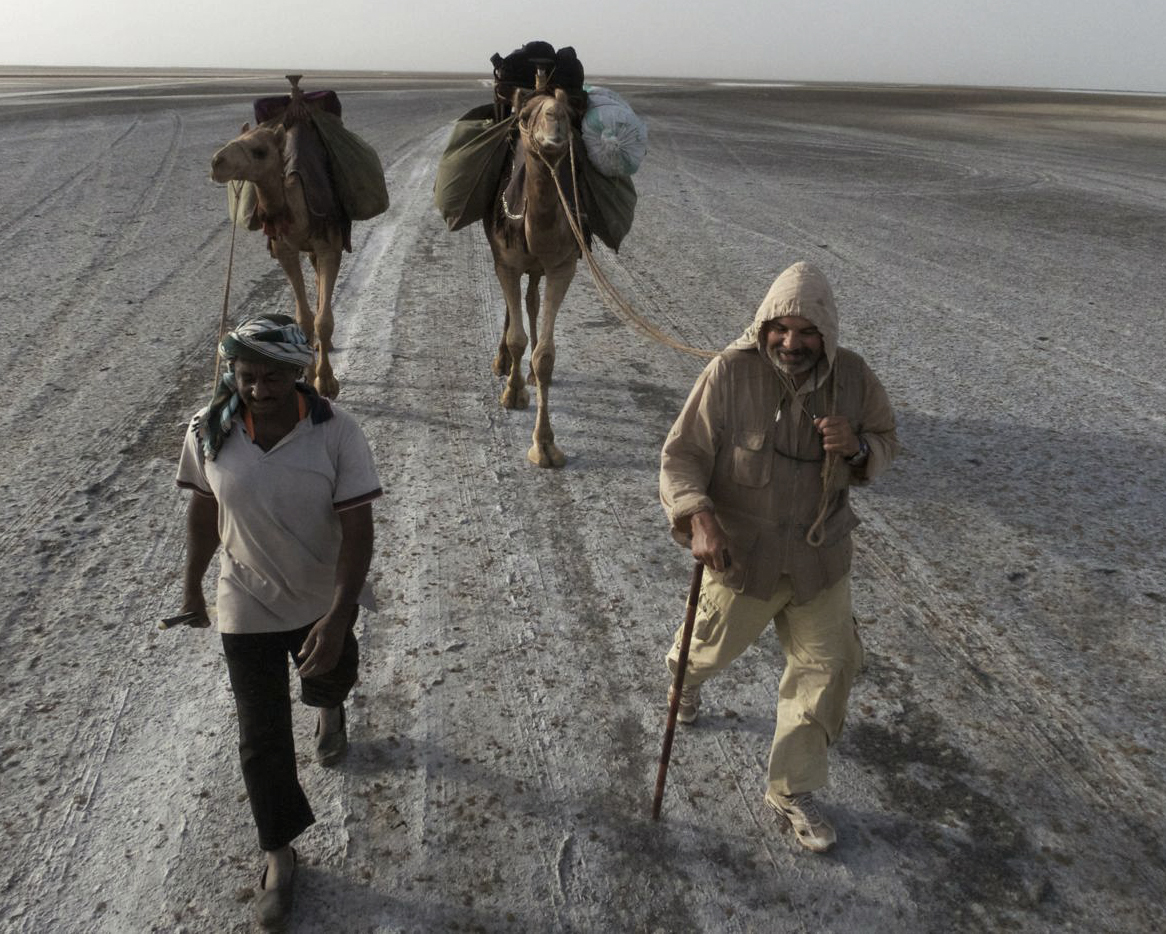
I am a discursive walker. I zigzag. I stop. I veer. I scribble with my feet. Banounah, by contrast, believes in missions—in beelines. He is an ex-soldier. He marches slowly but doggedly to objectives: toward a lemonade at a highway mini-mart, to a GPS coordinate. Under any circumstances, walking with a partner who does not match your essential rhythm, your basic stride, is no easy thing. Slower, faster—it hardly matters: forcing the will of a footstep saps both parties. After 30,000 or 40,000 such footfalls—the average in a 25-mile day—the friction between two gaits can be shattering. Tendons creak. Joints break down from unnatural strides. The body rebels. The best description of this effect comes in a story not about walking but about loggers in the forests of Montana a century ago. Pushing and pulling at opposite ends of six-foot saws, the workmen either coordinated their muscles precisely or were quickly exhausted, whipped:
“As to the big thing, sawing, it is something beautiful when you are working rhythmically together—at times, you forget what you are doing and get lost in abstractions of motion and power. But when the sawing isn’t rhythmical, even for a short time, it becomes a kind of mental illness—maybe something even more deeply disturbing than that. It is as if your heart isn’t working right.”
The fluorescent lights in the hospital waiting room are glacial. But I hear the Filipino nurses laughing. It is Banounah. His ribald jokes. He is a positive life force.
The author of the world’s only Arabic-language desert survival guide, Banounah is an amateur herpetologist, a collector of Bedouin folk tales, a lay archaeologist, and a gifted wildlife photographer. During the course of these pursuits, he has been bitten on the finger by a carpet viper (the snake that kills the most human beings in the world), stung by scorpions, broken both wrists falling off a mountain, and had a large area of his hide removed upon being dragged—while strapped into an old parachute—behind a car driven, obliviously, at high speed, through the desert, by the teenage son of a friend. He joined the Out of Eden Walk three months after major gall bladder surgery.
“Paul, you have a big problem here,” he told me when I first rang him from Africa, to discuss the logistics of walking through Saudi Arabia.
I paused, bracing myself.
“It is your name,” he went on. “In Arabic it means ‘urine.’”
He then proceeded to guffaw for nearly a full minute.
Walking is like language. It is like most ideology, theology, and cosmology: a locally conceived idea. Countless inflections, dialects, and variations of walking will appear and disappear along my route. How many such taxonomies must I navigate across the world? And will my own walk survive?
Banounah, who like 83 percent of Saudis lives in a city, cannot walk without a support car. So the grotesquely loaded Yukon, steered by his sidekick Farhan, will continue to follow along. I will continue to mutter and send it away for days at a time. And Banounah, walking far behind, will continue to flag down passing Bedouin in their dusty pickups and send them on delivery errands: They drive up hours later, at our midday camps, with plates of fast-food chicken and rice. Banounah will laugh his goaty laugh at my surprise. He is foraging. He is hunting and gathering. He closer to the Stone Age wanderers who first discovered the world than I.
Editors Note: From late May to late July there was a lapse in our posting of your comments about Paul’s dispatches. Apologies for this. Your comments, and Paul’s responses, are now up to date again.