A gas flare burns on the horizon—a second sun. We walk past it. We slog by the silver dome of a roadside mosque. (Its parking lot features a spigot gushing refrigerated, ice-cold water for travelers.) We tug our camels past an oil-stained truck stop. Then, rippling like a hallucination in the distance: an archway of poured concrete. It juts 40 feet or more above the desert flats. It looks like the gateway to a fabled walled city from he Arabian Nights. Except there is no city—not yet, at least. And there is no wall. There is only sand dimpled by the six stilt-like legs of darkling beetles. And a hot, embalming wind.
This is the laboratory called King Abdullah Economic City.
One of Saudi Arabia’s biggest mega projects, KAEC—pronounced “cake”—is a brand-new metropolis being built, from scratch, on the barrens of the Hejaz coast. Its ambitions boggle. More than 50 square miles of factories, malls, universities, marinas, desalination plants, parks, hospitals, hotels, office blocks, and warehouses will sprout from this achingly desolate spot. Cost: the GDP of many small countries, of Latvia, of Luxembourg. ($27 billion? $80 billion? Estimates differ.) The largest industrial port on the Red Sea is being scooped out on its empty shore. Two million people could live here within 20 years. Some will commute to work in Venetian-style canals, aboard motor yachts.
You can walk up the austere eastern shore of the Red Sea and be startled by the familiar packaging of America’s long partnership with this conservative Islamic kingdom: the same gluttonous superhighways (even the white-on-green highway signage is identical); the same car-centric, round-curbed housing tracts; the same Pizza Huts; the shared diseases of affluence (Type 2 diabetes; ballooning waistlines on Saudis’ robes). But then the triumphal arches of KAEC appear. And you are reminded that you are not walking through Arizona.

Construction engineers from Pakistan are among the thousands of workers building a metropolis in the desert.
Paul Salopek
“This is the biggest privately funded special economic zone ever built,” says Rayan Qutub, the friendly KAEC executive who takes me on a tour of his embryonic city. “Saudi Arabia needs more of our kind of challenges. Oil prices go up and down. We’ve been through hard times before because of that. We can’t always depend on government spending.”
Qutub’s minivan speeds us along silent boulevards. Palm trees of identical size hem these ghostly strips of asphalt, screening the vast alkali desert beyond. Scattered here and there: an international school, a luxury hotel, a strip of restaurants. A KAEC patrol car, lights flashing, leads the way. It is parting the instant city’s still non-existent traffic.
The monumental—often inhumanly so—scale of Saudi Arabia’s building projects reminds me of a long vanished era: of Brasilia, the pre-planned capital of Brazil, or of the heroic age of public and private works in the United States. (The Tennessee Valley Authority, the golden age of early skyscrapers of New York.) That bluff confidence, that sense of control, still lingers in Saudi Arabia. Qutub ticks off the corporations buying into KAEC’s vision in the desert: Pfizer, Mars, Toys R Us, Saudi Airlines. He notes in passing, apologetically, that construction is behind schedule because of the global recession: the city’s glass office towers and golfing villas aren’t built. (Other instant cities are being sketched out in the kingdom.)
I watch a promotional video at KAEC’s headquarters.
What is striking is not the sleek, futuristic design of the city. Not its layered subterranean parking. Not the millions of shipping containers that may one day flood through its computerized port. No. It is the people. The artist has depicted Saudi men and women mingling freely in elegant outdoor spaces. There appears to be little gender segregation. It is a vision of social mixing, of liberality, that exists today largely inside the walled compounds of foreign workers in the kingdom. KAEC and other projects like it occupy the murky frontier between the forces of modernization and religious orthodoxy in Saudi Arabia.
“We are not a Dubai,” Qutub tells me, carefully. “Dubai is an international city. Like Singapore. We are a Saudi city, but one that looks outward. We want to respect who we are, our traditions, but be open in the way the Hejaz was always open, open to the sea.”
What will change? What will endure? What does modernity even mean in Saudi Arabia?
My guide Mohamad Banounah, my cameleer Awad Omran, and I walk past yet another noisy truck stop. It is after sunset. From the dazzling fluorescent lights of the gas station, three men walk out into the darkness to where we stand, calming the nervous camels. They are men in robes. They hold out their hands, palms up, in gesture of invitation, of welcome. They are village men—not rich. They cannot see us clearly. But we are rahalla—travelers. They are inviting into their homes to break bread in the night.

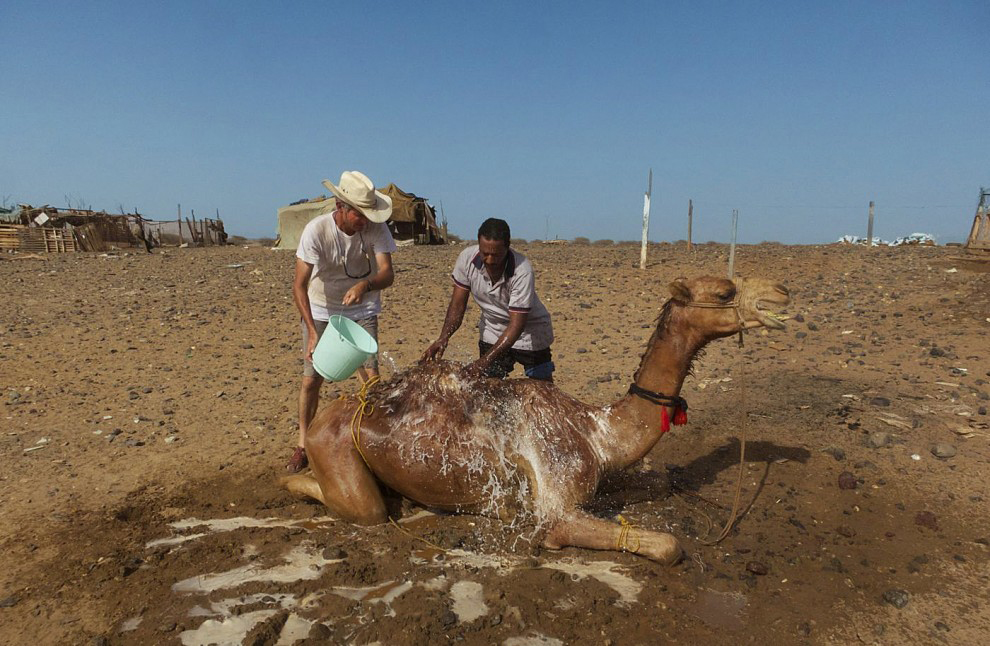
En route again—pausing to water the camels at a Chinese laborers’ camp on the trail north.
Paul Salopek