I wait out the hottest weeks of the Hejaz desert in the Red Sea port of Yanbu. While waiting, I ride in circles in a Jeep. This occurs at night at a stunt driving rally, under the white floodlights of an urban stadium.
The Jeep advances at a radical tilt. It balances on its two right wheels only. The man performing this driving feat is a stocky showman called “Captain” Ahmed al Shagawi. The Captain has agreed to take me along as a passenger. He wears a motocross jersey and the bored smile of a professional daredevil. He says to me, calmly, as we wobble along: “Be calm.”

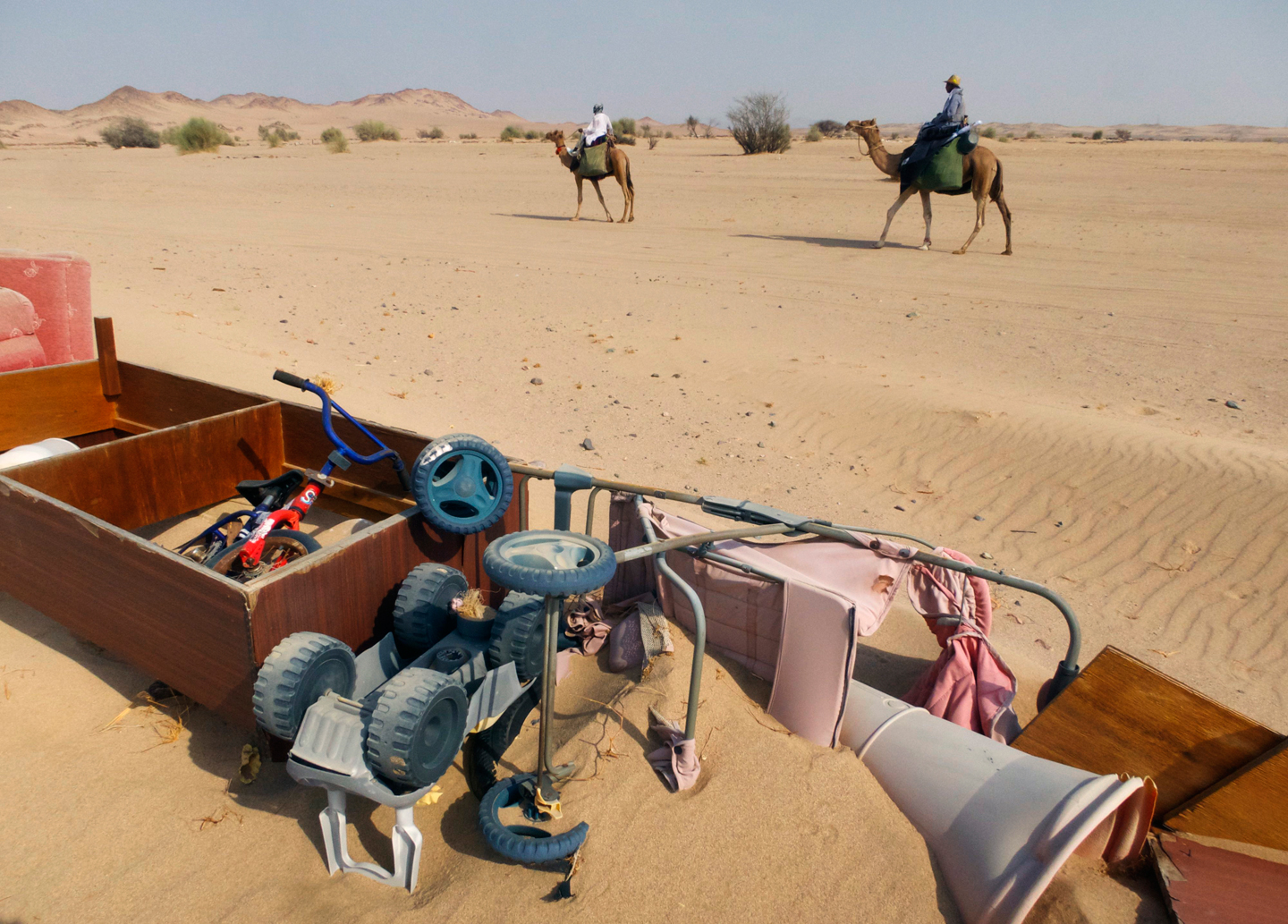
Ahmed al Shagawi’s windshield view.
Paul Salopek
But I am not calm. Gripping the car seat, I wonder: What will future anthropologists make of this ritual? Automobiles circulating in impossible angles atop a track designed for human foot races? Watched by several hundred rapt men and boys? (There is one woman in the audience—a hotel manager from the Philippines.) Will the experts in early 21st century culture say such gatherings were dances of male bonding? Rituals of warrior prowess? Or benign outlets for the universal desire to witness calamity—communal rubbernecking at car crashes? All are fair assumptions. Tonight, in the Yanbu stadium, all risk is proxy risk. The true danger lurks out on the roads.
Tafheet or “drifting” is an underground motorsport particular to the Middle East at the turn of the millennium.
Young men who chafe against the social and political conformity of their lives are taking to public highways to freely express their testosterone—to spin and slide and wreck cars (often rental cars), much as American drag racers did in the buttoned-down America of the 1950s. These young Arabs film themselves with smart phones. They post their exploits on the Web. Sometimes, they kill themselves. Recently, in Saudi Arabia, a rebel drifter was sentenced to death by beheading for fatally crashing into two other motorists. Yanbu has organized a stunt-driving exhibition to channel this brooding energy.
“Ah! This crowd is nothing,” Captain Al Shagawi says. “I performed in Qassim Province in front of 50,000 people.”
The Captain adds, modestly, that the real draw at that event was an attempt by local Saudis to enter the Guinness Book of World Records by cooking the world’s largest plate of kapsa, a traditional dish of rice and meat. Saudi Arabians hold the record for the world’s largest collection of prayer beads (3,225), the largest bowl of soup (2,600 gallons), and the largest gold ring (118 pounds of precious metal).
An energetic figure, a man as thin as a locust-stripped twig, runs the Yanbu stunt-driving rally. He is everywhere on the field: taking photographs, patting drivers’ backs, kissing children. This is Saeed Al Faidi. I have stabled my two camels at Saeed’s desert farm while I wait for daytime temperatures to subside below 120 degrees Fahrenheit. I am walking through the Arabian Peninsula.
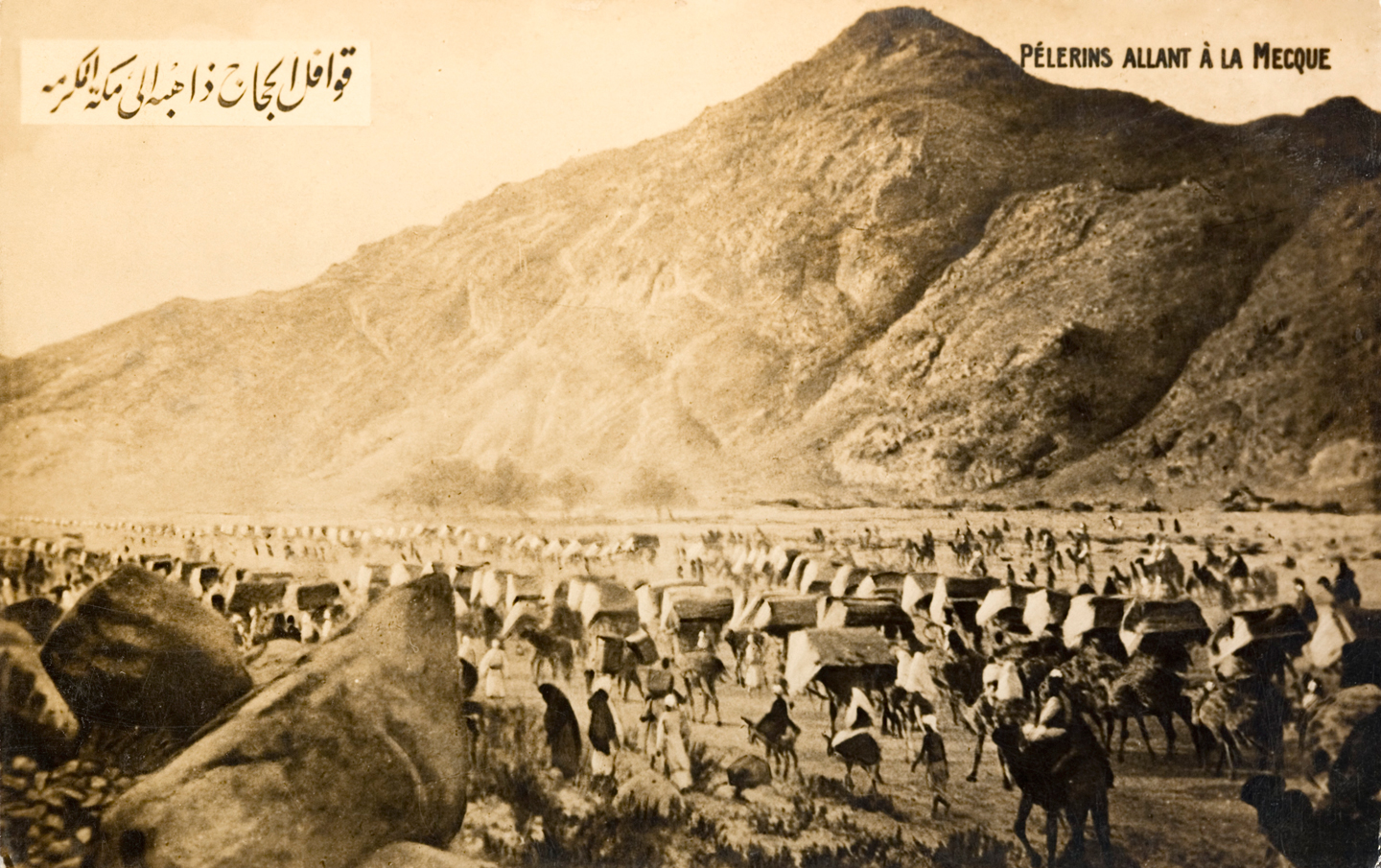
My camels carry food and water, a stack of notepads, a satellite phone, my house key from New Mexico. My Sudanese camel handler, Awad Omran, is preparing for our departure. He has repaired the saddles with electrical tape. Together with an interpreter named Ali al Harbi, we will cross the barren foothills of the Radwa Mountains—a redoubt of wolves—following the old pilgrim road to Sham, a pathway of ancient human migration. Trekking 25 miles a day, helping to hobble and feed the camels, making camp dinners—all of these chores will strangle my written dispatches. There will be silences.

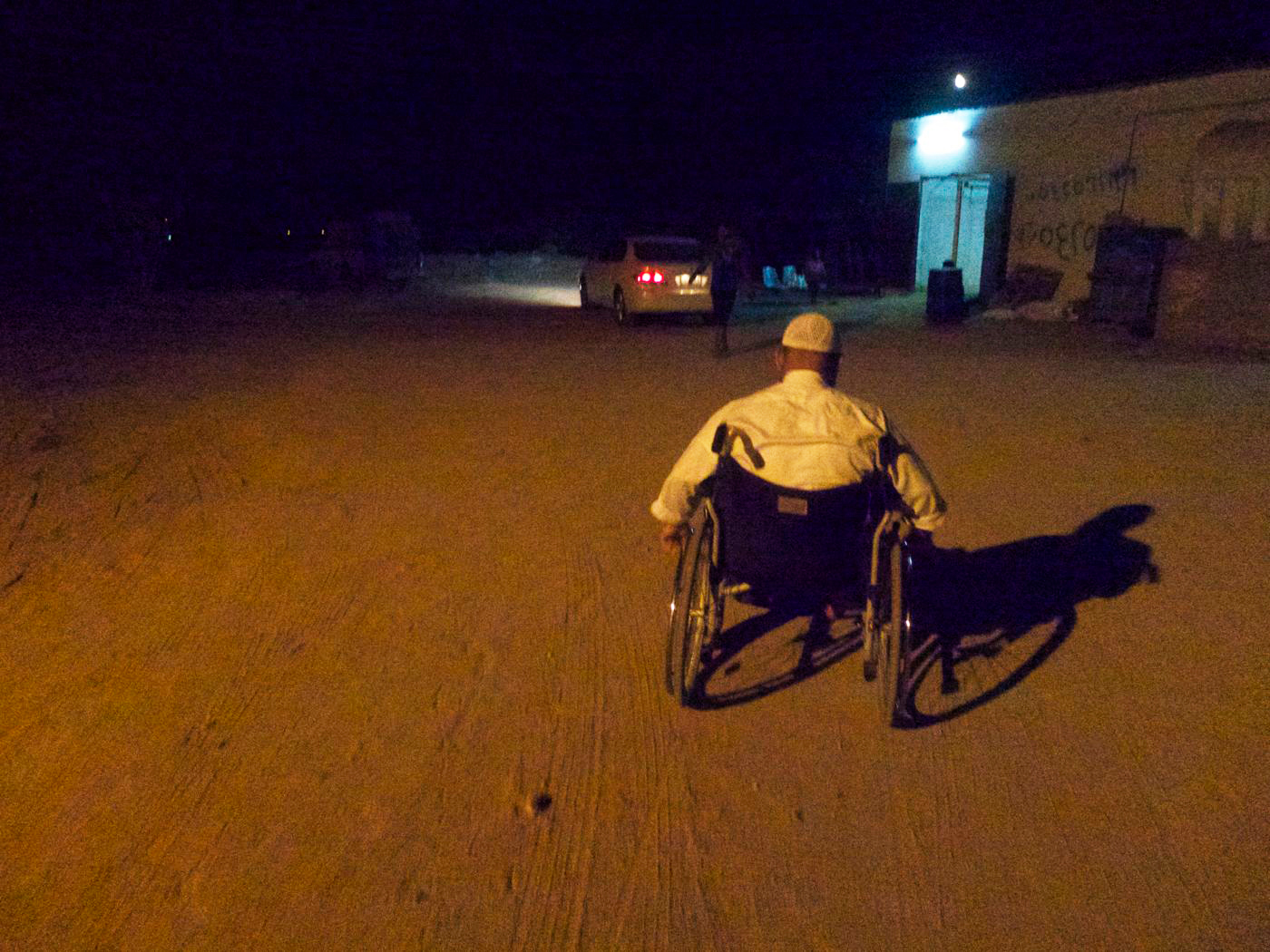
Cameleer Awad Omran and helper Abu Ali repair a saddle in preparation for our resumed journey.
Paul Salopek
A few days ago, I stood with Saeed al Faidi at his sun-blasted farm, appraising the camels’ condition. I greeted these stout-hearted animals as I always do, in Spanish.
“Que pasó—” I began to say.
And Saeed, the son of Bedouins, an ex-oil man who once lived at the California border with Mexico, completed my sentence: “—vatos.”
I stared at him. But he was cooing at Fares, rubbing the big, grumpy bull behind his ears. Saeed did not realize how he had touched my heart in that instant. He is my new logistician.
Staying put too long is a form of drifting.
I am riding in circles, on two wheels, in the dark.
Forty miles south in this uncanny world, near the fishing village of El Reis, we resume our journey into the Levant. Massive oil tankers sail close past that coastline. Their towering superstructures, gliding eerily above the seaside hills and dunes, look as though they are plowing through sand.