Banounah walks no farther. He has laid aside his walking stick. He has hung up his boonie cap.
He will not walk with us to the Jordanian frontier. He will not follow the old Haj trail from Sham or see the ruined Ottoman forts that crumble like rotting brown teeth atop the burning hills—how they guard nothing now except for the passage of the hot winds. Winds that send out flying columns of dust devils that spin atop the blistering plains. Whirlwinds that some call djinn. He will not cross the wadis where the tombs of Nabateans are cut into stone cliffs that glow the hue of fire-red clouds at sunset. He will not walk where Moses walked, dry-shod, onto the beaches of Arabia after parting the Red Sea.
Mohamad Banounah, my friend and Saudi guide, has landed in intensive care after complications from an earlier surgery. He has walked 240 miles with an abdominal hernia.
“I don’t know how he made it this far,” marvels the Egyptian doctor at the hospital where we take him. “He must have put up with much pain. This is not a small matter.”
Banounah is an ex-soldier. He is trained to keep pain stoppered, this time to his detriment. (When is it not?) And this trek, this strange journey, this forever walk begins to circle a familiar, melancholy topography, the rolling basin and range of new friends made and left behind: beloved people waving, one hand up in a parting salute, on the horizons. “We were a great team,” Banounah, gripping my hand in his hospital bed, says hoarsely. “Weren’t we? “
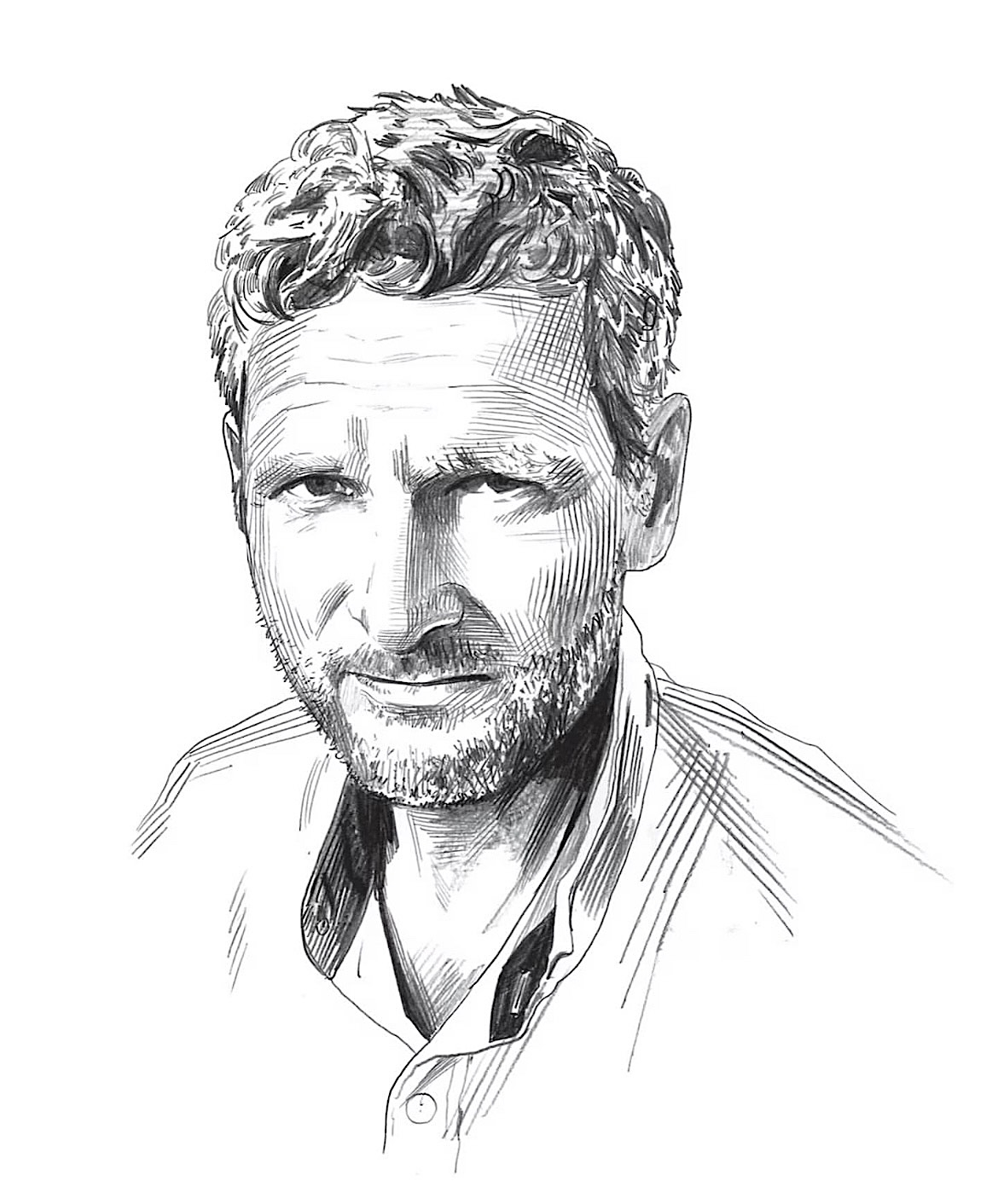
What can be said about this man?
That his medical condition has been aggravated by too much jollity? (By way of a warning during his current recovery, the doctors say his previous operation’s incisions may have never mended because Banounah belly-laughs too uncontrollably, too hard.)

Banounah in action: telling stories at a herder’s camp near Rabigh.
Paul Salopek
Or that he is a library of fading Bedouin lore? (A bitter desert melon call hadaj, when cut in half and placed on your cheeks, sucks the thirst right out of your body.)

Banounah demonstrates an old Bedouin remedy to ease thirst: Placing bitter desert melons on your cheeks.
Paul Salopek
Or that a lack of charity is the only spark that fires his cannonball temper? When a restaurateur, looking straight at me, blocked his eatery doorway to us—owing as much, I think, to our appalling stink as any anti-foreigner bigotry—Banounah invited the man, with a firm shoulder clasp, into a private sidewalk conference. The owner returned a fawning angel. What did you tell him? I asked Banounah. “I said to him, ‘You will give us water and rest, or I will bash your head into this wall,’” Banounah said evenly. As we left, he apologized to the terrified man because “a good Muslim cannot go to bed angry at someone. You have to go fix it, or you cannot sleep in peace.”
Banounah is from an old Mecca family, a clan of Hejaz sheiks and travelers descended from the Prophet Mohammed (in the time of dhows and caravans, one ancestor rambled as far as Morocco). “I am a simple man,” he once told me, ruefully. “Not too psychological. People like me—for being simple.” Yet Banounah is no rustic Zorba, lusty and colorful. Over the course of long afternoons waiting out the sun under some scrap of shade, he explained with supple nuance how the tribal history of Saudi Arabia still tints its worldview. And he heard out my tiresome complaints, with patience and empathy, on the emotionally isolating effects of the Saudis’ strict gender separation.
And then there was the afternoon on the broiling salt flats of Masturah.
We were walking in a nimbus of light. The air was like steam—like breathing through wet cotton. Then, without warning, we walked through shocking waves of cold air, pulses that lasted perhaps a few seconds: icy, unnatural and beautiful, like the opening and closing of a gigantic refrigerator door. I thought I was hallucinating. I glanced over at my traveling companions. Awad Omran, our Sudanese camelman, merely nodded silently in acknowledgement. But Banounah was grinning hugely. I said something about microclimates, about convection, about freak air currents. Banounah, as usual, chuckled at my rationalism. “We are lucky guys!” he said. “God is with us!”
I waited the month of Ramadan in the coastal city of Yanbu for Mohamad Banounah to recover, to rejoin the walk. But he cannot. He has returned home to Riyadh. The other day, his replacement, a young man named Ali al Harbi, sat sprawled and dazed, miserable and sweating, in the oven of an abandoned shepherd’s hut. His cell phone rang. Within a minute, he was laughing. It was Banounah, of course, calling to buck us all up.
“He is giving to us many compliments,” Ali said. “He is saying that he is with us today in his heart. And he is saying that your grandfather, Paul, had to be Arab.”