The heat.
We hide from it. We attempt to escape it. But our efforts are pathetic, absurd, useless. It always finds us. It mocks our every strategy, plan, defense. It vaporizes our will. Heat always wins.
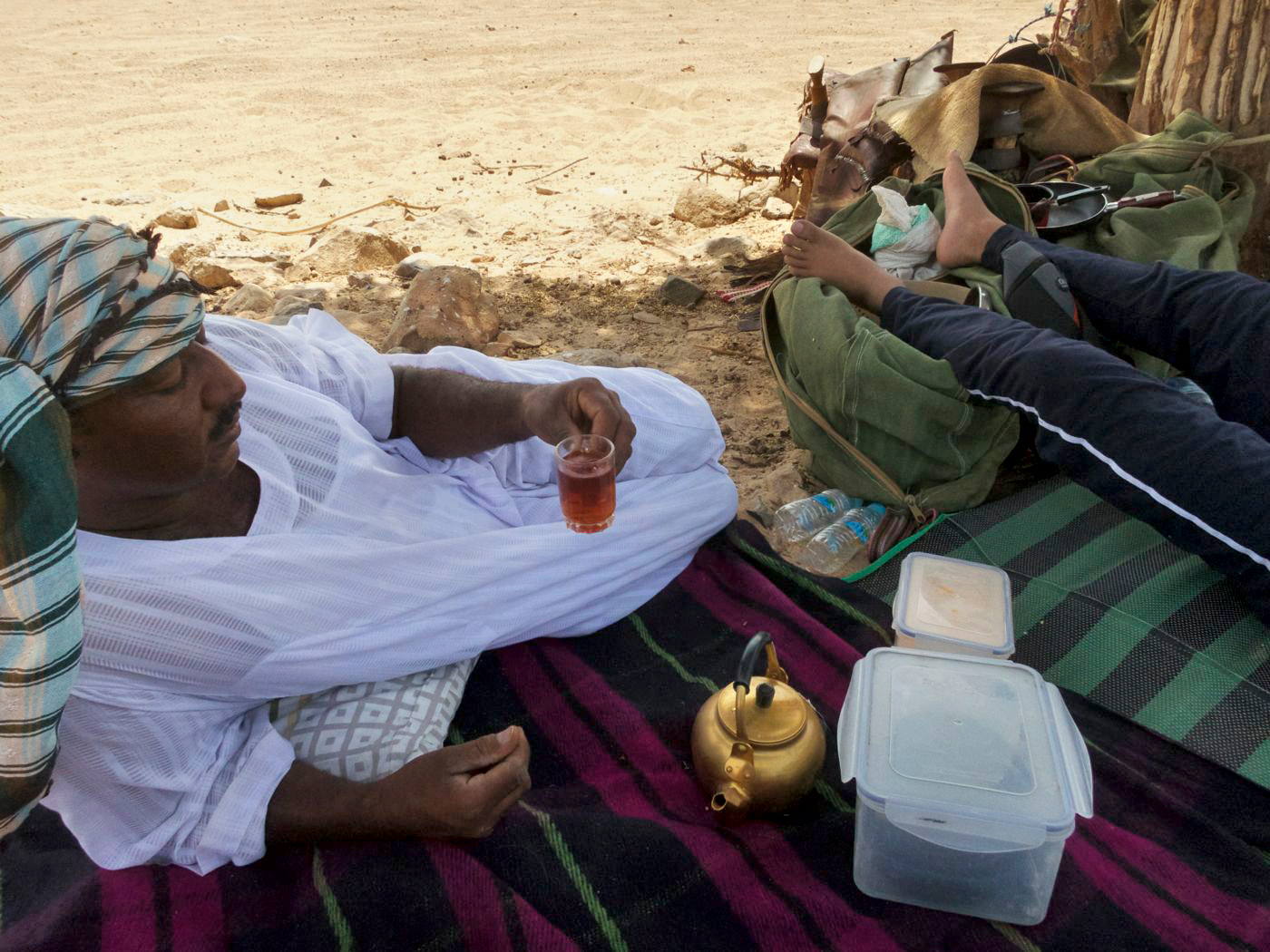
Ali al Harbi, the interpreter, sits upright in the scorching dark, in the nights that offer no relief, his heart racing. “It is very strange,” he says mildly, in a clinical way, as if he were talking of somebody else’s woes. “I cannot control my breathing.” He speaks like this because he is not, in fact, in full control of his body. His body is possessed by a malignant force: the heat. Hyperventilating, his lungs struggle to pump out boiling air.
By 10 a.m. our camels falter. Big Fares sits down again and again in the dunes of Wadi Safra. We plead with him. (“Be a good boy, Fares,” Ali says. “Please get up.”) The animals lunge at desert wells. They sink their muzzles deep into the green slime of stock tanks. Within two minutes each sucks up five gallons of water. We humans, by contrast, shrivel inside our thirst. To evade the sun we withdraw inside ourselves. We retreat under our skins, taking refuge into the deepest, dankest, wettest marrow of our bones.

Seema goes to the source at a desert well.
Paul Salopek
Beneath a thorn tree, Ali holds up his cell phone. A message that has never appeared before flashes onto its screen: “This device has exceeded its operating temperatures.” Heat has shut it down. Ali explains this to me three times before I understand. I blink out at him stupidly from inside the cave of my skull. Apparently, my circuits have melted, too.
Our logistician, Saeed al Faidi, sees us off with a pizza. A pizza baked by his wife, Hind Yahya al Shareef.
Cheese, tomatoes, olives, and peppers shine under the desert sky like a hallucination: an 18-inch mirage. I have not seen a pizza in nearly a year. We eat it atop a dusty Bedouin cistern. Afterward, I tell Saeed that he must not bring us such treats again. He cannot cater our walk across Arabia. He will spoil the men. (Awad Omran, the camel handler, already complains of our canned beans, stale bread, dented onions, salty instant noodles.) But the truer reason is more selfish: Such lush urban fare wrenches me clean out of the desert by my taste buds. It jars. It causes sensory whiplash. Its richness and artificiality overwhelms the crystalline emptiness of the Hejaz, making its immense burning voids even more remote—more alien, more inaccessible, more unreal. (T.E. Lawrence tells of a ruin in Syria, a queen’s palace, built with the essential oils of flowers kneaded into each chamber: jasmine, violet, rose. “Come and smell the very sweetest scent of all,” his guides told him, leading him to a room wide open to the desert winds. “This is the best: it has no taste.”)

Saeed al Faidi (right) brings his wife’s homemade pizza to celebrate our first well camp.
Paul Salopek
More than a week later, Saeed appears once again on the trail.
This time he brings us a chocolate cake. Again, baked by his siren wife.
He sees my expression. “It’s our anniversary cake,” he explains, holding up his hand to preempt my food bigotry. “I told the missus, ‘Hey, we have to share the love with the guys.’”
The cake does this. Only one half has been eaten. Arabic letters drizzled onto the frosting say half of: I LOVE YOU.
We walk inland.
We follow the tarik al hajj, the long disused pilgrims’ road from Bilad al-Sham, from Syria and Jordan, to the holy cities of Mecca and Medina.
Mountains of translucent gauze. As if painted on air. Sunlight pools in the sweltering valleys. A scattering of orange-barked sahur trees offer life rafts of shade. The intense heat makes my ears ring. I begin to suffer aural delusions—an intermittent ringing.
But no—it’s my cell phone.
It is the women. They keep calling.
Their phone numbers are unfamiliar. They are strangers. They ask plaintive questions in Arabic that I cannot understand. There are dozens, maybe scores, of them. Who are they? I cannot say. How did they get my number? I haven’t the slightest idea. But I suspect the idiosyncratic Emirati phone service called Mobily: It recycles old phone numbers. Mine appears to have been the former toll-free hotline for Arab women plagued by existential dread. “Malesh, malesh,” I say to these anxious callers. “Mafi Arabi.” And I hang up. But they call again.
One woman dials me 40 or 50 times. I pass the phone to Ali.
“You have a wrong number,” he informs her sternly.
“I know,” she says, and hangs up.
It then occurs to me: These are Saudi women. Isolated. Bored. Crouched behind the gender-based barricades of their deeply conservative society. Locked into social purdah. I can almost feel their air conditioners pulsing out cold, sad, metallic air against my ear. The hum of loneliness, of ennui. They are seeking any form of human contact outside their closed circle, I decide: Any sympathetic ear will do (even an ignorant foreign one). So they keep calling me. Such irony! For months I have been trying to interview representatives of this half of the Saudi population. But it is no easy task, particularly in the remote communities along our route. It requires effort. And now, thanks to Mobily’s random standards of customer service, the veil is lifting at last. Albeit electronically. And alas, incomprehensibly. My heart suffers for these women.
“Mobily gave you a strange number,” Ali tells me later, from atop a camel. “All those women? They think they are calling some labor office. They are looking for maids.”
We walk past strange artifacts in the trackless desert.
Tires, sofas, dining room tables, rolled carpets, office swivel chairs, a television—junk laid out in crooked but deliberate lines, into quadrangles, into squares. Windbreaks of furniture? A message to aliens? Landscape art? No: these are Bedouin fence lines demarcating old fields, long abandoned plots of sand where watermelons once grew.
“There’s nothing out here to use for fences,” my logistician, Saeed, says. “The Bedouins go to city dumps. They bring this stuff out to mark off the desert.”
The quality of Saudi garbage is very high. Some of the fencing materials are intimate, poignant. A set of china still stacked in its cabinet. Children’s yard toys. Drawers that still hold a cook’s stainless steel spoons. (Awad pokes through it, looking to upgrade his cheap camp kit.) It is as if our contemporary world had mysteriously ended. As if the blowing sands of the Hejaz had shifted, exposing our own future: a lost Atlantis, but made of Tupperware.
Our third day out of El Reis there is gunfire in the desert. Pop …pop … pop.
The hunters are after doves. But there are few doves. We see men driving around the scalded barrens in old HiLux pickups, in late-model Land Cruisers, rolling down their windows and firing at the sparse thorn trees, at ordinary sparrows, at other birds perching there.

A dead bird, made of plastic and brass.
Paul Salopek
The environmental laws of Saudi Arabia are as rigorous as any in the world. There are sophisticated government and private captive-breeding programs for threatened animals. But the country is large. And out in the unpatrolled desert, the oldest laws of predation hold. The landscapes of the Hejaz are perhaps the stillest deserts I know.
These are not bad men. They are friendly. One stops to give us a jug of cold water. But I cannot help imagining what their Bedouin great-grandfathers—patient desert hunters, stalkers on foot, on camelback, men who gripped lances, who knew how to track like Apaches—would say of this motorized havoc. I try to think of a word to describe it. It is not hunting.
“It is,” Ali says, “like shopping.”
Yes.
After five days of walking, we hit a paved road.

Ali and Fares contemplate the Anthropocene.
Paul Salopek
We have covered a hundred miles up from the Red Sea, across plains of frying gravel, through glowing basins of ochre dunes, to the mountain village of Yanbu al Nakhal. It is the hottest walk of my life—a journey in itself to write home about, but merely one of hundreds of minor steps in a dance across the world.
We shake hands, Ali, Awad, and I. A car stops. They take our pictures. They call me a Pakistani.
Back on the grid, my cell phone rings for the first time in four days. It is an unknown woman. She asks me questions for which I have no answer.