We walk across the shining disc of the Hejaz. Our caravan is a stylus that bumps along a groove—a compass bearing, an imagined meridian—singing.

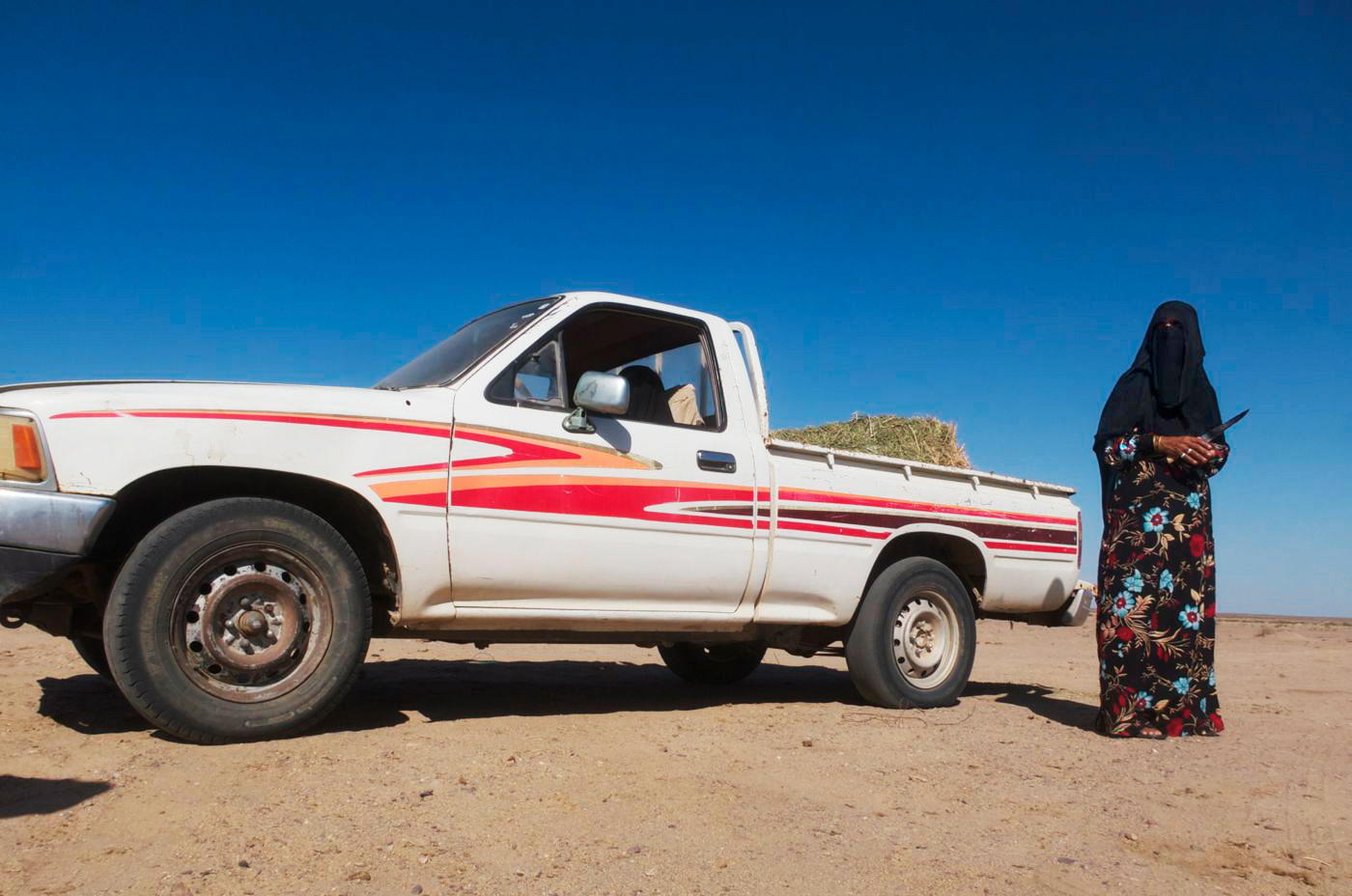
Awad and Seema dance with dawn shadows near Wadi Dabd.
Paul Salopek
Did the first humans who passed here between 60,000 and 100,000 years ago sing, too, as they wandered?
Bruce Chatwin, the British travel writer, believed the first human beings sang their way across the Earth. Drawing on the work of ethnologists, he cited the case of indigenous Australians. These hunter-gatherers memorize epic songs passed down from a Dream Time—the age of creation—and are, in fact, musical maps of their universe. The songs’ lyrics identify landmarks associated with the travels of totemic ancestors, giants who roamed the Australian continent “singing out the name of everything that crossed their path—birds, animals, plants, rocks, waterholes—and so singing the world into existence.” Even the melodies of these “songlines” reflect the rise and fall of topography. Learning to sing them is considered a spiritual and practical survival tool, a rite of passage.
Today, having settled into farms, villages and cities—having boxed our horizons with brick and sheetrock, with the radial arms of clocks, with alleyways called “jobs”—the human impulse to sing has been coopted, like everything else, by specialists: in this case, artists, entertainers, clerics.
Out walking, however, there are no professionals. We do what comes naturally.
Ali al Harbi, the translator, sings—humming wheezy, tuneless tunes as he slogs forward under the iron sun.
The cameleer Awad Omran drones out spontaneous, hungry poetry from atop Seema the camel:
Go, go everywhere. We walk the pilgrim roads and we make the far distance close. God please make things easy for us. We walk the pilgrim roads. We make the far distance close. God please make things easy for us. We are in the mood for good food. Saeed, Saeed, bring us barbequed fish. I croak out fragments of Mexican corridos.
Only at night, when we are immobilized by fatigue, do we swap the vocal music of the nomad for the crooning of the sedentary world.

Holding back the void: Ali in his pup tent, Awad in his cradle net.
Paul Salopek
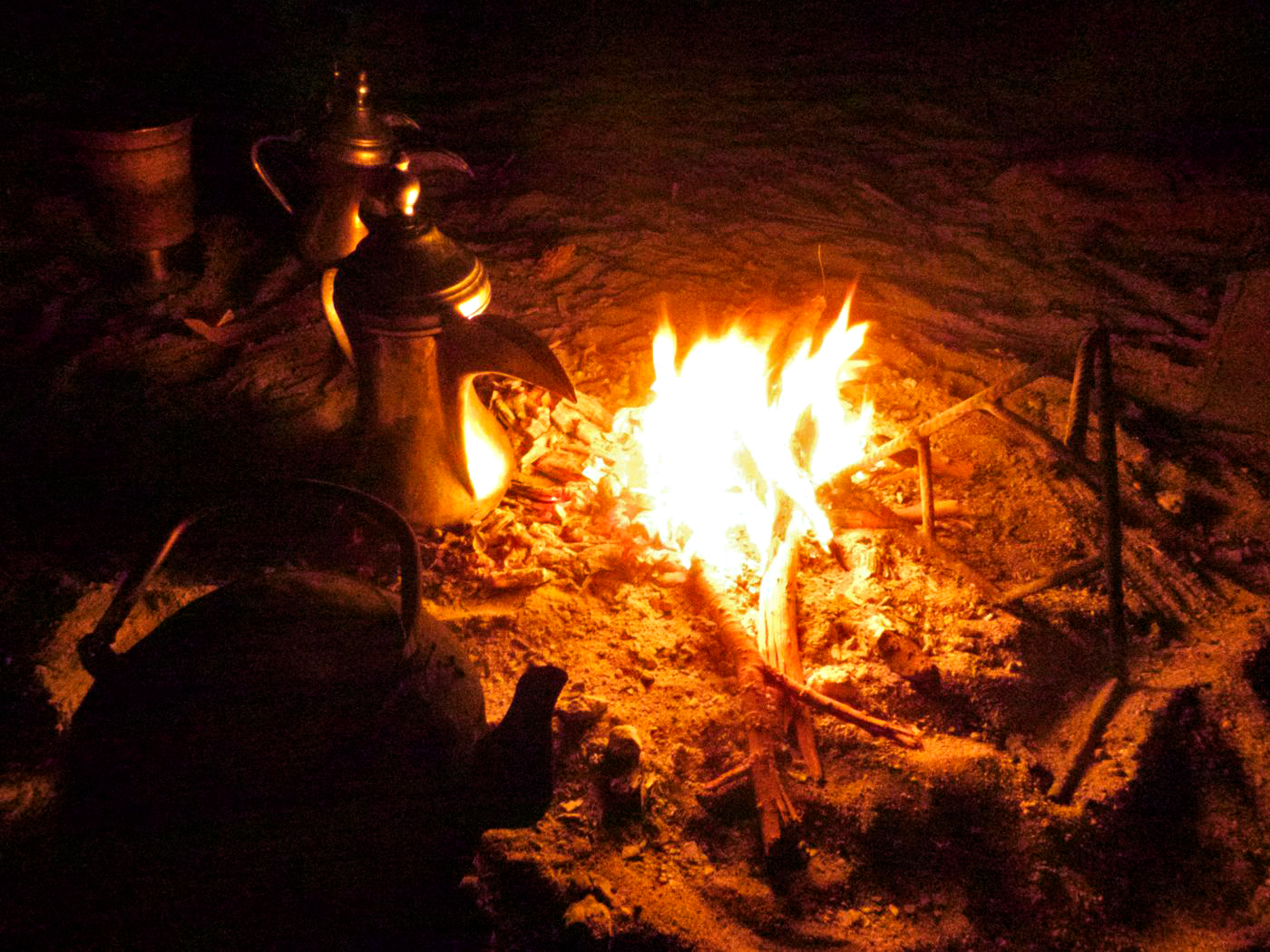
Awad flips a switch on his cell phone. He tunes into emphatic Sudanese and Yemeni radio stations. The camels grunt in the dark. The phone battery runs low. And soon enough, splayed on our backs in the still-warm sand, our lonely songs are met by the stars’ response.
It is a cold blue chorus. It sounds like this: