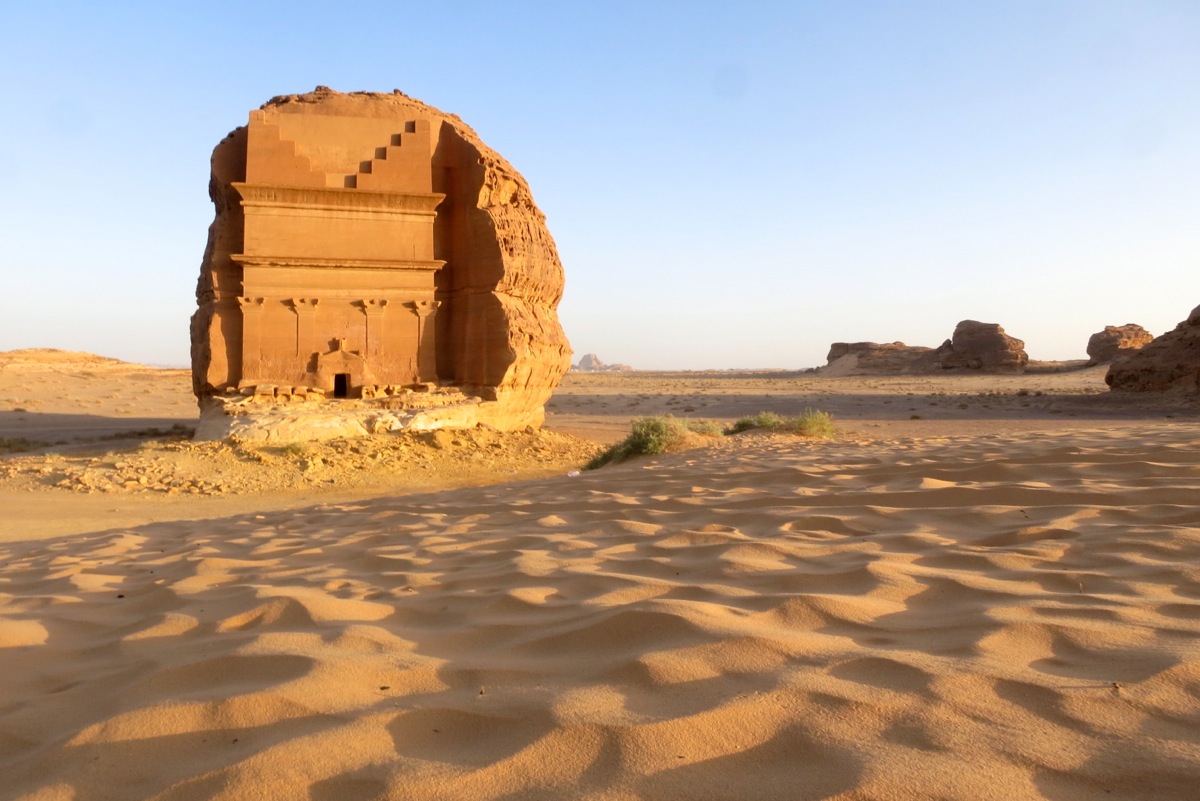
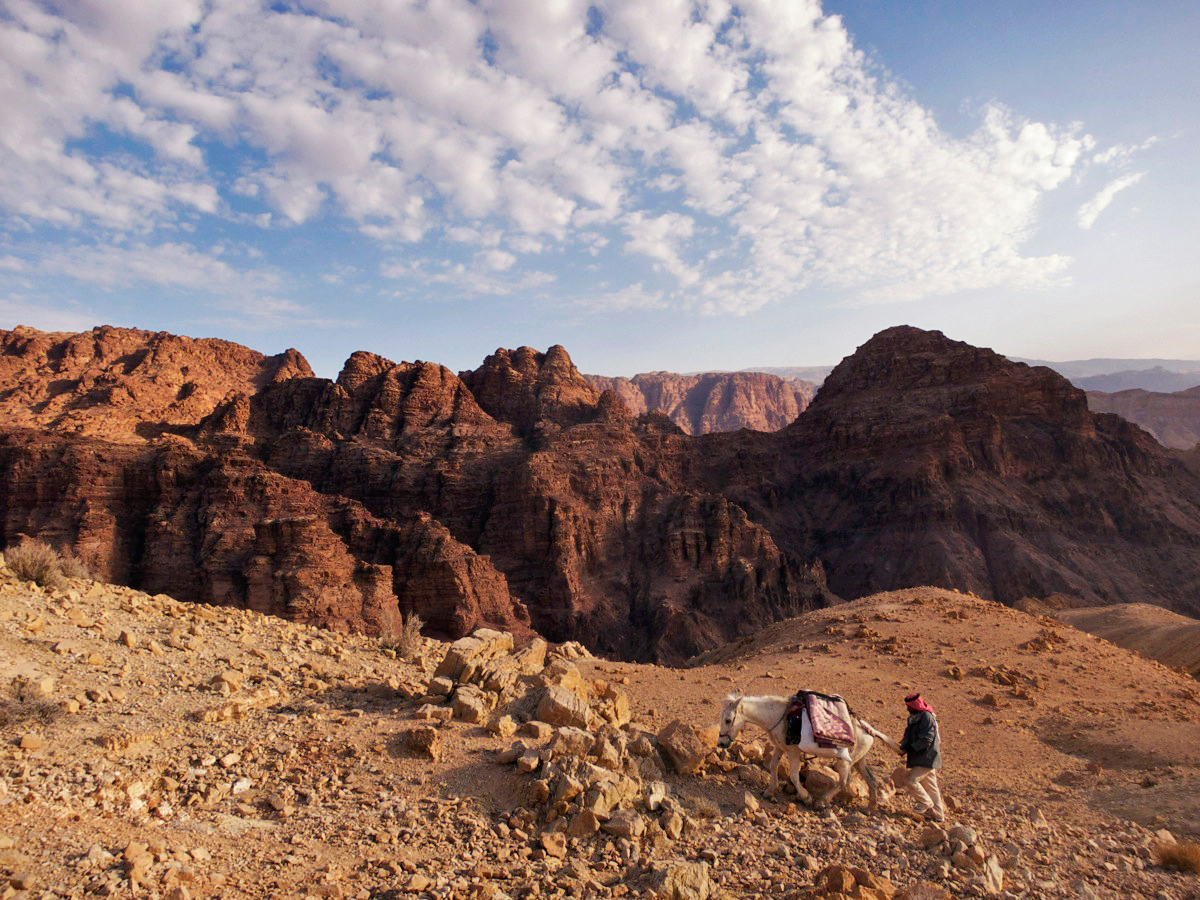
Brick-red sands. Brittle shrubs—pale, ghostly, diaphanous, like puffs of artillery smoke frozen by a camera. Totems of sandstone. Of basalt. A cobalt sky marbled with cirrus. Silence.
We have left Aqaba far behind a seam of mountains. We have entered a colossal hall of space, a still wilderness of towering stone monoliths that Arab travelers once called وادي القمر—the Valley of the Moon.
Today it is better known as Wadi Rum, a timeless artery of migration.

Ancient footprints connote pilgrimages.
Paul Salopek
More than 80 miles long, Wadi Rum links the sunburned desert extremities of nomad Arabia to the complex, rumpled, many-chambered heart of the Levant. Paleolithic hunters first drifted through when lions crouched in vanished grasslands. Cattle people arrived later, loose-limbed, elongated by protein, whistling and whooping on their wanderings, carrying new lactose-tolerant genes within their DNA. Proto Arabs from an empire called Nabataea, builders of spectacular stone cities before the age of Christ, once claimed this otherworldly place. Roman invaders displaced them. Jews and Christians rode caravans through Wadi Rum to the Hejaz before Islam. The Prophet Muhammad’s cavalry galloped the opposite direction, green banners rippling, to establish a vast Caliphate.
We establish meager squaw campfires. We walk.
There are four of us: two colleagues visiting briefly from America and our desert guide, Hamoudi Enwaje’ Salman al Bedul. Each leads by a chain a cargo mule. Soon, the stone messages begin to appear. Throughout its many roles as a valve of history—corridor, funnel, choke point—Wadi Rum remains, above all, a colossal scriptorium of human restlessness.
“There are literally tens of thousands if not hundreds of thousands of inscriptions there,” says Glenn J. “Joey” Corbett, an independent American archaeologist who has surveyed the region. “There are few other places in the world like this for rock art. Australia. Maybe the American West.”
Some of the earliest depictions are of cattle—boldly carved bulls, looking surprisingly modern because artists such as Picasso cribbed their Neolithic style—perhaps 9,000 years old. The most recent work dates from a century ago: prayers hewn by Muslim pilgrims trekking toward Mecca in the twilight of the Ottoman Empire. There are numberless drawings of camels. Of ostriches and oryxes. Scenes of men at war. The most numerous inscriptions, through, are scratched out in Hismaic, a 2,000-year-old precursor to Arabic, etched painstakingly by the shepherds, mounted hunters, and caravaneers who wandered Wadi Rum for centuries. Many are names. They are inscribed, in servility, to the power of encroaching empires, to forgotten gods, to forgotten royalty.

Inscriptions in Wadi Hafir.
Paul Salopek
Bdhrtt—”servant of Aretas
Bdsqlt—”servant of (queen) Shaqilat.”
Mrktb—”man of al-Kutba.”
A Jordanian friend and archaeologist Mahmood Alfageer, takes us to a canyon called Wadi Hafir. We meander among an immense gallery of words. Scores of the antique signatures, perhaps hundreds, are visible on a five-minute walk. Relics of ordinary lives gouged for an eternity. I record their images on a computer memory card that, like the mainframes that will store the camera’s digital code, rely on a steadfast current of electricity. I copy the strange, antique, snaking lettering of Thamudic E onto cheap paper that will begin to fade within a year. A new lacuna, a digital void, begins to grow in Wadi Rum’s stone narrative. I wonder for how long—when must we take up the chisel again? Then I veer northwest.

Mahmood Alfageer interprets rock art.
Paul Salopek
Hamoudi and I, alone now, make for the old caravanserai town of Al Quweira, singing badly. Al Quweirah was the logistical base for the Hollywood crew that filmed “Lawrence of Arabia,” the ephemeral celluloid inscription of a traveler who passed through Wadi Rum only yesterday. Lawrence had seen the rock carvings. He called Wadi Rum “a processional way greater than imagination”:
The Arab armies would have been lost in the length and breadth of it, and within the walls a squadron of aeroplanes could have wheeled in formation. Our little caravan grew self-conscious, and fell dead quiet, afraid and ashamed to flaunt its smallness in the presence of the stupendous hills.
The mules’ hooves clap hollowly across the faceted mud tiles of a dry lake bed. We inch into the Middle East.
Video by Paul Salopek, Adam Jabari Jefferson