A sodden dusk.
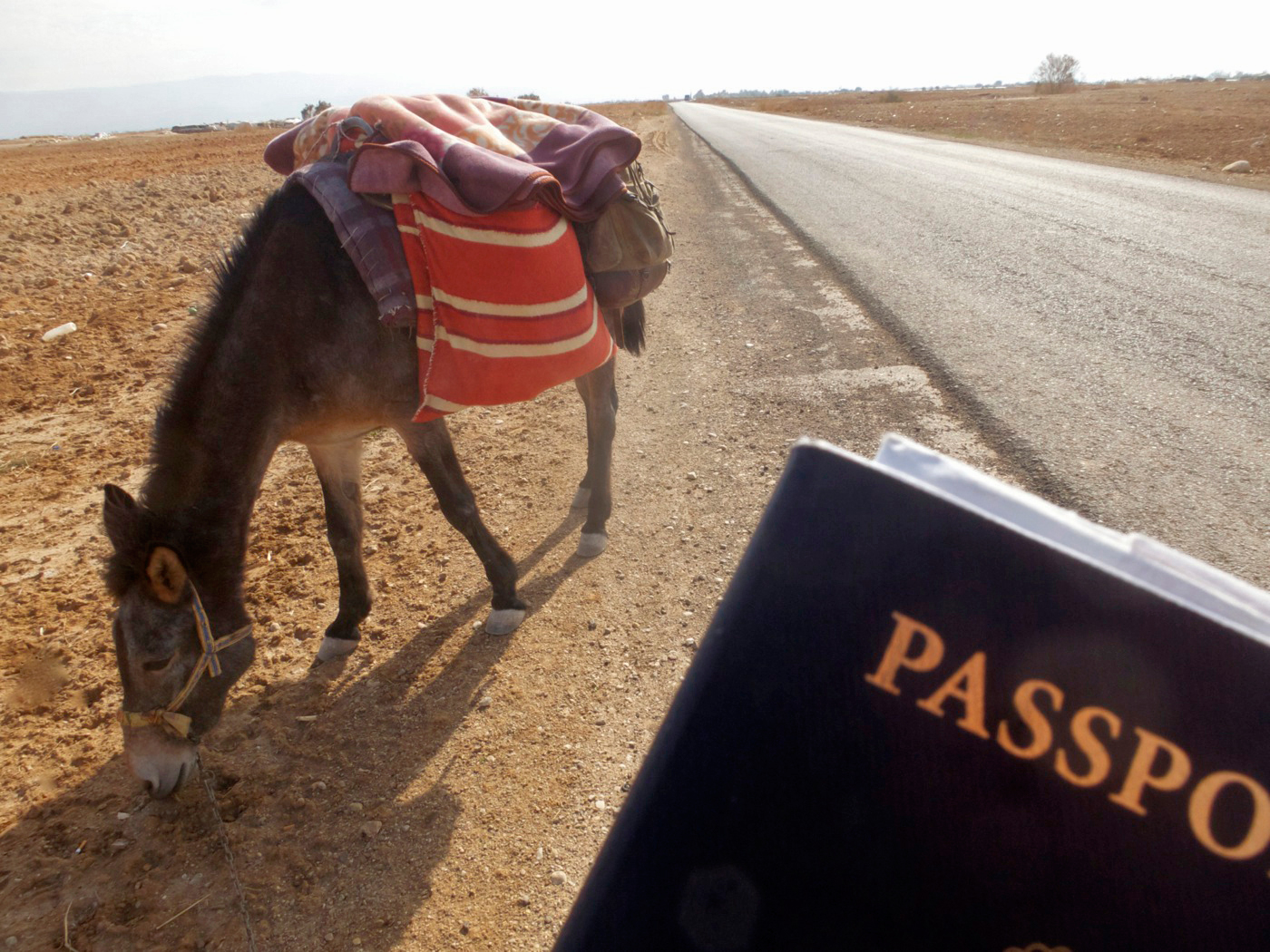
We walk into the small market town soaked, muddied, dizzied by an astonishment: the first rains in a year of trekking. Rain varnishes the town’s cratered pavements. Electric shop signs glint and glitter in the rain. Car taillights spill their cherry hues into puddles. In the drizzle, the street lamps burn like fireballs. A carnival of reflected light. Yet the rain deters no one! The streets are filled with splashing people. We tug our two weary pack mules through damp crowds at intersections. We are seeking lodging—a roof, a room, anything. But what are these townsmen doing outside? Are they celebrating the precipitation? It seems plausible, in such a parched Middle Eastern town. I glimpse their faces. I am startled. They are African.
“Never use the word abed here!” Hamoudi Enwaje’ al Bedul, my Bedouin guide, whispers into my ear. He wags a finger in warning. “Big problem!”
As if I would. Abed: slave, an Arabic insult for Africans. A painful slur. Hamoudi is tense. He is out of his element—a tribal man, this citizen of the desert—in such an alien place. But I am warmed, comforted, charmed even: I lived in Africa for more than a decade. It is my favorite continent. And here, somehow, I have stumbled across a remnant population of Africans living in the Jordan Valley. I am transported instantly back to the walk’s starting line. As it turns out, though, we may both be mistaken, Hamoudi and I.
“I don’t know where we come from,” says Muhammad Zahran, the director of the local museum, who permits us to sleep in the guard’s kiosk. “I’m not sure we came from Africa. We could have been Ottoman soldiers. Many people here are from Amman. Or Bedouin tribes or Egyptians. Or Palestinians or Syrians. We are mixed.”
Zahran refers to his ethnic group, the Ghawarna—dark-skinned Jordanians who farm the great alluvial fans south of the Dead Sea. I stare at him, puzzled. He looks like my friends from Ethiopia or Somalia. Moreover, cursory research reveals that scholars agree: The Ghawarna, who number in the tens of thousands, are genetically African. They came to Middle East unwillingly, as slaves, either to work in 12th-century sugarcane fields (a colossal sugar mill has been unearthed near Ghor al Safi) or as house slaves in the 19th-century. But the townspeople I question, like Zahran, bat away the idea. They frown. They shrug. They disagree.
“Maybe it’s the sun here,” the manager of a women’s sewing coop, Nawfa al Nawasra, suggests. “Maybe it just burns us darker.” Al Nawasra informs me that her ancestors come from Iraq.

Ghawarna women dye wool using oxide-rich mud.
Paul Salopek
What is going on?
“The Ghawarna have been the subject of color prejudices for a very long time in Jordan,” says Edward Curtis, a professor of religious studies at Indiana University, in Indianapolis. “The local solution, in this context, is to adopt a totally Arab identity.”
Curtis recently conducted an ethnographic study in Ghor al Safi and concluded that no identifiably African folk traditions exist. No oral histories peg Africa as the ancestral home. Such is the power of discrimination, underdevelopment, and shame in one of Jordan’s poorest regions. Relatively little intermarriage goes on between the Ghawarna and other Jordanian ethnic groups.
“I came looking for a narrative of black Muslim pride,” Curtis says. “But that turned out to be my own American idea. These folks don’t even see themselves as African. They are Arabs who happen to be black.”
The basis of identity, of race, is not in any sense granitic.
It is highly fluid. It is like a river—a tidal stream, in fact: Its flow is not linear, but one that winds and bends, drifting first in one direction, then in another. Not only could our direct ancestors have been different colors through time: Given the right combination of migratory patterns and solar exposure, they could have been different colors several times over. This isn’t a philosophical viewpoint. It is genetics. Scientist think that skin pigmentation can change appreciably in as little as 100 generations.
The next morning Hamoudi and I plod north up the Jordan Valley. We drive the two mules before us.
We are both mistaken about the river’s eddy called Ghor al Safi. Walking fast, Hamoudi puts uneasy distance between himself and a town of apparent outlanders—Africans—who are as culturally “Arab” as he. And I am far more African, in memory, than the wary black residents of Ghor al Safi whose kinship I clumsily seek out. The Ghawarna teach us this. We are, for better or worse, whoever we say we are.