We sit at the hostel table sketching routes on old newspaper. Straight lines. Circles. Zigzags. Nothing works.
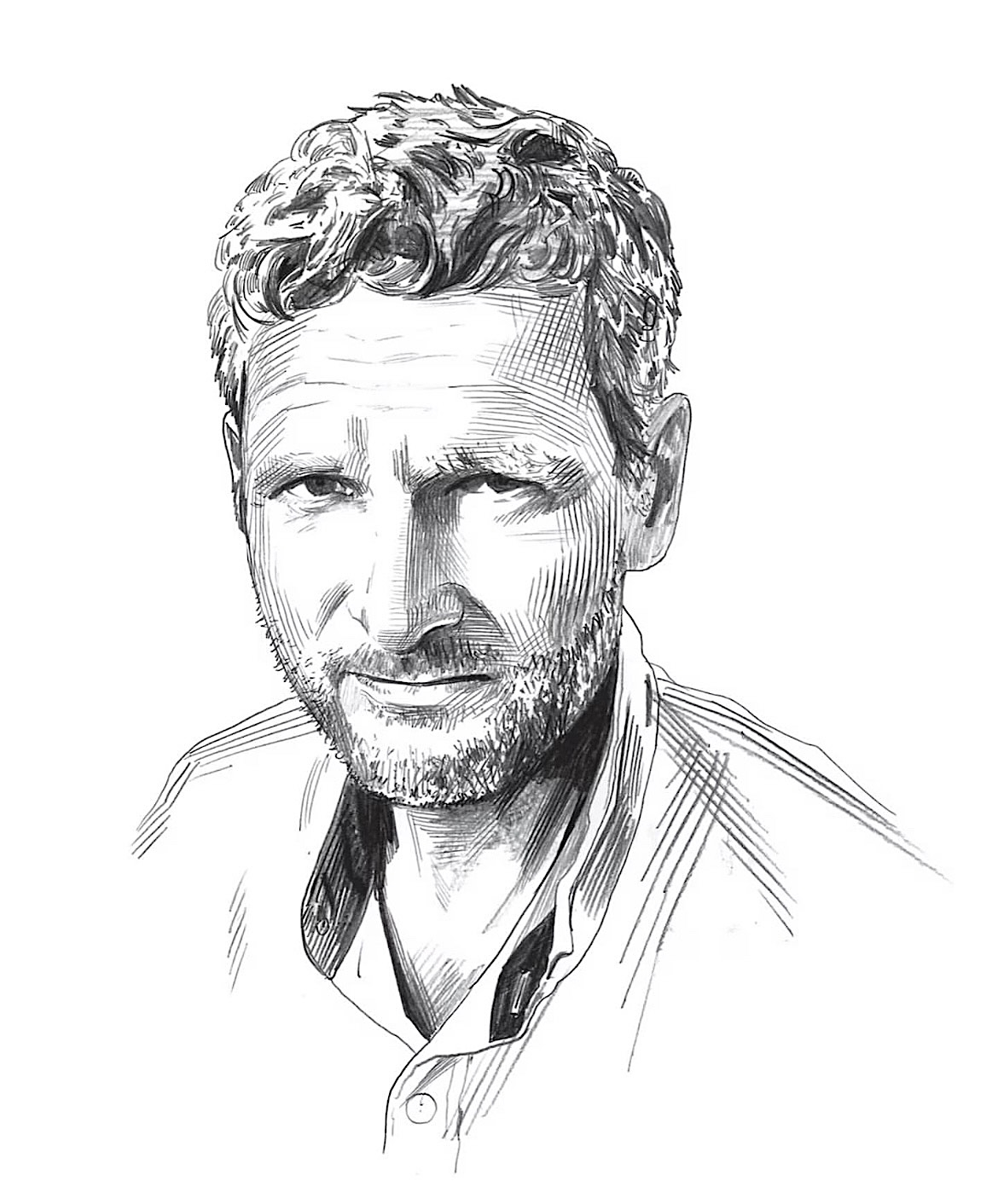
“This place is too complicated,” says Yuval Ben-Ami, my walking partner in Jerusalem. He is a big man with gentle eyes. A writer. A radio host. A street singer—a bard. He has hiked Israel’s entire perimeter along its borders. He knows its village bus stations. Its cheap Ethiopian restaurants. Its most scenic battlefields. He has been up all night thinking. “The only way we can do this—”
And with a blue pen he draws a curlicue.
It is absurd: the pathway of a snail.

Snail’s path: a rational man’s efforts at planning a walking route through Jerusalem.
Yuval Ben-Ami
Such is our plan to cross Jerusalem on foot. The goal: produce a narrative map of one of the most important religious and cultural capitals of the world. We will snap photos of local people, record neighborhood sounds, shoot videos. The Out of Eden Walk’s first digital city map, of Jeddah, Saudi Arabia, was a relatively simple affair: a linear route up the beach of a desert port. Jerusalem is another matter.
“Here,” says Ben-Ami says, fueling up for the walk on breakfast cereal, “straight lines miss everything.”
Awash in history, scarred by conflicting political claims, sacred to all the Abrahamic faiths and thus revered and contested by Jews, Christians, and Muslims alike, Jerusalem’s 48 square miles of compacted real estate—World Heritage Sites, shrines, posh hotels, slums, hilly parks, museums, checkpoints, souks—comprise one of the most complex urban spaces on Earth.

Urban oasis: outside a bar in West Jerusalem.
Paul Salopek
Today, more than 800,000 Jerusalemites inhabit two contiguous but radically different cities, each shaped by conflict, and both currently under Israeli control. West Jerusalem: newer, leafier, cosmopolitan, a Jewish-dominated mosaic of suburbs constructed mostly since Israel’s 1948 war of independence. And East Jerusalem: older, dryer, poorer, a Muslim-dominated swath of the city captured from Jordan during the Six-Day war, a place where severe growth controls have preserved the atmosphere of an overgrown village. Somehow, under a fraying peace accord, this is to be the shared capital of each people.
The 3.5 million tourists drawn annually to Jerusalem’s Old City center do not often explore this bigger, edgier, divided metropolis. Most visit epicenters of their faith. The Wailing Wall. The Church of the Holy Sepulcher. Al Aqsa Mosque.

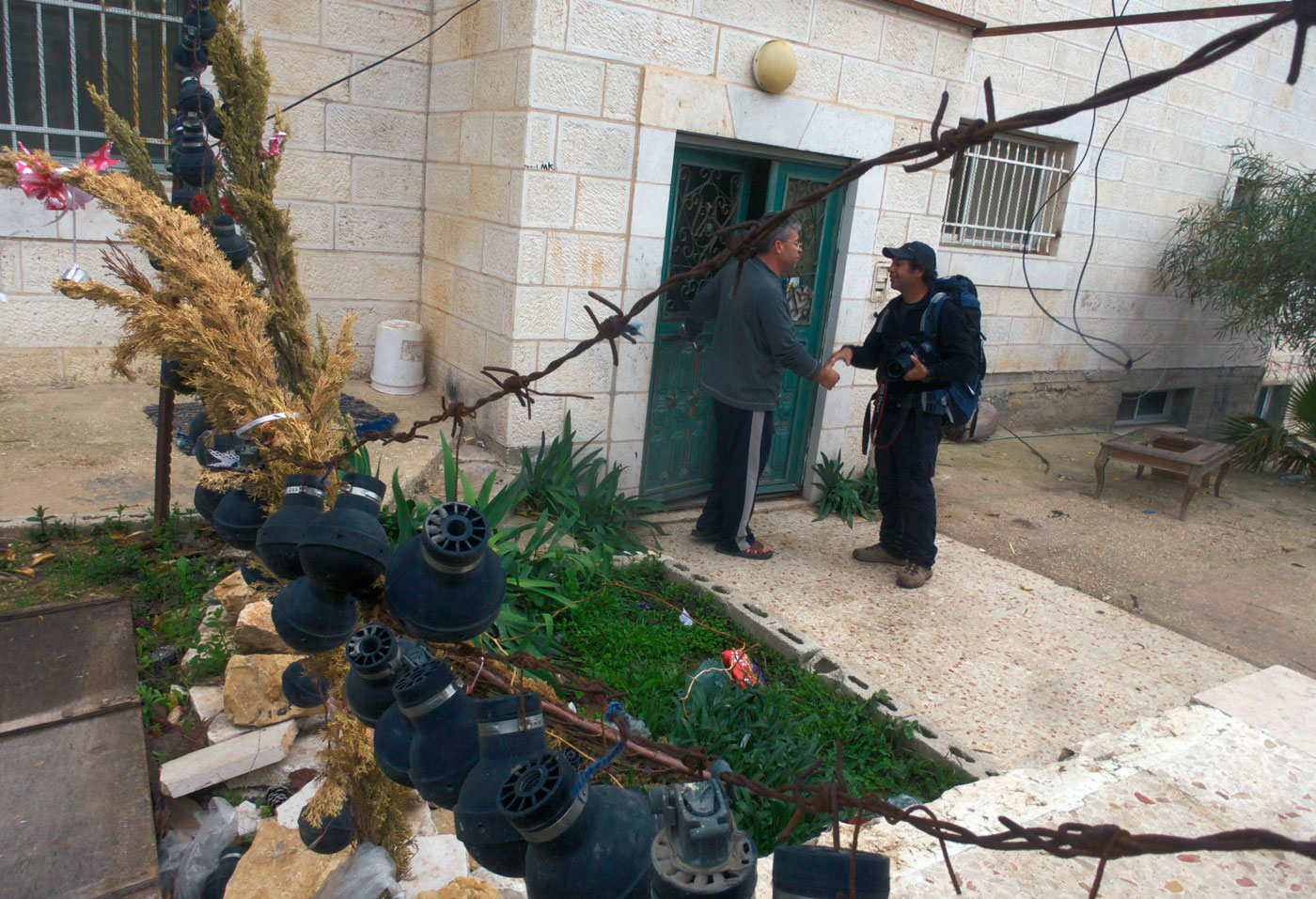
Yuval Ben-Ami at the Separation Barrier in East Jerusalem. Erected by the Israeli government to thwart terror attacks, it cleaves some Palestinian neighborhoods in half.
Paul Salopek
For this reason, Ben-Ami and I try something different. We start our trek at the distant western edge of the modern city—under the Bridge of Strings, a symbolic gateway facing the Mediterranean—and walk counterclockwise, at a leisurely pace, toward Damascus Gate. Libraries are stuffed with descriptions of the wonders that lie beyond that fabled entryway to the Old City. Our urban trail to reach the ancient gate, by contrast, is terra incognita to many outsiders.
We ramble for three days. We form a shambling relay. Aziz abu Sarah, a Palestinian peace activist, joins us. So do Israeli friends Noa Burshtein and Osnat Skoblinski.
Our route is spiral. Or, more precisely: a vortex.
In a 5,000-year-old city where changes in neighborhood zoning rules earn international headlines—such is the ferocity of ownership over each square inch of Jerusalem—we orbit painful questions of identity, of zealotry, of personal loss, of national survival. We trudge over a hundred lonesome boundaries—invisible and monumental—that Israeli and Palestinian Jerusalemites do not cross. We encounter desecrated cemeteries. (One Jewish, one Muslim.) A shopping mall with a hundred-foot replica of Noah’s Ark on its roof. A sleepy Palestinian pool hall.
One day, we climb the only flour-grinding windmill in the Middle East, operated by Spanish-speaking Jew from Argentina. On another, we descend into the tomb of an eighth-century Sufi poetess—or perhaps a fifth-century Christian prostitute-turned-saint. (Nobody knows.) We will be turned away by only two people, one Muslim, one Jewish. And Palestinian children will shout in Hebrew, in a rose-colored dusk over Wadi Kidron, “I love you!”
“It is the source of all my confusion,” Ben-Ami says, smiling in sad wonder at the fractured, golden city where he was born. “And it is the hometown of my heart.”
The narrative map of Paul’s route through Jerusalem was produced with the collaboration of the Knight Science Journalism program at MIT, the Center for Geographic Analysis at Harvard University, and National Geographic.