Bassam Almohor leads the way into the West Bank.
What is the West Bank?
The West Bank is a shard of a future homeland—the core a possible nation—for the world’s Palestinians. It slopes under the sun, in chalky ridges and tan valleys, like the pleats of a rumpled skirt, down to the muddy currents of the biblical Jordan River. (Hence: the west bank.) It is a small enclave of dusty olive groves and minarets that could fit twice inside the area of the Hawaiian Islands. It is an island itself—walled off, fenced, an Arab atoll occupied since 1967 by the Israeli army. Yet more than 2.5 million people live there. They are packed into ancient towns pooled in the valley bottoms. (These are Palestinian.) Or, they peer through razor wire from American-style tract homes that crown many hilltops. (These settlements, erected by nationalist and ultra-religious Israelis, are deemed illegal by most of the world.) The two communities—the people of the valleys and the people of the hills—fear each other. They inhabit opposing universes that happen to overlap exactly within the West Bank. They are hostile. They rarely communicate. They are married by grievance.
“Our world is a world of checkpoints,” Bassam says, pulling on his backpack. “We have a whole hierarchy of them. We measure ourselves by them.”
He explains: “People will say, ‘My checkpoint is better than yours!’ Or they will say, ‘Man, listen to my worst checkpoint story!’ That is how much we have bought into these divisions. People put on checkpoint airs.”
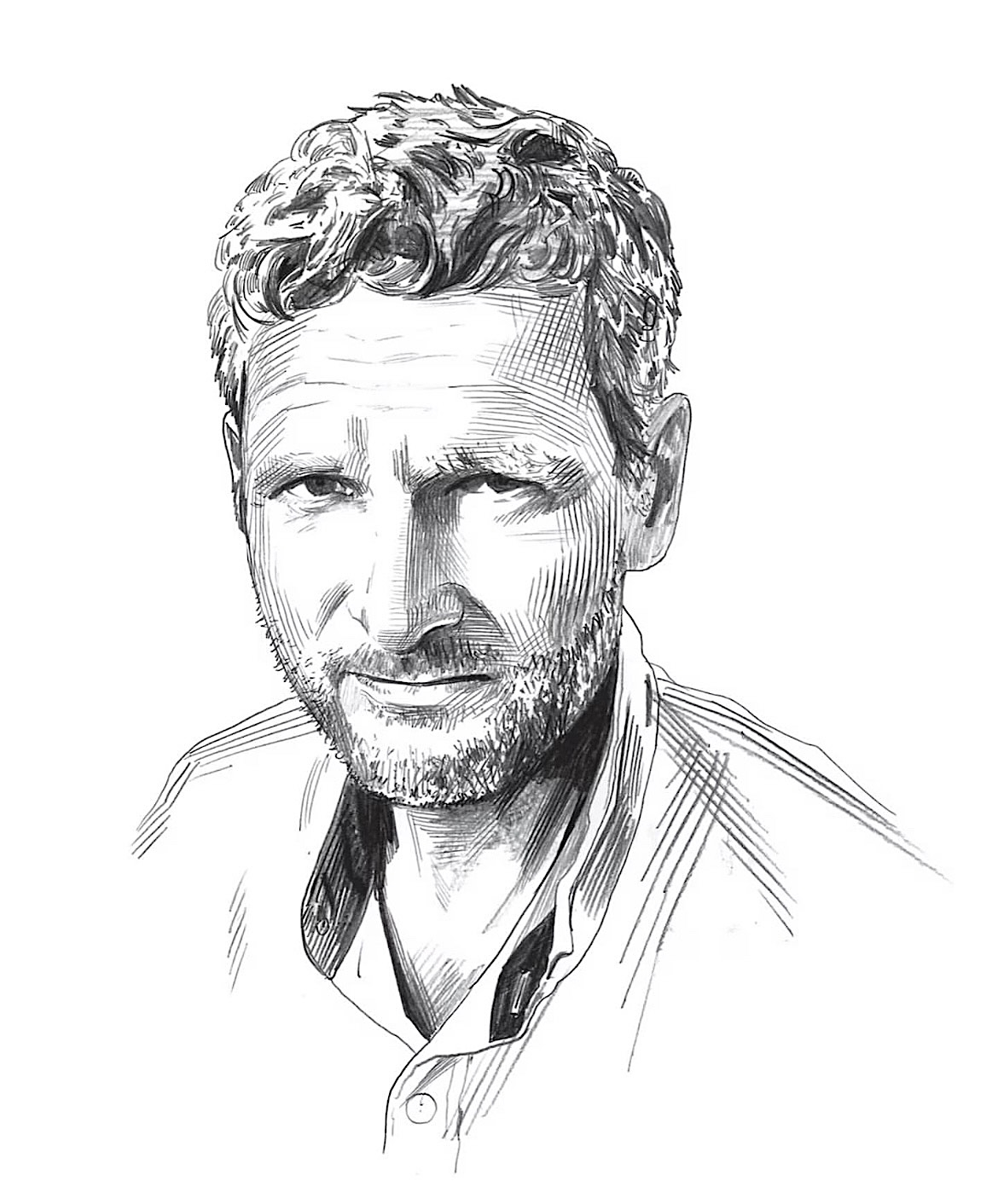
Bassam is my new walking guide. He trudges ahead, a compact man with frizzy hair, with the melancholic face of a philosopher, with legs of iron. He has tramped all over the West Bank. (“Walking makes a small place large.”) He has held many jobs. With me he will be a pathfinder, storyteller and photographer. He carries a small bag of dried fruit and a very large camera. He is an original: a humanist who has made somber visits to the death camps of the Holocaust in Europe. An intellectual. A contrarian who, with his wife Haya, has sent his son to a Quaker school in a Muslim society. He wears the wicked smile of a man inviting you to savor the ironies of the world. He leads me through the West Bank—his home—in the manner of a doctor offering a tour of an insane asylum.
We depart from Jericho, among the oldest continuously inhabited cities in the world.
We employ no cargo animals. The West Bank is much too small to require mules. If we wished, we could walk across the region in a day—it is less than 20 miles wide at its narrowest point. But its size is deceptive. It will take us weeks to meander through the West Bank. Why? Because of its complexity. Because of its dense, compacted history. Because of its maze of frontiers, boundaries, micro-prisons, no-go zones.

In the barren hills above Jericho, Ibrahim Musa Salim mans the world’s loneliest juice stand.
Paul Salopek
Every few hours—sometimes every few minutes—Bassam steps across invisible lines that I cannot see. One kilometer: Area A (Palestinian control.) Another kilometer: Area B. (Joint Israeli-Palestinian control.) The next kilometer: Area C. (Full Israeli control.) Then: repeat and mix. Each zone imposes its own rules for land ownership, for civil rights, for freedom of movement. (Most Palestinians do not dare approach Israeli settlements. Israelis cannot legally set foot in Area A.)
This cracked arrangement was conceived as the solution to—though it could be mistaken for the root problem of—the Israeli-Palestinian conflict. The current political map of the West Bank, which looks like a cross-section of a diseased brain, was drawn by the Oslo Peace Accords in 1993. As Israeli settlements multiply, the dividing lines grow more mottled, more intractable.
“Where are we now?” I often ask Bassam.
“Area A,” he will say, walking past a darkened casino in the outskirts of Jericho. Its lobby rings with silence. Its unused slot machines gather dust in blue shadows—a lost gamble after the violence of the Second Intifada.
Or:
“Area C,” he will huff, climbing up a rocky canyon called Wadi Qelt toward an Orthodox Christian monastery. For the first time in a year of walking, I spot trail markers. A luxury of affluent societies. A startling transition to order. An Israeli organization has painted them on the stones.
Or:
“This is a United Nations camp,” he will say, shuffling along one of the gritty alleyways where hundreds of thousands of war-displaced Palestinian refugees live in urban squalor. Only garbage dumpsters stenciled “UN” reveal the community’s true ruling authority.

Artifact of forced migration: a UN dumpster in a suburban refugee camp in Jericho.
Paul Salopek
I attempt to record our route’s political hopscotch during 24 hours:
6:30 a.m.—Area C. Bassam and I awake in a camp of gloomy Bedouins near a highway. Why gloomy? These nomads have been displaced many times by the Arab-Israeli wars. More than 60 years ago, they lost their original pastures in the Negev desert. They cannot migrate annually with their sheep as their ancestors did: No free space remains in the West Bank. They must inhabit tin shacks next to an Israeli Defense Force artillery range. They have nowhere else to live. Over fire-roasted coffee, they ask endless questions about my camels in Saudi Arabia. They laugh in delight at the stories. They struggle to recall their own. It is difficult to look into their faces.
9:15 a.m.—Area C. We walk past Nabi Musa, according to folk tradition the tomb of Moses. A compound of white domes set in barren, waterless hills. A mile farther on, we stumble into an Israeli tank training ground. The road is cratered, littered with shell casings, with spent bullet rounds. Then, around a bend, a hallucination: Several pubescent girls are dancing, gyrating in bright spandex, to Israeli pop music. There are no other human beings in sight.

Bullet on the road to Bethlehem.
Paul Salopek
“It’s for a Bat Mitzvah,” says a man filming with video camera.
11:00 a.m.—Area C. A geyser of water jets high into the ceramic blue desert sky. From a broken pipe? From a miraculous spring? It is impossible to say. It is a fountain that sparkles, unwatched, in the gravel wastes east of Jerusalem. Israeli dirt bikers roar by us, leaving us in clouds of dust. As if not dehumanized enough by their loud machines, they wear their machines’ license plates pinned to their jerseys. The cyborgs nod at us. Bassam laughs.
4 p.m.—Area C, or maybe B. (Or maybe even A: It is unclear.) We stagger down a rugged scarp across from Mar Saba, the beautiful, 1,500-year-old Orthodox monastery outside Bethlehem that restricts entry to women and even female domestic animals.
“On steep slopes you must carry my pack,” I inform Bassam. “It is in my National Geographic contract.”
He mutters an expletive.
“I’m afraid you get charged $100 every time you insult me, too,” I say. “I have a good contract.”
He repeats the expletive twice: “One for you. One for National Geographic. Consider it a donation.”
7 p.m.—Area A. Back in full Palestinian Authority control. We reach the city of Bethlehem after 26 miles of walking. Later, Bassam leads me, gingerly, on blistered feet, to the Church of the Nativity. The grotto where Jesus Christ was born is controlled by the Greek Orthodox Church. The church teems with pilgrims from France, from Argentina, from Nigeria, from Texas.
Next door a newer Roman Catholic cathedral must make do with a peep hole. This hole, drilled through a locked door, is located in a lonely basement passage next to the underground grotto. Visitors must bend down. They must peer through into the yellow light of holy birthplace. The hole is just big enough, I note by testing, to admit my pencil. A true West Bank arrangement: a celestial Oslo Accord.

In Bethlehem, the Church of the Nativity.
Paul Salopek