Çoban Ali Ayhan sings like a human being in pain—like a man pouring salt into the open wound of his heart.
He bounces a wounded cry down into the canyons of the Tigris River: a blade of rusty water that saws its way through the bedrock of time. Ali’s song is a hymn to true love, which is to say, to love unrequited. It is the tale of a beautiful woman who remains blind to the longings of the singer. It is a lyric of loneliness. Of waiting. Of resignation—a form of acceptance. It is the perfect ballad for this antique river and this doomed, haunted town.
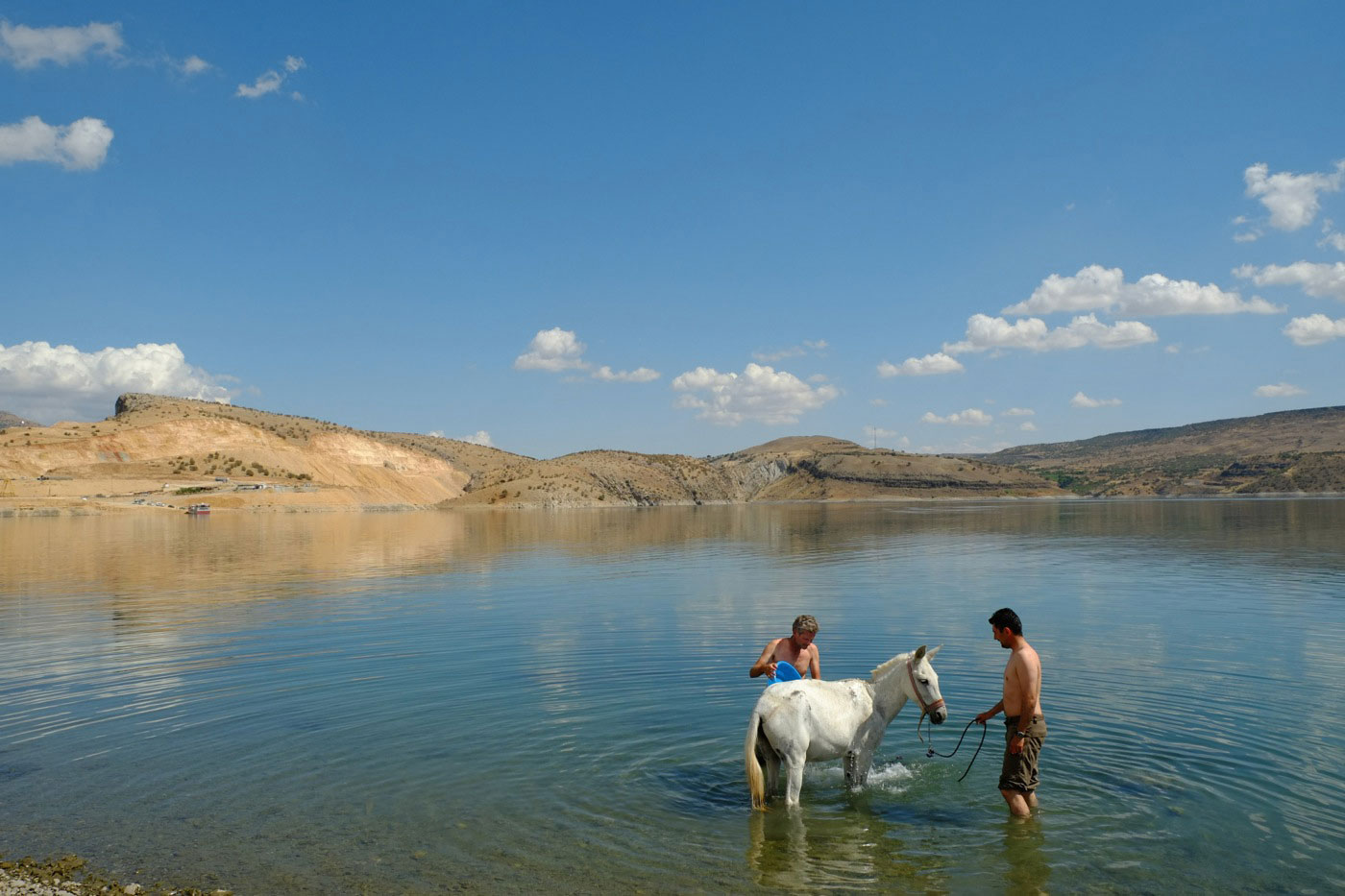
The caverns of Hasankeyf were lit by the campfires of the Neolithic. Its ruined fortress walls, ornate minarets, and cliff-top citadels span 12,000 years of history. Here, memory is layered at least ten civilizations deep. Plumed legionnaires marched from Imperial Rome to guard this frontier outpost against Persia. Marco Polo may have strolled across the town’s centuries-old stone bridge. The Silk Road once braided its way through the narrow medieval streets. Many of these sites will soon disappear. Like many river towns in eastern Anatolia, sections of Hasankeyf will be inundated by a new dam project. The land where civilization was born is being flooded, inundated, erased.
“What can we do?” Ayhan says. “We opposed the dam. It is going ahead anyway.” His song echoes away on rock, on water.

The ancient city of Hasankeyf. A historical gem threatened by the promiscuous damming of the Euphrates.
Paul Salopek
In Turkey, hundreds of dams big and small stopper the headwaters of the Tigris and Euphrates, the two most fabled rivers in history, the streams that moisten the Fertile Crescent. The government insists that these tons of poured concrete are essential for agricultural self-sufficiency, for irrigation, and through hydropower to help reduce the country’s dependency on foreign energy. Environmentalists and archaeologists disagree. The rivers are throttled, they say. And if the Tigris and Euphrates can be deemed the mothers of modern urban life—the nurturers of history’s first cities—then the frenzy of construction, they say, represents a form of parental abuse.
I first cross the Euphrates in the town of Birecik. The river is a mud-colored slick. The cargo mule, Kirkatir, bucks her away cross a narrow bridge. She momentarily blocks all traffic to Mesopotamia.
Farther to the east, the pathways to Asia are closed.
Iraq is mired in brutal turmoil, in the violent spillover from Syria’s bloodbath. Iran has not granted me passage. So I must take a compass bearing due northeast, for the lower Caucasus, cutting a diagonal through Turkish Kurdistan. Kurdistan: a term the government in Ankara hates. A name symbolizing the separatist leanings of millions of Turkey’s rugged, marginalized Kurdish minority group. A long and terrible guerrilla war has been fought over this word—37,000 have died, and the killing only eased in 2012, thanks to a now frayed peace process. I will walk for 400 miles through the Kurdish heartland. Most of the Kurds I meet will refer to Turkey as a foreign country.
I acquire two new walking guides in Birecik.

Northbound: Kirkatir and guides Mustafa Filiz and Murat Yazar. The strategic Birecik bridge over the Euphrates was commandeered by the mule—for about 15 terrifying minutes.
Paul Salopek
One is an air steward recently resigned from Emirates Airlines, a strapping man named Mustafa Filiz, from the western, European coastline of Turkey. For a project that involves trekking across the globe, the idea of a guide who lives in the air is irresistible. How much do you walk—I ask Mustafa—on an average intercontinental flight? “It depends,” he replies deadpan. “On a big Airbus 380, which has two decks, and on a flight, say, from Australia to Europe, I probably walk up and down the aisles for five kilometers [three miles].” He has alpine experience: a boon in the Caucasus. He says he needs a change of pace.
The other guide is a Kurdish Jack Kerouac: Murat Yazar, a former aid worker among Syrian refugees, an underemployed photographer (is there any other kind?) and a sidewalk philosopher with a loping gait and colossal feet. Murat develops blisters after the first day. His new boots are too tight. He walks for more than two days, atop scorching asphalt, in undersized shower flip-flops.

Big toe blues. Near Adiyaman, Murat plods two days across burning asphalt in shower slippers.
Paul Salopek
There is strife all around us. The Kurds are restive. Murat carries a sack of ice for his sore big toe. In faraway Ankara, a president who wants to be a Sultan moves into a palace of a thousand rooms. The Tigris and Euphrates squeeze their way through pipes and concrete channels to Basra, the home of Sinbad the Sailor.
Mesopotamia: “The land between two rivers.”
Everything stays the same. Everything is new. This is not a lunatic enterprise.