“When it snowed and the roofs and the people were covered with white snow, the Arabs said, Ash hadha nazala mina’s-sama al-qut-ni, meaning, ‘What is this? It’s raining down cotton from the sky!’ The Turks said, ‘God be praised, look at God’s mercy!’ and they ate the snow. The Arabs gathered here and there and when they tasted the snow said, Lahha’ad barda’n-nar, meaning, ‘My goodness, cold fire!’”
— Ottoman traveler Evliya Çelebi, on the reaction of two peoples to snow. Circa 1650.
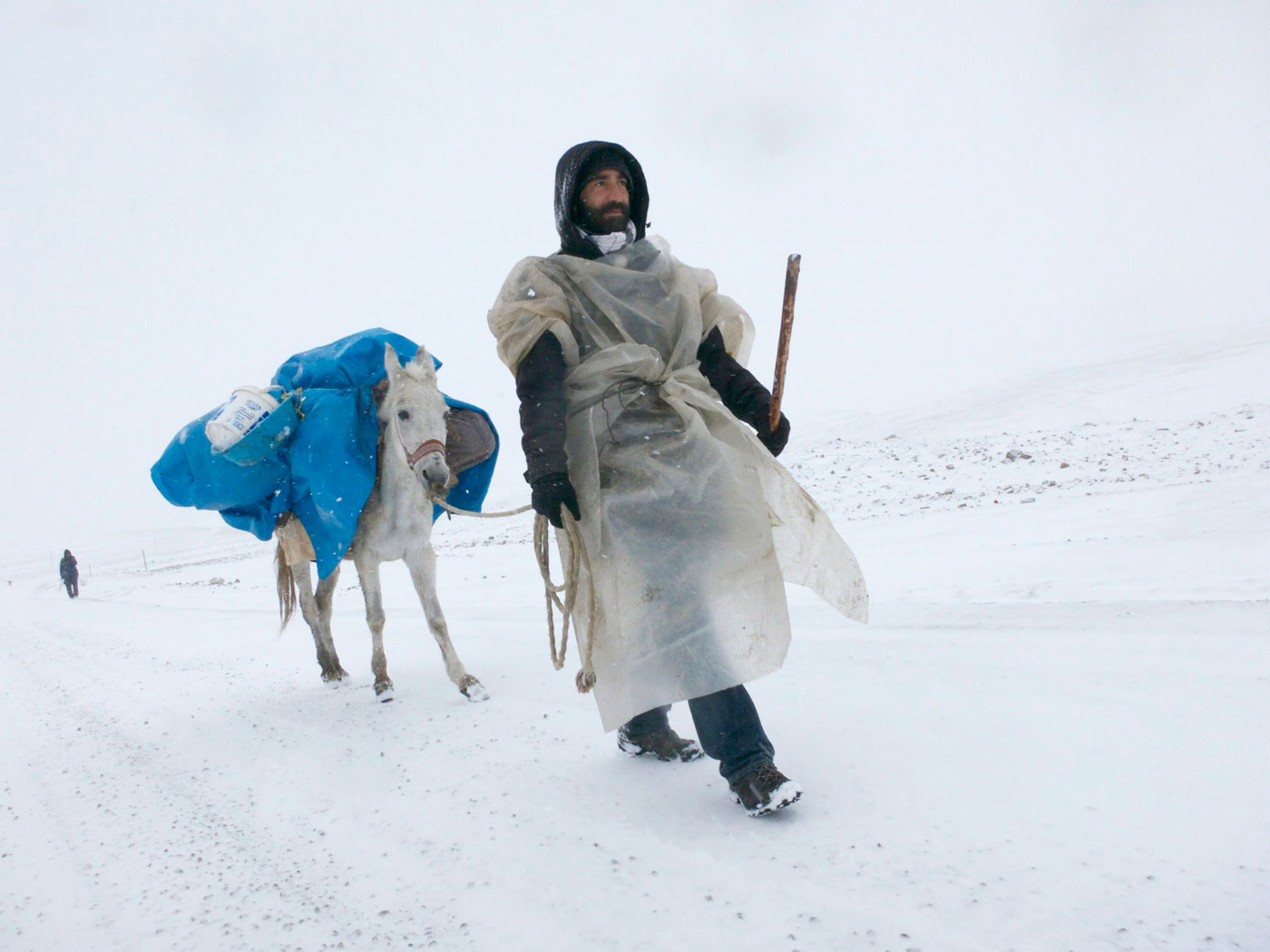
We descend the 8,000-foot pass in a blizzard. We reel like sleepwalkers. We grope our way forward through a cascade of blinding snow.

Murat Yazar breaks trail in the Caucasus range. Kirkatir the mule and Mustafa Filiz follow.
Paul Salopek
At the village we ask for the imam. We always ask for the imam. Asking for the mukhtar, or headman, is good. But the imam is better.
“Teacher,” we tell him, our breath steaming in the early dusk, “can we sleep in your mosque?”
The imam stands in the doorway. He spreads his palms skyward—a gesture of infinite sadness. It is prohibited, he explains—against the law. But he relents. Almost always the imams relent.
Walking through Anatolia, we have slept under minarets sheathed in polished aluminum, smooth pillars of metal that shine in the moonlight like glossy swords. We have slept under sagging minarets built from rusty 55-gallon drums welded end-to-end. We have dreamed beneath minarets of brick, of river stone, of pumice, of wood. In one mosque: a vast purple carpet of drying raisins. In another: cheap glass chandeliers that glinted overhead. There is warmth. There are stories, and remembering, and jokes. Sometimes, there is a tray of food. All our attempts to leave donations are rejected. Village mosques are our refuge.

Reward at day’s end: After walking through a blizzard, rest inside a hand-painted village mosque in Karacaören.
Paul Salopek
“Do travelers sleep in churches in America?”
It is my walking guide, Mustafa Filiz. He will be leaving us soon—abandoning the high cold heaven of the Caucasus range, returning to jammed streets of Istanbul, to another life, to another world.
I look out the frosted windows of a mosque. It is in a forgotten hamlet called Karacaören. Sunset tints the frozen mountains apricot. Children drag sleds through the snow. Crows whirl. Coming down the pass through the storm, ice had balled under the mule’s hooves. She had slipped and skated down the trail. We stopped often, chipping the rime from her iron shoes. It was hard. With numbed hands. With abrasive blasts of ice crystals whipping into our eyes. We were like a band of penitents embarked on some arduous hegira, bowed before the old gods of winter. Stopping. Pecking ice. Kneeling on the white world.

View from the mosque window in Karacaören.
Paul Salopek
Maybe, I tell Filiz.
It is snowing. In this tiny jewel-box of a sanctuary, with its bright walls of hand-painted roses, with its imam pouring hot tea, anything seems possible.