“You can’t stay.”
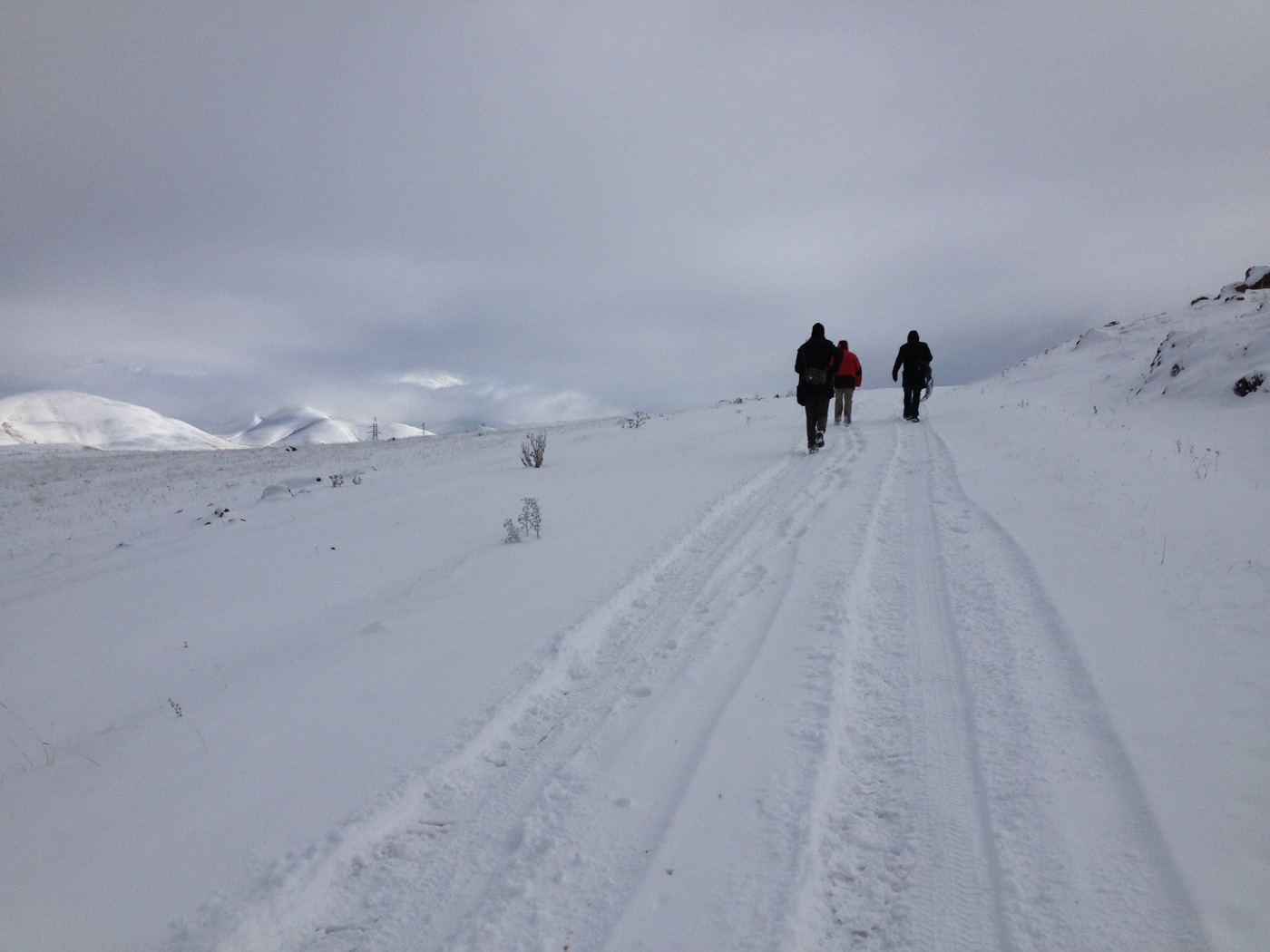
The lone workman at the highway maintenance shed turns us away. He will not shelter us, he says. Company rules. He warns us to descend the mountain immediately. A terrible blizzard is coming. But can’t he see that we are not in a car? That we have not driven to the top of this bitter 8,000-foot pass? That we are on foot? That we cannot escape this freezing wilderness on wheels? That we must descend one step at a time? He sees. But so cocooned are we humans in our motorized worlds that we often disbelieve our own eyes. The workman wishes us well, waves us off. He closes the warehouse door.

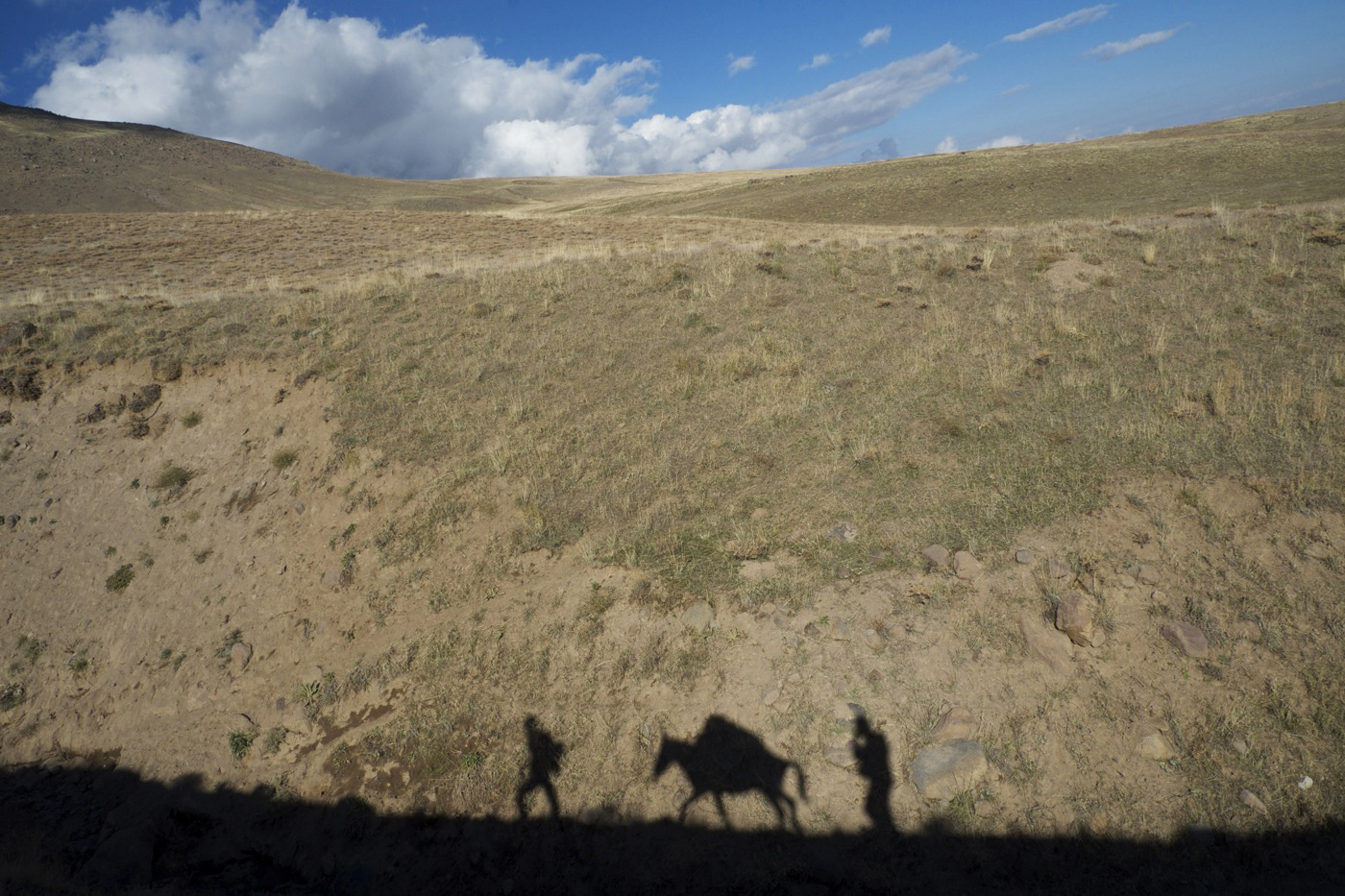
Shadow scarps: Into the high Caucasus range, near Turkey’s border with Georgia.
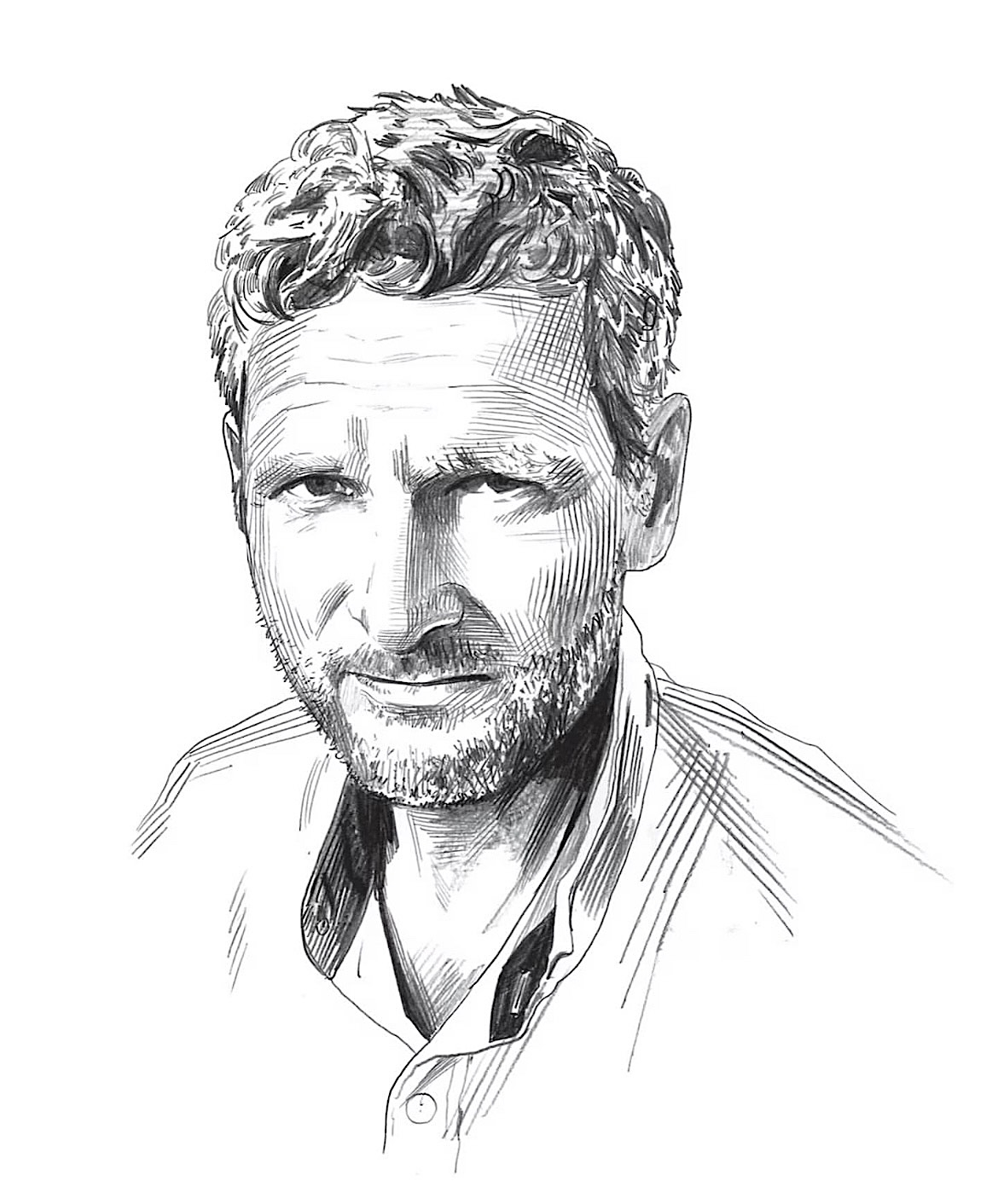
Paul Salopek
We set off at a jog.
Down, down, down—down to a survivable elevation. It is late. A weakling sun drops below the jagged white horizons. Icy wind razors our exposed skin. Clouds blur the mountain peaks. It has begun to snow. Hard little beads of ice begin to form on the pelt of Kirkatir, our cargo mule. The sky darkens. Where the clouds tear apart—a deep high-altitude blue, like the bluing on a gun. A few frozen stars. It is race against the cold.
“We must walk all night to keep warm,” declares Murat Yazar, my Turkish walking guide.
But the closest town is many miles away. And our new walking partner, the French photographer Matthieu Chazal, is lightly dressed. He wears plastic bags tucked inside his sodden leather boots.
I cinch my parka around my face. I think of Sarikamiş.
Almost precisely 100 years ago, roughly 100 miles due south, Ottoman Turkish soldiers pressed an attack against the invading armies of the Russian Empire that would mark one of the first mass slaughters of World War I. The largely forgotten battle of Sarikamiş, unfolding high in the Caucasus Range of northeastern Turkey in the winter of 1914-1915, saw entire military units annihilated. Men fought each other at bayonet point in blinding snowstorms. In yard-deep snow. In frozen fogs. One daylong Turkish assault sent half a division to their graves—6,000 men.
All the soldiers fought desperately on two fronts: against a human enemy and against the inhuman cold. The cold was far more lethal.
Temperatures plunged to -40 degrees Fahrenheit. Turkish troops, in some cases dressed in light summer cottons, were ordered by generals schooled in the tactics of the Napoleonic era to slog through blizzards for 24 hours without a break. Some managed to advance barely five miles up high, icy scarps. Men were stupefied by the cold. They succumbed to hypothermia. They grew indifferent to machinegun fire. At the end of three weeks of war, between 50,000 to 90,000 Turkish troops lay dead. As many as half froze. It was a crushing defeat for the Ottomans.
Our tiny, staggering column is in full retreat. We cannot go far. Matthieu lags far behind. It is too cold.
In the gathering dark, Murat smashes ahead through the snow. The snow glows that strange nighttime color, a blanket of metallic grey, shining like polished lead. After an hour, he somehow finds an abandoned herder’s camp.
“We make fire here,” he says. “We burn wood all night.”

Blizzard refuge: Torching broken furniture in an abandoned herder’s hut.
Murat Yazar
He begins stomping about with his boots—feeling in the snow for kindling. With clublike hands we gather scraps of broken furniture, old benches. We yank up wooden posts. We drag these items into a doorless stone hut. I stable Kirkatir in a tiny blackened room.
“We could have made it to the next town,” Murat says later.
He is sitting beside a sloppy fire inside the hut. He is shoving planks from a warped table into the flames. Steam wafts from his sopping jeans, his soaked pack, his drenched jacket.
“It would have been very difficult,” he reassures us. “But we would have made it.”
The Russians pressed another Caucasus attack in the brutal winter of 1916. They took much of northeastern Turkey. The following year, when the Czarist government collapsed before the Bolshevik Revolution, the Ottomans took it all back and more. Armies seesawed across the crystal mountains. Villagers on all sides were massacred. Especially the local Armenians. Seeing them as Russian collaborators, the Turks wiped them completely from the entire region.
I step out of the cramped, life-giving shepherd’s hut.
Outside a gale skims snowflakes past my eyes. I had ground my teeth on the descent from the mountain, chewed the linings of my cheeks. I spit blood onto snow. Instantly, the storm blots out this puny stain. Somewhere out there are wolves.