“Tell me again,” says the puzzled voice on the cellphone. “You want to bring a donkey into Georgia?”
“No—a cargo mule.”
“A mule?”
“You know—when you mate a horse with a donkey.”
“I know what a mule is.”
It is Nika Zurashvili.
Nika—an employee of a friend of an acquaintance of a colleague. At the behest of his boss, David Lordkipanidze, the director of the National Museum of Georgia in the distant capital of Tbilisi, and at the request of the Georgian ambassador to the United States, His Excellency Archil Gegeshidze, and also at the polite urging of the National Geographic Society, of Washington, D.C., Nika has been saddled with a delicate and unusual job: to facilitate the immigration of one she-mule, Kirkatir, from Turkey into the Republic of Georgia. Nika is a lawyer. He is a seasoned logistician. A troubleshooter. A problem solver. One of the world’s Mr. Fix Its—a corner cutter, a facilitator, a creative go-to man. “I will call you back,” he tells me gamely. And a few days later he does. On a snowy roadside in the Caucasus Mountains, in Turkey, my phone rings. Nika sighs. He has tried everything. He has badgered the authorities. He has sweet-talked politicians. But there are laws. Veterinary restrictions. Quarantines. “I am very sorry,” he says. “Crossing the animal will not be possible.”
And so I must give away my mule.
Kirkatir: a faithful animal spirit, steady, uncomplaining, solemn, a bucktoothed stoic with a weakness for packaged cookies. True, she is no longer a young mule. Her rubbery lips are slack and wrinkled. Her hooves ring slowly along the stone trails. But she is wise. She suffers no foolishness. And like a born traveler, she knows all the tricks of the open road. She shades up immediately under the hot sun. She obeys the cardinal rule of long-distance walking: lay in a fat reserve. (Rain or shine, she eats tirelessly, constantly, one might even say neurotically: I have seen her dig down to the dead winter grass beneath a foot of snow.) She has been my mute companion across the immense breadth of Turkey. A world-weary being, born from the history-trampled red dust of Asia Minor. Her black eyes are unimpressed with the changeless beauty of the world: the rows of lush grape vines, the flexed brown muscle of the Euphrates River, the shining ice caps the Caucasus Mountains. Every dawn for five months—in mosques, or in stone huts, or camped under pistachio trees—I have enacted a ritual: I have peered sleepily about for Kirkatir. Seeing her pegged to the rolling landscape, I can relax. She keeps me anchored to Anatolia. I inhabit a still life with a mule.

Murat Yazar and Kirkatir bonding in the Lesser Caucasus mountains.
Paul Salopek
Yet nobody wants her!
Miles slip by. Days pass into weeks. The Georgian border looms. I ask ethnic Kurds. I ask ethnic Turks and Azeris. “We don’t use mules here anymore,” the villagers say, shrugging. Rural people drive tractors now. Their labor saving devices burn diesel, not hay. Today’s farmers have no need for farm animals.
“We must find the right person,” Murat Yazar, my Kurdish walking guide, says, worried. “We cannot just release her. She will be eaten by wolves.”
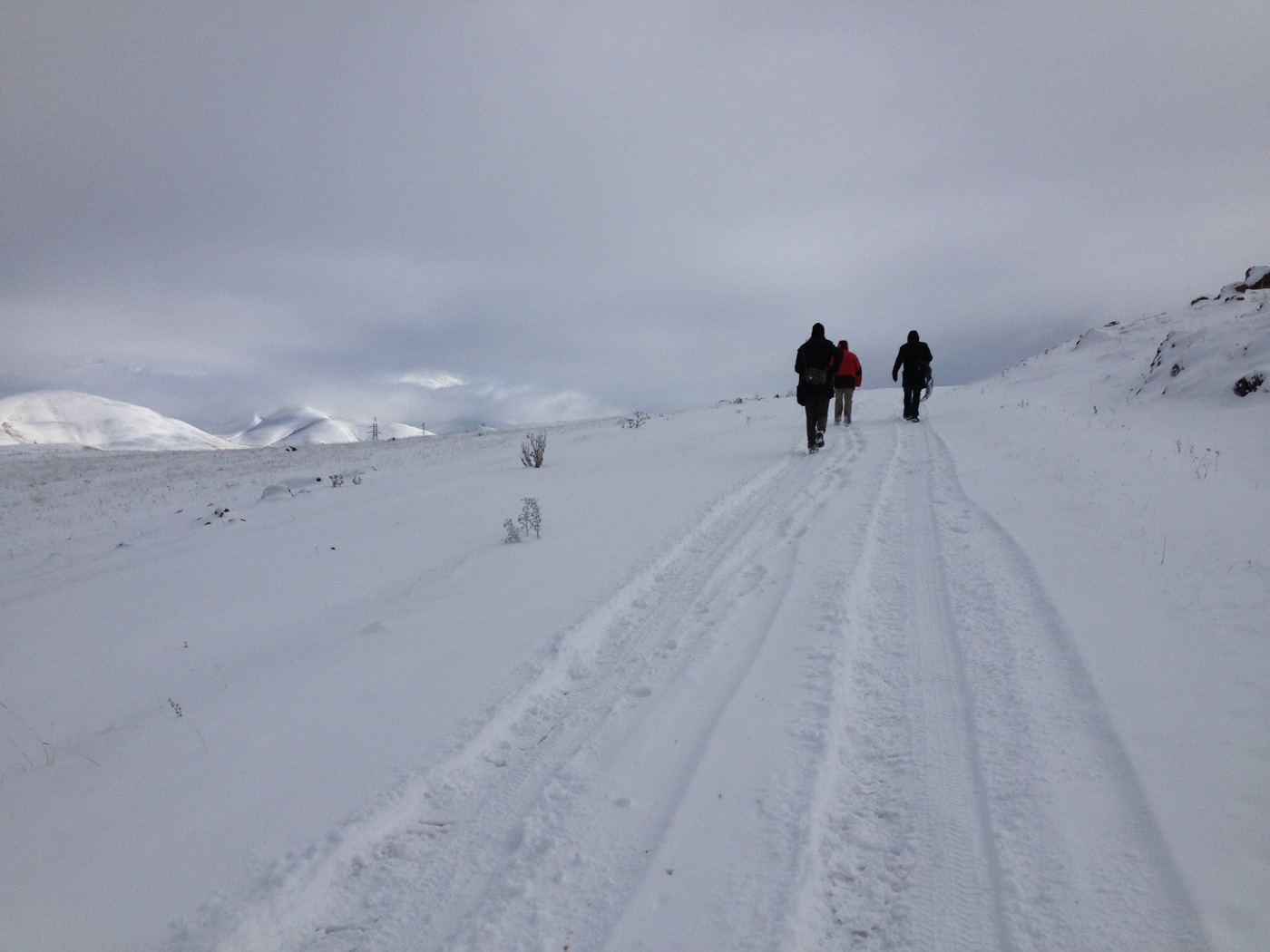
So we wander the crags of northeastern Turkey. We trek up the green guts of river valleys, plod across straw-colored steppes, slog through brilliant snowfields, chanting out our single ware: Would you like a good mule? Do you need a loyal mule? Can you use a first-rate mule?

Two immovable objects: Kirkatir and Che, near Halfeti.
Paul Salopek
Outside Posof, a creaky old man falls in beside us. He is friendly. Curious. Poor. Dressed entirely in black like a crow. Murat tells him the story: Our mule is so educated she should be wearing eyeglasses. She is strong as ten wrestlers. She is gentle as your grandmother. She has completed a mule pilgrimage of 700 miles or more across Anatolia, all the way from Mersin, from the steamy Mediterranean, where I bought her from a woodcutter named Ahmed. He was an Alevi, a member of an often suppressed minority Islamic sect known for its tolerance, for its openness, for its communal lifestyle.
“I will take your mule,” the old man declares. “And I promise I will take care of her well.”

End of the trail. Kirkatir boards a truck to her new home on a border farm near Posof.
Murat Yazar
Murat and I stop. We look at each other, giddy. We are out breath from the climb. The old man informs us that he too is Alevi. And that his name too is Ahmed. And on this naked hilltop with Kirktatir, from where all of Turkey unfurls westward behind us, we begin to laugh. A circle is closed.