You roll down a high snowy mountain into a country you never expected to be in.
It is a crossroads. It is a cul de sac. It produces poets. It is home to mass murderers. It invented wine. You have read one good book about it in English.

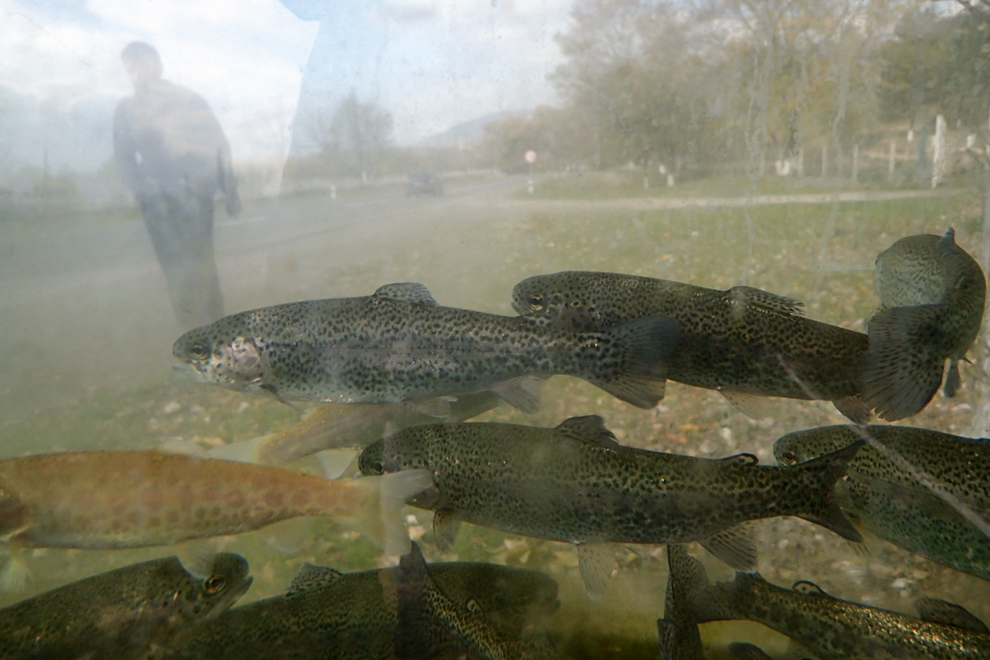
Primitivist art: car wash along the road from Georgia to Azerbaijan.
Paul Salopek
Two weeks in, you encounter the author of the book. She is visiting, by chance, from Paris. The bars are closing. It is 3:30 a.m. She sways in the middle of a cobbled street, holding up a man: a colleague, a local scribe. They weep into each other’s shoulders—for friends dead in the Caucasus mountain range, for the shared dead of war. The man, whom you do not know, whom you have just met, and who looks like a languorous Spanish count, and whose name you will not recall through the ax blows of a morning hangover, holds up a regal finger. He gallantly volunteers to walk with you across his country: 250 rugged miles over high crags and across frothing rivers, for days atop punishing pavement, wrestling mud and rain and snarling shepherds’ dogs for nearly a month. And he does it.

Guide Dima Bit-Suleiman plods the sheep pastures of southern Georgia, bound for Azerbaijan.
Paul Salopek
Georgia is like this.
You fall down a high snowy mountain into a country you never expected to be in.
One February day in, you sit inside a backstreet café where the barista is a burly Homerologist—an expert on Homer. In walks a tai chi master from Tehran. The Homerologist yanks tables aside. And the master, named Ali, performs a spontaneous dance of such grace and beauty that the silent café rings. The man chaperoning Ali is an artist: He photographs nudes wearing nothing but flower petals and crows’ wings. You found this café on your first day in-country. You told the Homerologist, smugly, that you had just strolled in that day from Ethiopia. “That’s interesting,” the Homerologist said, “because the man sitting over at that table just walked in from France.” And it was true.

The daily generosity of Georgians: another farm breakfast along the trail.
Paul Salopek
Georgia is like this.
You fall down a snowy mountain into a country you never expected to be in.
One midsummer day in, when the plane trees blaze green above the boulevards, you wake up to find a woman sitting in your rented flat. She is not really sitting. She has keeled forward. She is resting her forehead on the table. She is a guest—one of dozens who have homesteaded in your apartment, rendering it a kibbutz. She has been up all night for many nights. She has been searching on a computer for a foreign specialist who will treat her dying infant nephew. At the local children’s hospital, a homegrown doctor who actually saves the boy, a weary man with uncombed hair and a hangdog face, is overwhelmed. Not by the anguish of his young patients. But by the parents. His phone rings day and night. He takes a call. He sighs. He tells you a 14-year-old just died in his ward. As you leave, he pulls a bottle of saperavi from a drawer. He hands it across his battered and cramped desk. It is the practiced gesture of defiance in a place that his been conquered and invaded many times, that has known rage and defeat and tragedy, that has rebuilt many times from rubble. The bottle of wine stands among sonograms, cardiograms, X-rays of tiny skulls and limbs. The doctor smiles a thousand-year-old smile.

The unbearable lightness of Georgia: a leaf suspended in the Lagodekhi River, near the Azerbaijan border.
Paul Salopek
Georgia is like this.
You fall down a snowy mountain into a country you never expected to be in.
One autumn in, and you are walking out—making for the next border, the next country. Making for China. You start in mountains that stopped the Arabs cold in the seventh century. You walk literally from home to home. Ethnic Azeris. Armenians. Georgians. (“The only difference between us and our Georgian friends,” a Muslim Azeri man tells you warmly, “is our geography. We got our heads chopped off first whenever the Persians invaded.”) Nobody turns you away. Not once does nightfall find you without shelter. Your guide, the new friend who looks like medieval Spanish royalty, the tipsy journalist, clocks quick yard-long strides before you. He is walking away from a houseful of troubles, from bills, pressures, headaches, responsibilities. From middle age. Walking turns him into a tinker. He begins to fix things along your route. The doorbell in one house. The toy helicopter of a child. He fixes your GPS device. One night, you hear him imploring your latest host, a careworn old woman who is flummoxed by his insistence on mending her bicycle. “All it will take is one bolt!” In this way, mile by mile, he is repairing himself.

Mr. Fix-it: Dima Bit-Suleiman repairs the doorbell of a home.
Paul Salopek
Georgia is like this.
You fall down a snowy mountain into a country you never expected to be in.
And ten months later it is behind you. You trudge across a concrete bridge to a checkpoint under a new flag.
What surfaces to mind during this eventless departure is not the country’s light—that strange yellow glow that hovers above the Black Sea coast—nor the arm-aching rounds of toasts over khachapuri and roast pork, nor the Abkhaz refugee woman on the sidewalk who whispered your name to God Almighty when you bought her McDonald’s coffees, nor even the iceberg blue shadows in snow above Mestia. No. What you recall instead is the simple little room on the fourth floor of the national museum where you did your work. You remember the people who walked through its door: the famed paleoanthropologist who gave you that space and the translator of Rimbaud into Georgian, the Russian tutor who was a chess prodigy and the folk dancer with the face of a Picasso masterpiece. You remember the night guard armed with a scowl and a Kalashnikov, who always flung open your door in the wee hours, tapping his watch, scaring you witless. And how he stopped by on the day of your leaving to sadly shake your hand. And you recall how, on warm days, when a green wind blew in from the mountains and through the open windows, the chants of the parking attendants far down below went “Modi! Modi! Modi!”—“Come! Come! Come!”
Georgia is like this.