Paul Salopek is walking the global trail of the first humans who migrated out of Africa in the Stone Age. His continuous 21,000-mile foot journey, called the “Out of Eden Walk,” is recorded in dispatches.
The tables stand by the roadside. All are empty. They are manufactured of plastic, made of tin. Bright oilcloth covers them. They hold: cheap saltshakers, sugar bowls, a dusting of black car exhaust. Their legs sink into mud. These are sidewalk cafés without sidewalks in eastern Azerbaijan. They are run by the homeless for travelers. The waiters and cooks wear rumpled farm clothes.

Çavad Huseynov, 11, with his grandfather, Nemat Huseynov, in the family’s roadside café in Azerbaijan. Çavad has no memory of a mountain homeland lost in the Nagorno-Karabakh war.
Paul Salopek
“This was forest when we arrived,” says Nemat Huseynov, 55, a café owner and the patriarch of a family of refugees from the Nagorno-Karabakh war. “We came here in buses. It was 1993. We had nothing. We chopped down trees. We lived in tents. Then we built shacks. Now we have a few sheep. We sell bread and tea by the road. This land isn’t ours. It’s borrowed.”
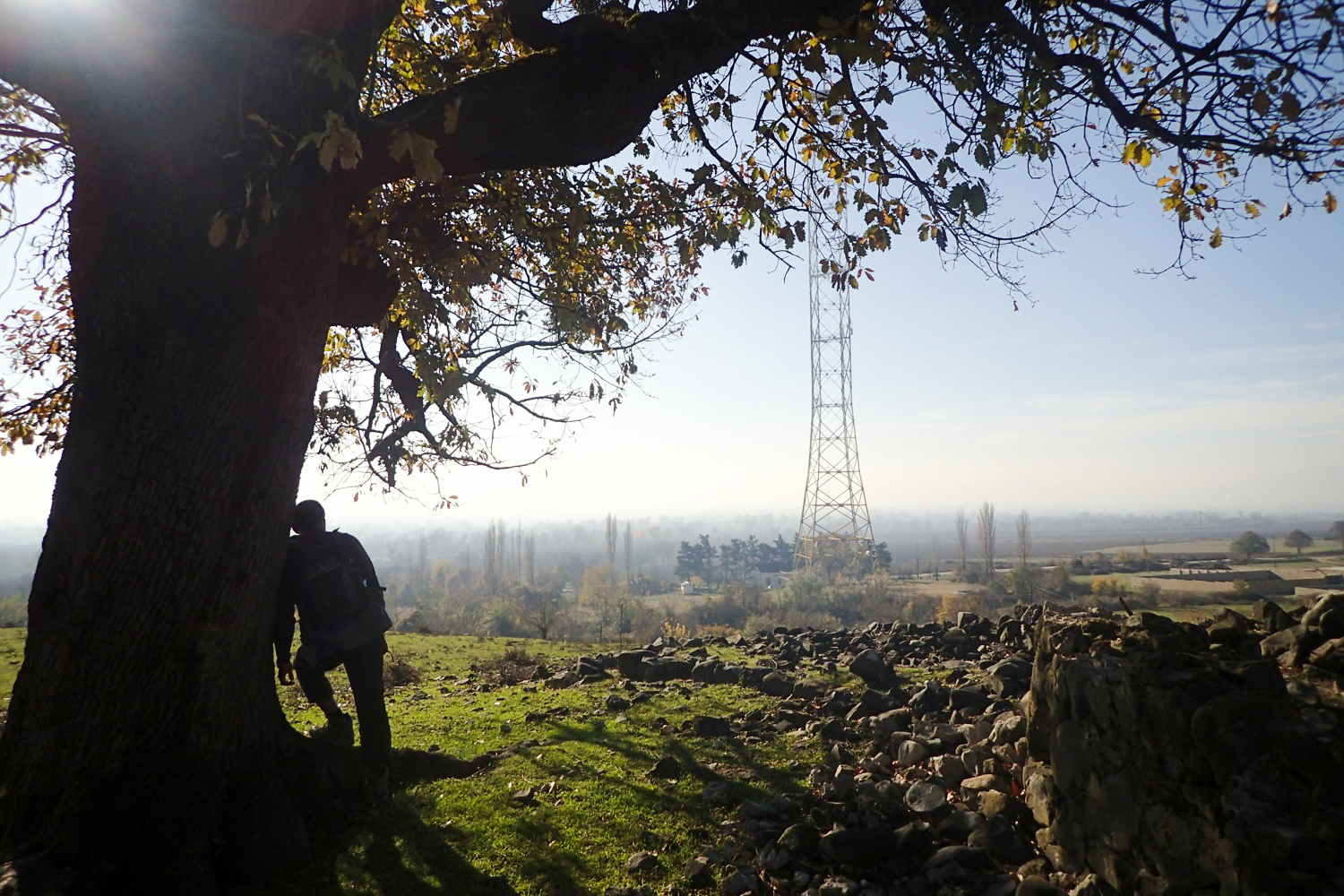
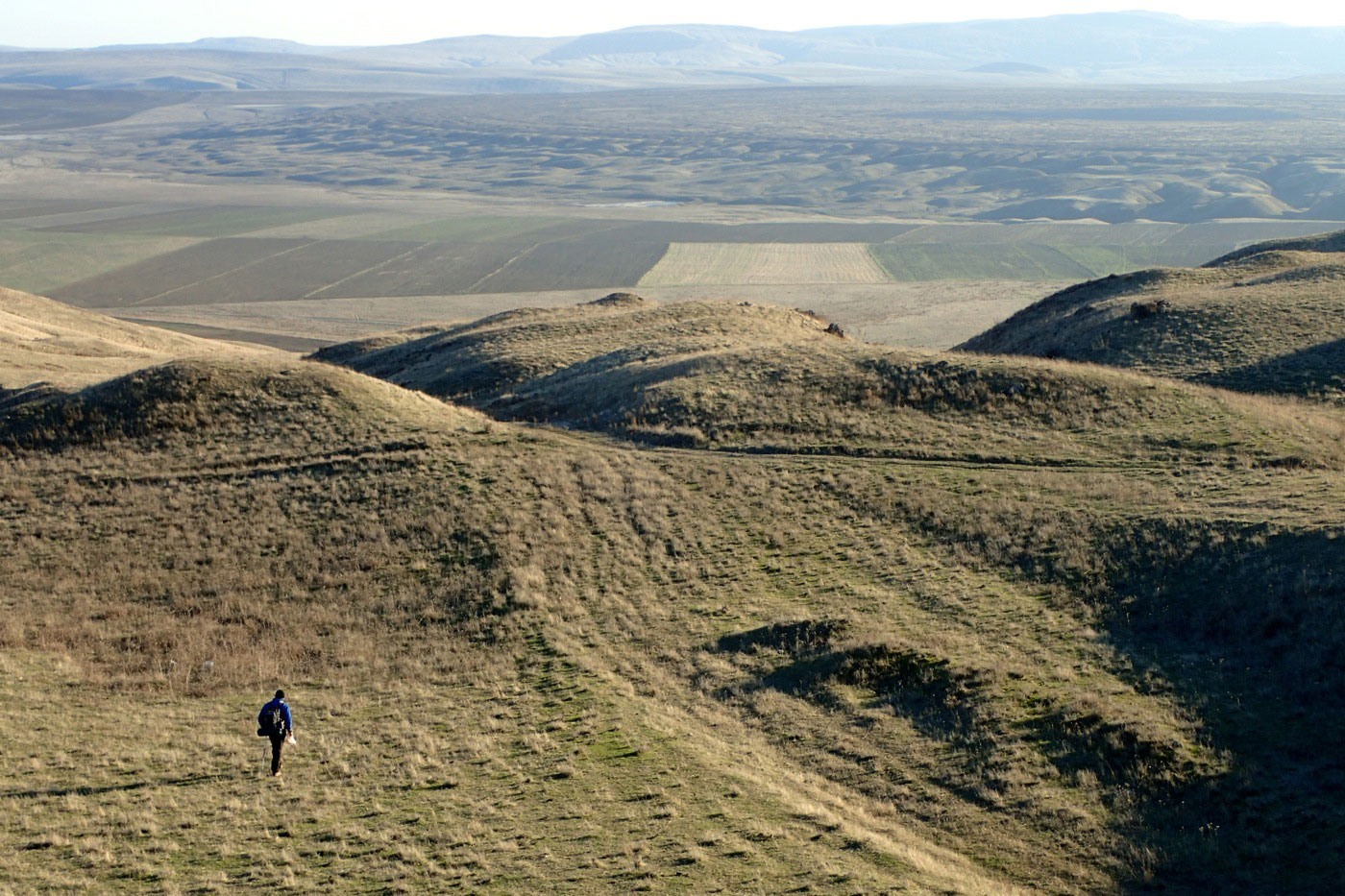
My walking partner, Rufat Gojayev, and I shuck off our packs. We sit at a table. We are tired. We have been yo-yoing across the foothills of the Caucasus for days. We have stumbled into one of the oldest refugee communities on Earth.
The United Nations says that today at least 243 million people live outside their countries of birth. About 59 million of these masses are refugees uprooted by economic upheaval or war. History has not seen such a tide of desperate humanity since World War II. From the first steps of the “Out of Eden Walk” I have encountered them, alive and dead, along my route. There were the bodies of Ethiopian migrant workers dead of thirst in the African desert. There were exhausted Syrian refugees camped in the pastures of Jordan and Turkey. And now, wiping their lonely tables, it is the aging victims of the 27-year-old “frozen” war in Nagorno-Karabakh.
“We have been waiting for peace so long,” Huseynov, the café owner, says. He places two small glasses of tea before us with his shepherd’s work-blunted fingers. “I tell my children about home. It is high in the mountains of western Azerbaijan. It is beautiful. It has hot springs where we used to boil eggs. The air was clean. It was a rich place. There are gold mines. But my children don’t know it. For them it is like someone else’s dream. They only know this place, this road, this camp.”

Gyoychakh Huseynov fires up her bread oven, in Jalut, Azerbaijan. In a country rich in gas and oil, she uses scavenged sticks.
Paul Salopek
Nagorno-Karabakh is a volcano of pain in the Caucasus. It is a conflict that has spewed out a million or more refugees.
It erupted like this: For 70 years under the Soviet Union, the remote and beautiful highlands of Nagorno-Karabakh had been a part of Azerbaijan. But as the Cold War ended, its ethnic Armenian majority complained that their culture was being suppressed. They demanded to join their brethren in neighboring Armenia. And they rebelled. A brutal war of secession against the Azerbaijan government began. (The rebels called it an act of historical reclamation.) Armenia joined the side of the insurgents. On the ground, the worst kind of fighting gutted farms, villages, and towns: neighbor against neighbor, a family quarrel.
Azerbaijanis had lived peacefully for generations among the Armenians. They ate each other’s food and sang each other’s songs. But by the late 1980s, trucks packed with wretched refugees were rolling out of the smoldering enclave. Some trundled west toward Armenia, more chugged eastward into Azerbaijan. Some 30,000 people, mostly civilians, were killed on both sides. A cease-fire took hold in 1994. But the bloodshed trickles on. Dozens of Azeri and Armenian soldiers still die every year along a trench works called the “line of contact.”
“In the past our relationship with the Armenians was good,” says Huseynov, who lived in Kalbajar, a district of Azerbaijan now emptied of Azeris. “We had relatives on all sides. I want to go back. But it can’t be like before. There have to be strict borders. We can’t live together again.”

Elshan Huseynov, a refugee since age six, missed a decade of schooling. “The war made it impossible, and now it’s too late for me.”
Paul Salopek
That bitterness is echoed on the Armenian side.
I had traveled months earlier to Armenia. I took the train from Georgia. The Nagorno-Karabakh front ran like a knife cut through fallow fields that had not been plowed in a quarter century. It looked like a museum diorama of Verdun. Young men born after the war’s first shots were fired still manned opposing trenches, locked in time. There is no trust—no human connection at all—between the opponents.
“I can’t live with them again, not me, not my family,” said Ara Kemalyan, a soldier from Stepanakert, the “capital” of Nagorno-Karabakh. (The breakaway region has declared its independence though no country recognizes it.) When he was a boy, Kemalyan lost his father in the fighting. “Coexistence is impossible. Maybe the next generation.”
Some Armenians driven from formerly mixed towns in Nagorno-Karabakh now live in houses abandoned by Azeris, people who themselves were expelled from other formerly mixed towns; some of these displaced Azeris, in turn, occupy the homes of terrorized Armenians who fled Azerbaijan. In this way, the two refugee communities occasionally inherit each other’s wallpaper. It is a symbiosis of suffering in the Caucasus. It keeps old wounds fresh.
Forty or fifty refugee families cling to the roadside where my guide Rufat Gojayev and I rest our feet. They squat in nobody’s houses. They live in shacks of tin and plywood, cardboard and plastic sheeting. They are among 600,000 war-displaced Azeris in Azerbaijan—7 percent of the country’s population.
“The day we ran away, I locked the front door of our house and hid the key under a stone in the garden,” Huseynov tells us. “That was 22 years ago. Maybe it is still there. ”
He grows embarrassed. He is sitting at our table. He looks up at the sky as if gauging the clouds, or reading the weather. He tells us later that his house was probably bulldozed a long time ago. We walk on.

Wishful thinking: A refugee café near Jalut carries the name of a territory lost in the Nagorno-Karabakh conflict.
Paul Salopek
Gojayev and I trudge past refugee cafés named for lost territories. The names are painted on scrap wood. Cars roar by. Every single table remains empty. It is strange. Who ever stops here? The tables seem to be set for ghosts. For neighbors who never come.