The hand is what draws your attention.
It belongs to a man. It rests, gently, on the woman’s face. The couple lie on their sides—the man on the left, the woman on the right—facing each other squarely. The woman’s knees snuggle up above the man’s. Their eyes appear to be locked. It is a gesture at once familiar, universal, and almost painfully intimate. Yet their eye sockets are empty. Their fingertips tumbled off long ago. And whatever secrets lock their embrace will never be broken. Because these two nameless lovers—that hand to the cheek makes it impossible to call them otherwise—are roughly 1,800 years old. They were unearthed last year from a burial in northern Azerbaijan, a surprise Valentine from antiquity.
“We haven’t completed our analysis, so we don’t know who they were,” said Jeyhun Eminli, the archaeologist who made the find. “We don’t even know their exact age or if they suffered trauma.”
Eminli, a friendly and effusive man, and a researcher with the Azerbaijan National Academy of Sciences, added one seductive detail: “Neither body was moved to make room for the other later,” he said. “They were put in the grave together. They probably died at the same time.”

Archaeologist Jeyhun Eminli and his colossal puzzle of medieval pottery at Old Gabala.
Paul Salopek
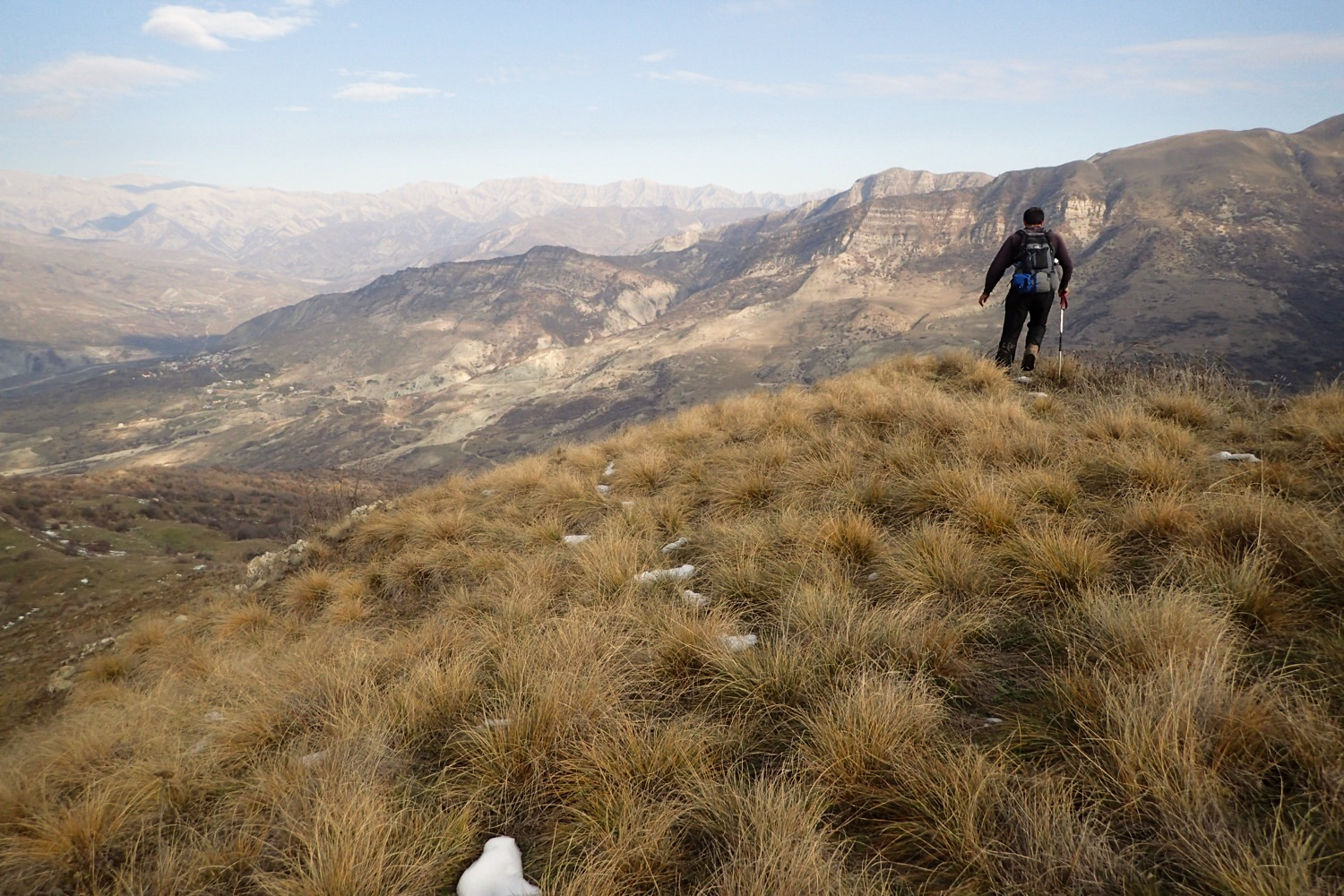
We have walked, my guide Rufat Gojayev and I, three-quarters of the way through Azerbaijan. We inched across the Caucasus Range atop rusty carpets of grass. We ricocheted wearily south, to a flatland town called Gabala. There, we dropped our packs in a truck stop inn. Its walls were steeped in yellow nicotine. We hired a taxi to escape the dimness. It dropped us at a historical monument: a random dot on a map. In the distance, a man built square as a butcher block strode in a pasture among open pits. He barked orders to workers. He waved his arms. He energetically rolled sheets of plastic over a million collected pottery shards. This was Eminli, the archaeologist. He invited us for tea. He showed us his skeletal beloveds.
The lovers were found at the site, called Old Gabala, of a 2,500-year-old “lost city” whose ruins were rediscovered only in 1959. Watered by two rivers, sprawling today across 33 acres of a grassy fields, the ancient trading post straddled a Copper Age migration route and later became a major hub on the Silk Road. For centuries Old Gabala prospered as the walled capital of a pre-Islamic kingdom called Caucasian Albania. (A culture with no connection whatsoever to European Albania.) And as was the case with many booming settlements in the Caucasus, the city attracted stampedes of plundering Georgians, Mongols, Persians, and Russians. It was so thoroughly wiped out in the 18th century that it vanished utterly from memory. Today its trove of artifacts hint at immense tendrils of power: Roman glass, Chinese ceramics, a scarab from distant Egypt. And then, there are its paired dead. Eminli has found four of them, from different eras. One couple was buried inside a large clay jar.
Humans have interred each other in poses of love at least since the Stone Age.
One of the oldest finds was a teen couple pulled from a swamp last year in Greece. The nearly 6,000-year-old Neolithic pair was spooning in a tight embrace. (Broken arrowheads littered their burial.) In Romania, a medieval man and woman, laid to rest holding hands, their heads cocked toward each other, have been dubbed “Romeo and Juliet.” The woman appeared young and healthy; the man had died of a blow to the chest. Dozens of Bronze Age graves from the Andronovo culture in Siberia contained men and women clasping hands. Nobody has a clue why. One theory that falls short of Valentine’s Day spirit: Without much evidence, some archaeologists suggest that wives were killed when their husbands died, to join their spouses in the afterlife.
Group burials are not uncommon in the Caucasus. More than a hundred dead, for instance, have been dug from a single Bronze Age funerary mound in Azerbaijan. At a younger Azeri site, about 2,500 years old, a woman was found cradling an infant to her belly. And in neighboring Georgia, a spectacular mound called Ananauri 3 revealed a Bronze Age chief buried in a chariot with six other people.
“The people buried with him might have been sacrificed slaves,” said Zurab Makharadze, the Georgian archaeologist who explored that site. (All the bodies in Ananauri 3 were cured in honey.)
But amorous dead are extremely rare. The lovers of Old Gabala are clearly Eminli’s pride.

Dead atop dead: Twelfth-century skeletons lay strewn in an ad hoc cemetery dug into the rubble of an older villa at Old Gabala.
Paul Salopek
“They lived in complex times,” he said. “There was so much movement here in the second and third centuries A.D.” The ruling Albanian kingdom itself, Eminli noted, had 26 different tribes. Nomadic raiders sometimes attacked settlements. Traders were moving through. “It is impossible to say that these two were even locals,” he said.
Objects placed with the lovers’ bodies suggested a high-status couple. Eight glass cups lay between them. Glass was a luxury item in the Caucasus at that time. A heavy iron sword, sheathed between the pair’s legs, might indicate the man was from a warrior caste, Eminli said. He shrugged. The research was still unpublished. He refused to speculate.
Turkish soap operas moaned through the flophouse walls back in modern Gabala. I sat alone in my room. I stared at photos of the antique sweethearts. They would live under glass in a museum. Their bones looked so clean. Everything about that hand gesture seemed so unblemished. But I knew this wasn’t true. I packed my rucksack to walk on in the morning.