We rise early, my guide Rufat Gojayev and I. We take our last footsteps together in the Caucasus.
Our path is a road—a modern, high-speed, multilane highway in Azerbaijan. It is a type of artifact I have not seen in many miles of walking. (Normally I avoid such rigid corridors: They are inhuman spaces to walk in, a world of harsh surfaces built for the requirements of metal and rubber, for machines, not for living muscle and sinew.)
To the left: We pass the barren, pleated flanks of a volcano that bubbles cold mud. We pass gas stations, truckers’ cafes that advertise kebab lunches and the Baku-Ceyhan pipeline that carries Caspian oil to the Mediterranean. Crude gushes 24 hours a day through the 1,099 miles of steel tubing, reaching the huge terminal at Ceyhan, Turkey, in slightly more than two weeks: a river of petroleum flowing westward at 70 miles a day, a jogging pace. (It has taken me 15 months to walk the same ground through Asia Minor and the Caucasus.)
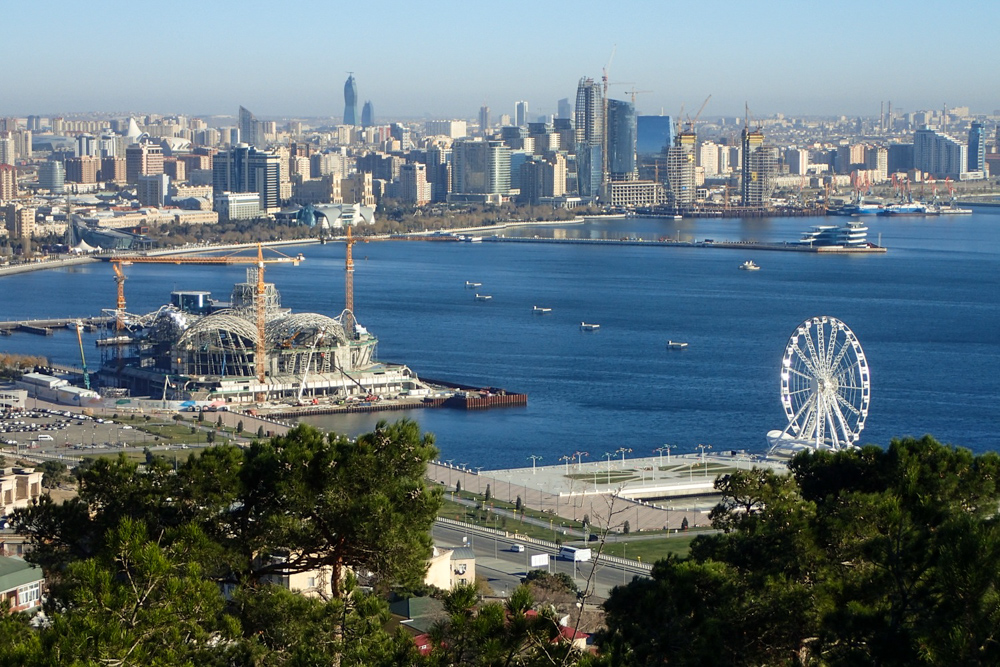
To the right: a string of petrochemical plants, tank farms, military bases, and the Khazar Islands construction site, an instant city being built atop artificial atolls that may one day host up to a million people, 150 schools, 50 hospitals, the world’s tallest building, and a Formula One racetrack. Or maybe not. The hundred-billion-dollar project is threatened by falling oil prices—Azerbaijan’s economy depends cripplingly on fossil fuel exports. Behind the construction cranes and jumbo video screens depicting potted palms and pedestrian malls glitters the Caspian Sea. My finish line in the Caucasus. From here I will step into an ocean of windblown grass. I will leave this ancient crossroads of East and West and commit myself fully to Central Asia.

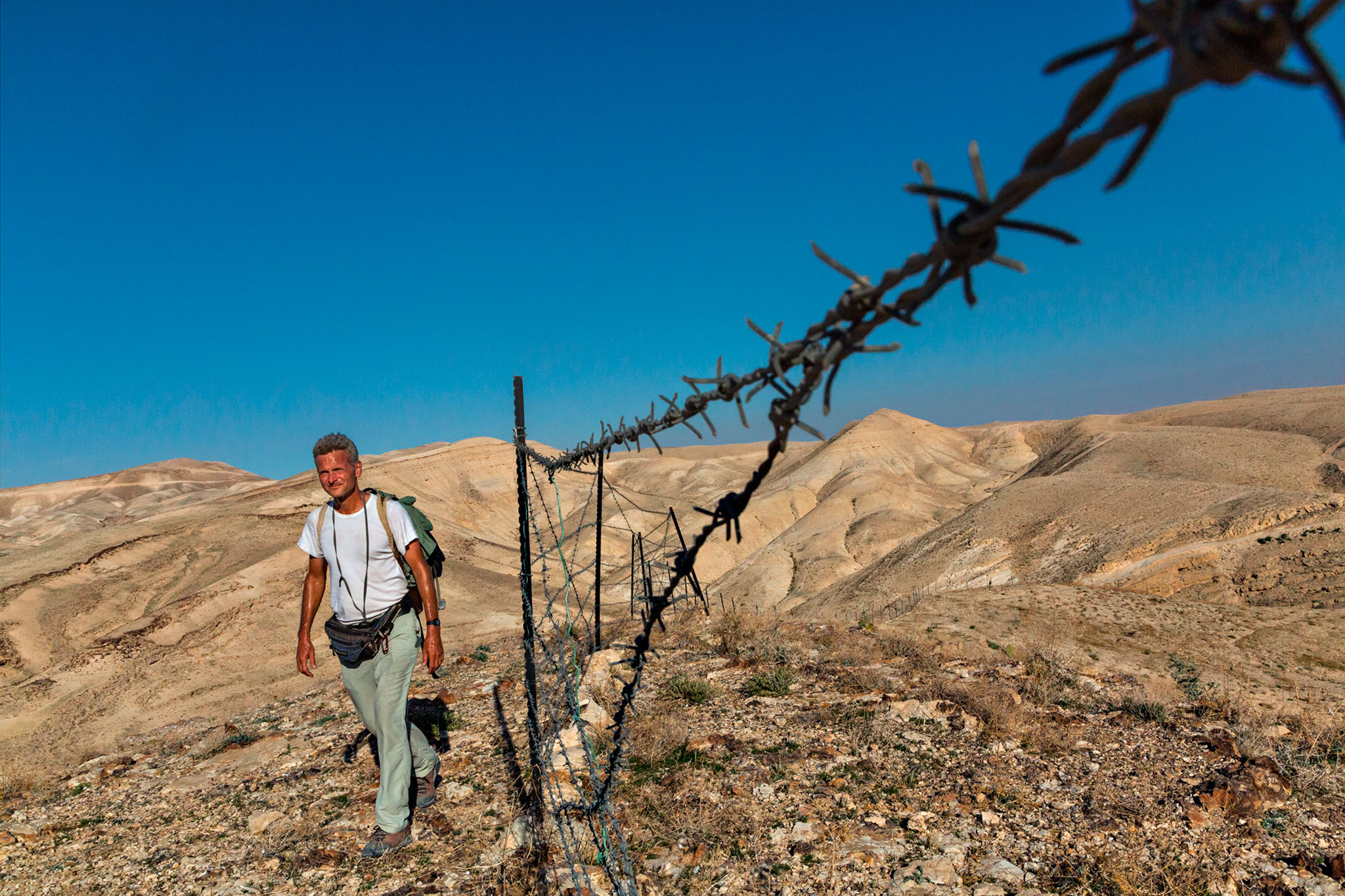
Old and sort of new: Cliffs scarred by WWII graffiti overlook the modern industrial port of Baku, Azerbaijan, the first oil capital of the world.
Paul Salopek
The Caucasus.
I have spent months rambling through—and pausing in—this fractured, craggy, storied region. A maze of history, a patchwork of ethnicity, a cockpit of empires, a storehouse of physical and political storms, an enigma. I have been stopped in my tracks by high snowy mountain passes. (The Greater and Lesser Caucasus ranges.) Stymied by withheld visas. (Iran.) By wars. (Nagorno-Karabakh.) By a blizzard of letters, memoranda, forms, explanations. (It is relatively easy to walk across the world; obtaining official permissions to carry out this simple exercise, however, can be a trial.) I have plodded 270 miles through Georgia. I have stepped briefly into Armenia. I have slogged 280 miles through Azerbaijan. I have been surprised daily.
Knock on any door in the Caucasus to ask directions: Which kingdom, what religion, what era will answer? It could be the bearded face from a sixth-century Christian monastery, or a forehead callused with a zebibah, a Muslim prayer bump. It could be antique Persia, Ottoman Turkey, classical Greece, chic Berlin, colonial Russia, the Mongols. It often is a complex mix of these worlds.
Gojayev and I walk the highway shoulder north.
We tread atop spent shotgun shells, a billion cigarette butts, and broken sacks of grain spilled from passing trucks—feasts for sparrows. On a cold night beach littered with rusting oil rig pipes, we knock on the door of a shack. The dead Soviet empire answers.
“Are you a spy?” says our host, Nariman, a middle-aged fisherman who trained as a masseur in Ukraine in the good old days of communism. He is half-lit on vodka. “You are from the American intelligence, yes?” He is father was Jewish, he tells us. He is a Muslim. He describes saving a man from drowning: He leaned over the side of a boat and yanked the unconscious body up through the waves by its hair. He asks to see my hands—to read my palms: “You will live to 120!”
“Jack London!” exclaims his sidekick, an aging taxi driver named Ali. “Ernest Hemingway!”
Ali toasts the socialist-leaning American writers permitted to be read in the Soviet Union. In my honor, Ali raises his vodka bottle: “To Theodore Dreiser!”

A toast to world literature: Ali raises one for Tolstoy. Near Baku, Azerbaijan.
Paul Salopek
Dawn cracks its bloodshot eye. Shuts it. Blearily reopens it. A black-faced dog sleeps at Nariman’s side by the wood stove. We walk on.
Gojayev and I bump into the clutter of the Anthropocene—the age of humans. We walk into the outskirts of a port city of concrete and glass. We trudge past the East: a replica of beautiful 13th-century mosque that was destroyed by the Bolsheviks. We totter past the West: extravagant mansions built in the early 1900s by oil aristocrats like the Nobels and Rothschilds.
We step wearily into a broad plaza ringed by globalized designer shops, by a McDonalds restaurant. A human dressed as a pink Tyrannosaurus rex—Barney the dinosaur—is having his picture taken with children. This is the end of the Caucasus. This is Baku.