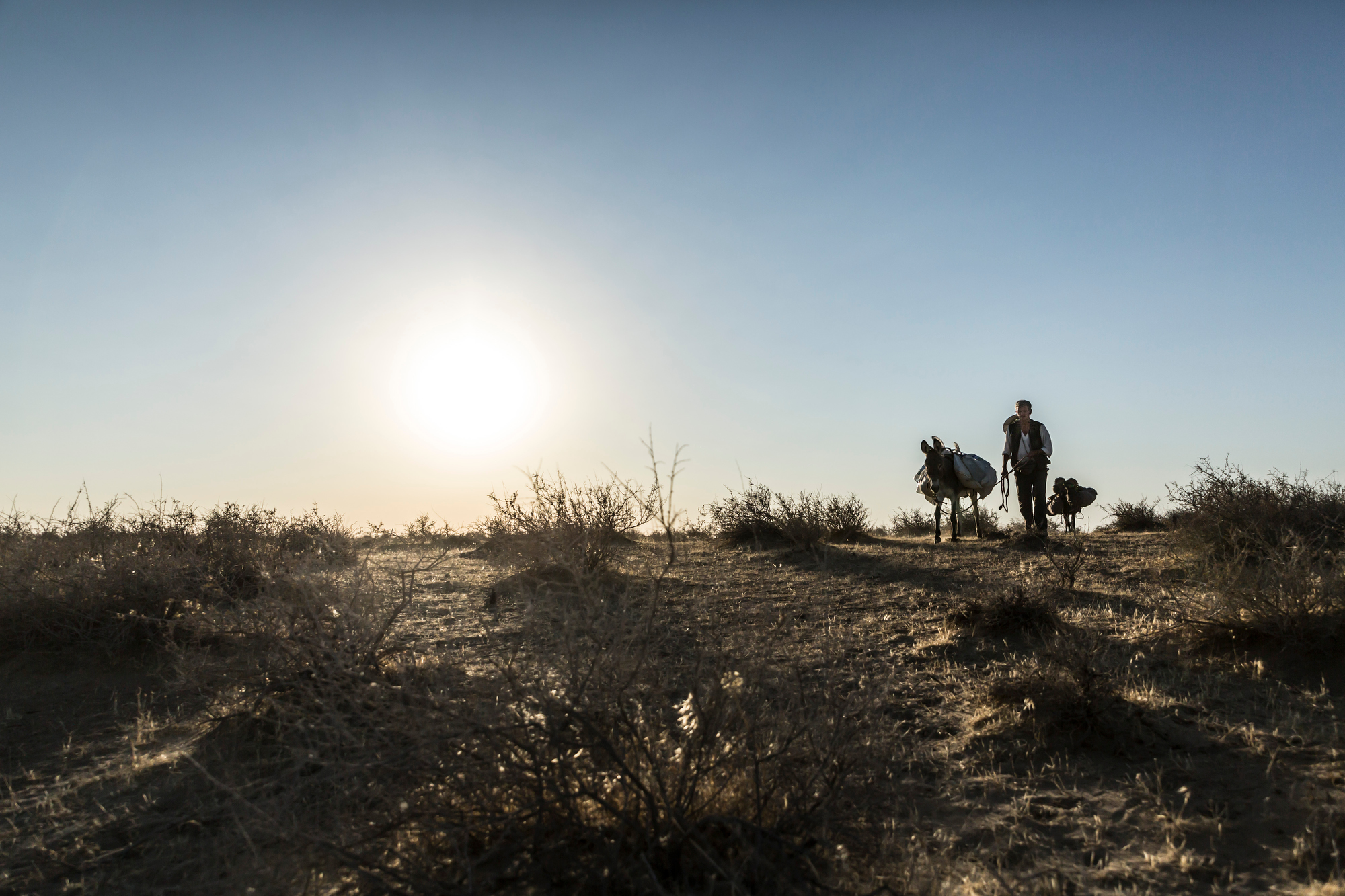
Walking through Central Asia en route to China, I often have been urged to visit the Aral Sea. This infamous body of water lay somewhere north of my route. (Where exactly was impossible to say: The sea keeps moving, shrinking, getting smaller.) So I parked my cargo horse and donkey at an Uzbek frontier town called Kungriot and hailed a cab. I went seeking ghost waters.
The story of the destruction of the Aral Sea is by now widely known. It is usually cited as one of the worst environmental calamities in history.

Edge of a dying sea—the shrinking banks of the Aral, Uzbekistan.
Paul Salopek
Beginning in the 1960s, the Soviet Union embarked on a massive irrigation project to make the Central Asian desert bloom with “white gold”—cotton. The distant engineers and bureaucrats managing this effort succeeded all too well. Bulldozing thousands of miles of canals, they sucked dry the Amu Darya River that feeds the Aral and turned the sands green. Even today, independent Uzbekistan remains the fifth-largest cotton grower in the world. The ecological price tag: killing the fourth-largest inland lake in the world. NASA satellite imagery shows the Aral shriveling to just 10 percent of its size during the past 40 years. It is a sprawling disaster zone of extinct maritime habitats, economic collapse, and elevated rates of human disease associated with pesticide-laden dust storms.
“You are at the edge of the old Aral,” Vladimir Zuev, a retired Russian pilot, informed me when I reached Muynoq, a former fishing town now marooned in the middle of a human-made desert. “But the new shoreline is still very far—maybe five hours away.”

Aral Sea guide Vladimir Zuev at home. He rescued the bust of Lenin from an old school.
Paul Salopek
Zuev offered to drive me.
New oil and gas rigs poked from the dusty former seabed where green waves once sparkled over an area of 26,000 square miles. We downshifted through dry sand past the bones of fish whitening under the sun. (One of every three fish consumed by the Red Army in World War II was said to come from the teeming Aral Sea.) When we at last encountered the final dregs of water—the Aral has evaporated into smaller remnant lakes—it was impossible to swim. The water was too salt-dense. We bobbled atop its gelatinous surface. It also was sterile. Nothing but brine shrimp survived in it.
“Today maybe 40 Russians still live in Muynoq,” Zuev said of his dwindling minority. “They stay here just to be buried in their family cemetery.”
We camped that night on the old sea floor amid millions of phantom fish. The dark tasted of salt. A gnarled man steeped in earned melancholy, Zuev swigged my stove’s alcohol fuel. I had half a mind to join him.
Aral Sea
Out of Eden Walk