Our water is gone.
We stand sunburned and dazed, my walking partners and I, beside an empty hole in the desert.
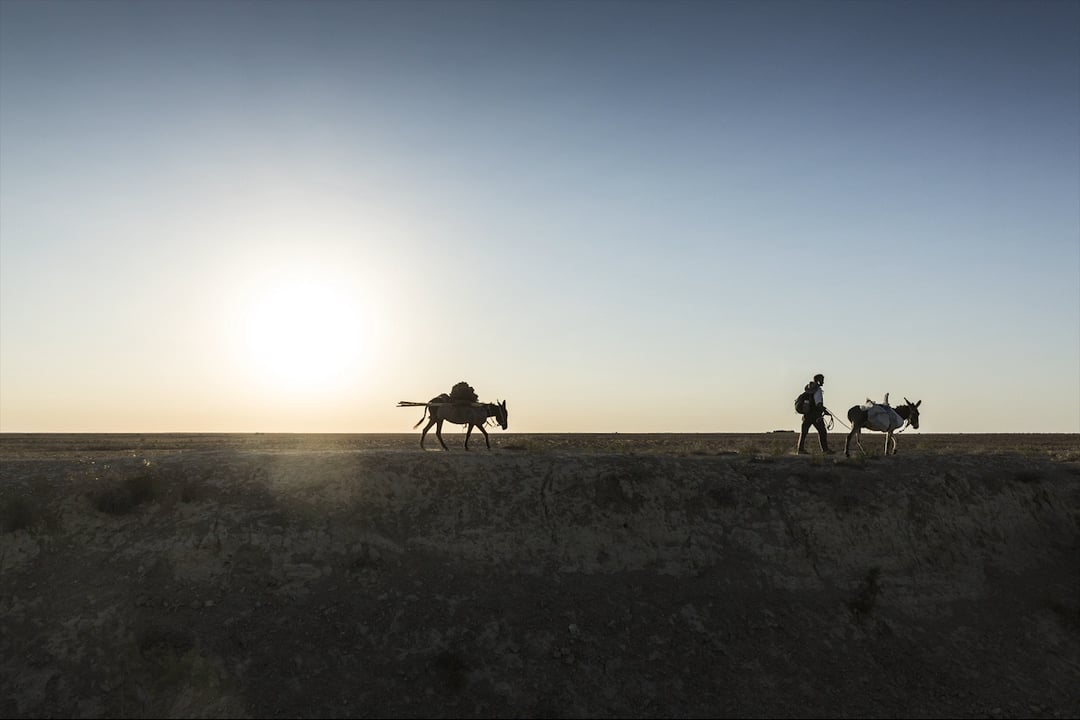
The hole once held our precious supply depot: more than 50 liters of bottled water, buried weeks before along the route of our trek through the Kyzyl Kum—a lunar waste of mineral silences that sprawls across 115,000 square miles of Uzbekistan and Turkmenistan. (What sort of person steals water in a desert? Surely not the chobans, local shepherds, who know the gravity of such a crime. A smuggler? A prankster? A city slicker from Bukhara?) We are walking across Central Asia. We have been on foot in this solar wilderness for eight days. I squint up at the sand horizons. There is no other human being in sight. It is impossible not to think of Arminius Vámbéry:

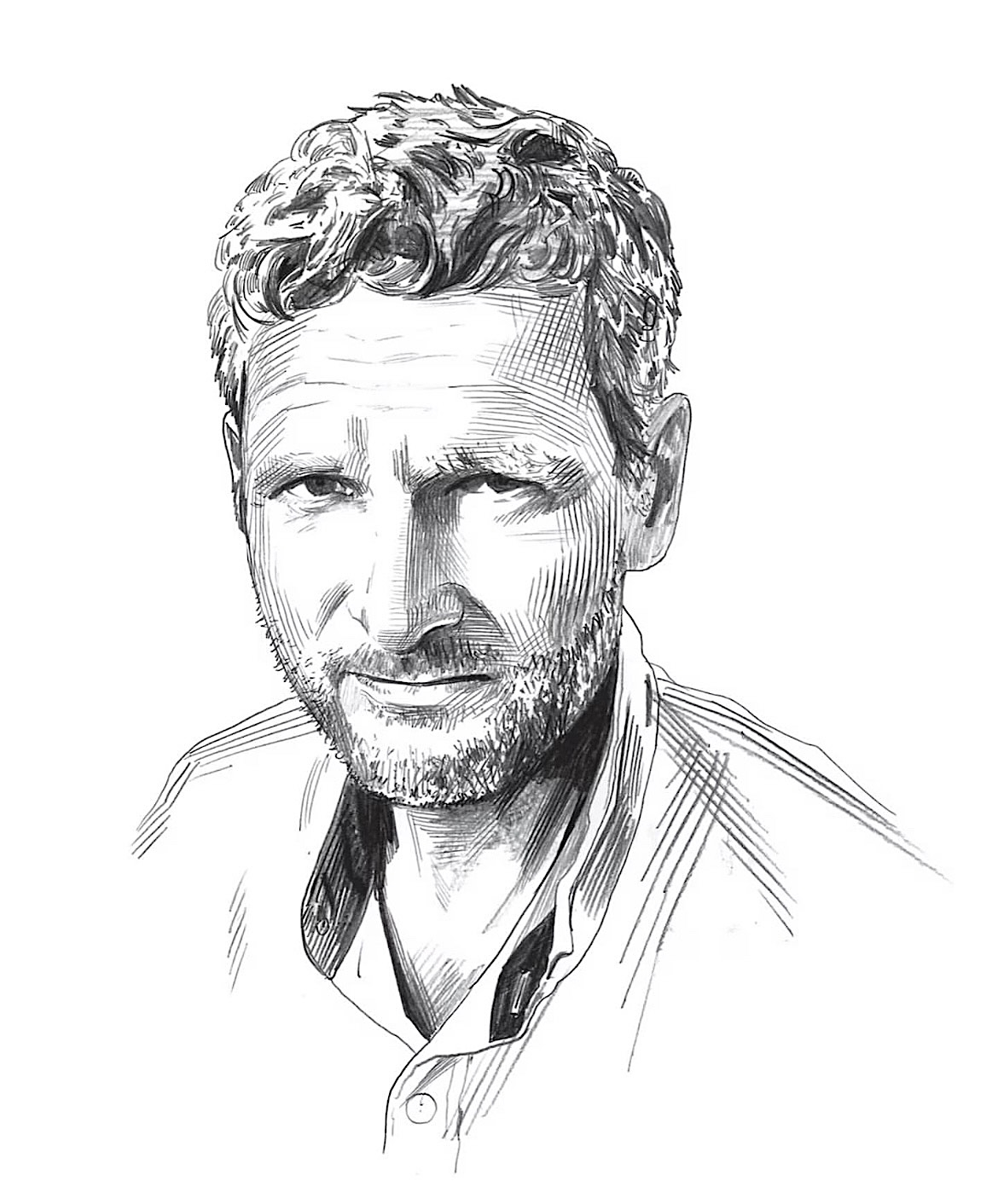
Arminius Vámbéry: portrait in the Bukhara museum
Paul Salopek
“I was no longer able to dismount (from a camel) without assistance; they laid me upon the ground; a fearful fire seemed to burn my entrails; my headache reduced me almost to a state of stupefaction. My pen is too feeble to furnish even a slight sketch of the martyrdom that thirst occasions; I think that no death can be more painful.”
Suddenly I am aware of my sandpaper throat.
The Silk Road has conveyed millennia of travelers to global fame: Alexander the Great, Marco Polo the entrepreneur, and the tireless Muslim chronicler Ibn Battuta, among many others. Yet the world’s greatest feats of exploration are often accomplished anonymously. Hunters, refugees, fishermen, soldiers, traders—these are the wandering souls who first tiptoe beyond the edges of maps. Time erases their names. Accounts of their fantastic journeys, if they even exist, lie in obscure archives or in private attics, reduced to frass by moths, by worms. Such is the case of Arminius Vámbéry.
Born to a poor Jewish family in 19th-century Hungary, Vámbéry was a brilliant and largely self-taught linguist, Turkologist, and amateur ethnologist. He was obsessed with the supposedly “exotic” East. And he was bold to the point of recklessness. Though congenitally lame in one foot, he traveled, destitute, at the age of 20, to Constantinople to study dozens of Ottoman languages and dialects. (He already spoke Hungarian, German, French, English, Latin, Russian, Serbian, and the Scandinavian languages.) After a decade of immersion in Turkish libraries and madrassas, he was versed enough in Koranic scripture to pass himself off as a dervish holy man and join a band of pilgrims returning to Khiva, one of the most forbidding kingdoms of Central Asia.
Arminius Vámbéry: portrait in the Bukhara museum
Paul Salopek
“I was no longer able to dismount (from a camel) without assistance; they laid me upon the ground; a fearful fire seemed to burn my entrails; my headache reduced me almost to a state of stupefaction. My pen is too feeble to furnish even a slight sketch of the martyrdom that thirst occasions; I think that no death can be more painful.”
Suddenly I am aware of my sandpaper throat.
The Silk Road has conveyed millennia of travelers to global fame: Alexander the Great, Marco Polo the entrepreneur, and the tireless Muslim chronicler Ibn Battuta, among many others. Yet the world’s greatest feats of exploration are often accomplished anonymously. Hunters, refugees, fishermen, soldiers, traders—these are the wandering souls who first tiptoe beyond the edges of maps. Time erases their names. Accounts of their fantastic journeys, if they even exist, lie in obscure archives or in private attics, reduced to frass by moths, by worms. Such is the case of Arminius Vámbéry.
Born to a poor Jewish family in 19th-century Hungary, Vámbéry was a brilliant and largely self-taught linguist, Turkologist, and amateur ethnologist. He was obsessed with the supposedly “exotic” East. And he was bold to the point of recklessness. Though congenitally lame in one foot, he traveled, destitute, at the age of 20, to Constantinople to study dozens of Ottoman languages and dialects. (He already spoke Hungarian, German, French, English, Latin, Russian, Serbian, and the Scandinavian languages.) After a decade of immersion in Turkish libraries and madrassas, he was versed enough in Koranic scripture to pass himself off as a dervish holy man and join a band of pilgrims returning to Khiva, one of the most forbidding kingdoms of Central Asia.

“Entry of the Emir into Samarkand,” from Travels in Central Asia, by Arminius Vámbéry
The year: 1863.
At the time much of Central Asia was a perilous destination for foreigners. Closed to the outside world like Tibet, yet far more unstable and violent, the region was controlled by warring Islamic khanates. Its main cities—Khiva, Bukhara, Samarkand, Kokand—were medieval relics, ringed by high walls, enriched by a robust slave trade, and disputed by fundamentalist khans who ruled via the chopping block. Vámbéry was among the first Europeans to traverse this fading remnant of the Silk Road since the adventures of Polo.
“I counted, of course, at first upon meeting with great opposition, and accordingly I was styled a lunatic who wanted to journey to a place from which few who had preceded me had returned,” he wrote, rightly. He was astonishingly cavalier with his life. Dubbing himself Hadji Reshid, he furtively scribbled down everything he saw, hiding his notes into the lining of a ragged coat.
After plodding 450 miles across western Uzbekistan, my walking partners Aziz Khalmuradov, Tolek Bekniyazov, and I first stumbled across the Hungarian’s 150-year-old footsteps in Khiva.

A water cache in the Kyzyl Kum desert. This one was intact—another had been broken into, its contents stolen.
John Stanmeyer
Today the khanate’s old capital is a UNESCO World Heritage site. Tourists from Germany and Malaysia ramble Khiva’s streets with selfie sticks, gaping up at blue-tiled palaces and sampling pilaf. When Vámbéry limped through, its central market was a collection point for the severed heads of the khan’s nomad enemies. (Fine silk coats were paid in exchange for 40 heads.) Vámbéry watched a public executioner gouge out the eyes of captives from a tribe of caravan raiders: “after every operation he wiped his knife, dripping with blood, upon the white beard of the hoary unfortunate.” He skipped town fast.
Vámbéry was a man of his time. He mocked local “superstitions” (while exploiting them as a fake Sufi pilgrim) and complained about the food, overlooking the dazzling economic, artistic, and intellectual legacies that Central Asian civilizations had bequeathed the world. He seemed unaware too that he was witnessing a universe in eclipse.
He rode a donkey through “primeval forests” along the Amu Darya, the main river of Central Asia, feasting on mulberries “as large and as thick as my thumb.” Today that vast riparian forest is all but gone, replaced by thousands of square miles of industrial agriculture. (Uzbekistan is one of the world’s cotton plantations and the fruit basket of Central Asia.)

Modern caravanserai: a tea shop in the Kyzyl Kum
Paul Salopek
He overnighted at fading caravanserais where traveling dervishes, mystics vowed to poverty, lived as blissed-out mendicants: “I found here two half-naked dervishes on the point of swallowing down their noonday dose of opium; they offered me a little portion also, and were astonished to find me decline. They then prepared tea for me, and whilst I drank it, they took their own poisonous opiate, and in half an hour were in the happy realms.”
And he walked through the twilight of independence of remote Muslim kingdoms that would soon collapse before an expanding Russian empire. Within a handful of years of his passage, the khanates would become tsarist colonies, and then, for nearly seven decades, part of the U.S.S.R.
Some things haven’t changed on Vámbéry’s trail.
My government-issued documents of safe passage in Uzbekistan echo the explorer’s laissez-passer extracted from a turbaned khan: “It is notified to the watchers of the frontiers and the toll-collectors, that permission has been given to the Hadji Mollah Abdur Reshid Efendi, and that no one is to trouble him.”
And fording the Amu Darya’s muddy waters with donkeys remains a struggle. Vámbéry’s rugged companions carried their terrified beasts on their shoulders. We coaxed our two reluctant cargo donkeys across modern highway bridges, setting off a bedlam of car horns.
Modern caravanserai: a tea shop in the Kyzyl Kum
Paul Salopek
He overnighted at fading caravanserais where traveling dervishes, mystics vowed to poverty, lived as blissed-out mendicants: “I found here two half-naked dervishes on the point of swallowing down their noonday dose of opium; they offered me a little portion also, and were astonished to find me decline. They then prepared tea for me, and whilst I drank it, they took their own poisonous opiate, and in half an hour were in the happy realms.”
And he walked through the twilight of independence of remote Muslim kingdoms that would soon collapse before an expanding Russian empire. Within a handful of years of his passage, the khanates would become tsarist colonies, and then, for nearly seven decades, part of the U.S.S.R.
Some things haven’t changed on Vámbéry’s trail.
My government-issued documents of safe passage in Uzbekistan echo the explorer’s laissez-passer extracted from a turbaned khan: “It is notified to the watchers of the frontiers and the toll-collectors, that permission has been given to the Hadji Mollah Abdur Reshid Efendi, and that no one is to trouble him.”
And fording the Amu Darya’s muddy waters with donkeys remains a struggle. Vámbéry’s rugged companions carried their terrified beasts on their shoulders. We coaxed our two reluctant cargo donkeys across modern highway bridges, setting off a bedlam of car horns.

Getting over the Oxus River near Khiva calls on some serious mule-ology.
Paul Salopek
The Kyzyl Kum, meanwhile, retains its awesome brutality.
“Not a bird visible in the air, not a worm or beetle upon the earth,” Vámbéry wrote, “traces of nothing but departed life, in the bleaching bones of man or beast that has perished, collected by every passer-by in a heap, to serve to guide the march of future travellers!”
The place nearly killed him. Chased deep into the desert by Turkmen brigands, his caravan ran out of water. The camels foundered. One man died of thirst. Others withheld their canteens from family members. (“It was even comical to see how the slumberers slept, firmly embracing their water vessels.”) The Hungarian’s tongue blackened with thirst. He was saved by shepherds, Persian slaves, who poured sour milk down his throat.
Exhausted by his life of subterfuge (he carried a large Koran slung about his neck on a cord), and worn down by the stress of being discovered as an infidel and outlander, the explorer eventually doubled back to Europe—to the starch of crinolines and frock coats; to a best-selling if now forgotten book, Travels in Central Asia; to the rejection of his linguistic theories by his homeland’s academics; to a circuit of dinners at men’s clubs with aristocracy and literati. It isn’t too surprising that recently declassified documents reveal he was spying for Britain during the Great Game, the stealthy, 19th-century struggle between St. Petersburg and London over control of Central Asia. (His 1913 obituary remembered him as an “Orientalist, traveller, friend of kings, lover of England, and hater of Russia.”) Some Dracula fans think he was the prototype for stubborn Professor Van Helsing, the vampire hunter in Bram Stoker’s classic horror novel.
We face no marauding horsemen in the Kyzyl Kum, my guides and I.
We camp amid an infinity of salt scrub. We gush sweat. We watch our shadows swim across pink sands like steel-blue planarians. We discover our looted water cache. And we are not rescued by human beings in bondage.
Instead, we climb a lonesome dune and call for help on the satellite phone. Water is a beautiful whisper in Uzbek—soo. In the sand at my feet lie shards of pottery. They could be from lost caravans. In the dusk to the east, the electric lights of Bukhara begin to tint the sky.
“Man must keep moving; for, behold, sun, moon, stars, water, beast, bird, fish, all are in movement; it is but the dead and the earth that remain in their place!’” A kazakh nomad woman told Vámbéry that.
The Kyzyl Kum. A redoubt of ghosts.