This must be what I wanted to be doing,
Walking at night between the two deserts,
Singing.
—Air, by W.S. Merwin
We have walked to the Osh border.
What is the Osh border?
It is another tragic Soviet-era experiment in social engineering—a nonsensical boundary gouged jaggedly across the map of Central Asia by a distant and vanished empire. On one side of the barbed-wire fence: the beautiful Fergana Valley of Uzbekistan, with its fallow winter fields of wheat and rice, ancient Silk Road palaces, snow-smeared mountains, and teahouses. On the other: the beautiful Fergana Valley of Kyrgyzstan, with its fallow winter fields of wheat and rice, ancient Silk Road mosques, snow-topped peaks, and teahouses. Not so long ago, the people who had coexisted peacefully for generations along this artificial line burned each other’s houses and shops—they were at each other’s throats.
But today it is not the divide-and-conquer legacy of Stalin’s borders that weighs on my mind. No: It is the nature of friendship.
I must say goodbye to my walking partners from Uzbekistan.
Tolik Bekniyazov: a tall melon seller from faraway Nukus, the desert capital of Karakalpakstan. A man of few words. The strong-handed grandson of pastoral nomads. (Nobody can untie his knots.) He is our indispensable donkey wrangler. (“You can treat a donkey with every kindness but he will still shit on your blanket.”) Bekniyazov carries with him the sweetest smile east of the Caspian Sea.
And Aziz Khalmuradov: a cultured urbanite from Tashkent, capital of Uzbekistan. A cosmopolitan. A lover of Russian novels, good Uzbek cognac, and multilingual conversation. Khalmuradov is a problem-solver, a professional tour guide and logistician. For six months he has walked through the agony of terrible foot blisters to complete what is likely the first foot traverse of his sprawling country in a century. “Keep going,” was Khalmuradov’s refrain. “It hurts when I stop.”
At the border, under a cold gray winter sky, we complete our last chore together.

New walking partner Sergei Gnezdilov on the highway eastward toward China. Osh, Kyrgyzstan.
Paul Salopek
Khalmuradov, Bekniyazov, and I unpack the cargo bags—for the thousandth time—from our donkeys, Haram and Mouse. (These two brave animal spirits will soon retire to a nearby farm.) Truckers idled by customs paperwork gather around us to stare, to joke. We ignore them. There is a strange delicacy among us three. We are oddly formal with each other. It is because we are miserable. Six months ago these men were total strangers to me. I couldn’t even pronounce their surnames. But after pacing off 1,500 miles of Uzbek steppes, deserts, steamy riverbanks, and snowy mountains together—sometimes shouting at each other in arguments, but more often doubled over with laughter—we are dear friends. Without hesitation I place my life in their palms.
Bekniyazov pops my knuckles with a goodbye handshake. He must stay beside the road with the animals. He raises an arm in silent farewell. A sentinel gesture. Khalmuradov walks me through the last gauntlet: the row of scowling immigration officers locked inside their glass sarcophagi.
I am reminded of many things on crossing borders.
Today, while navigating this 13th political frontier of my global walk, two distant encounters come to mind.
The first, many winters ago, occurred in newly democratic South Africa. An acquaintance named Willem, a burly and bearded Afrikaner, a settler of Dutch descent whose ancestors invented apartheid, was sitting under a mopane tree, explaining why he still longed for the days of racial separation and white supremacy. “I wish to live only among my own kind of people,” he said, unhappily. “Why is this such a sin?”
The second meeting took place years later and a hemisphere away, inside the Field Museum of Natural History, in Chicago. John Terrell, an anthropologist on staff, peered at me across a cluttered desk and asked, pointedly, as if expecting a challenge, “Do you believe people are basically good?”
Terrell had spent years investigating a human mystery: the capacity for kindness among unrelated strangers. Cave paintings, folk songs, and thousands of novels and movies all have celebrated the intimate links of family. Even religion mimics a proxy family relationship: the Father in the sky, or Mother Earth. But what of “mere” friendship?
Eventually Terrell published a book, “A Talent for Friendship: The Rediscovery of a Remarkable Trait.” His thesis: The social glue of friendship can be as powerful a force in determining human survival and success as the more obvious “biological” bonds of ethnicity, clan, family, blood.
Terrell’s work challenges the popular view of humankind as a hairy brute in a business suit, a bleak assessment summarized by the famed sociobiologist E.O. Wilson: “Our bloody nature, it can now be argued in the context of modern biology, is ingrained because group-versus-group was a principal driving force that made us what we are … Each tribe knew with justification that if it was not armed and ready, its very existence was imperiled.”
Terrell’s own research in the South Pacific, however, pointed to a different conclusion: “Our evolved ability, our psychological and biological capacity, to make friends even with strangers is a defining characteristic of our species.”
Terrell studied the coastal people of northern Papua New Guinea—half of a gargantuan island that also is sliced by another irrational border—a land of atomized tribes and nearly a thousand languages. The Papuans sometimes warred with each other. But just as often they cultivated sprawling and complicated cross-cultural networks of friendships.
“Almost as astonishing, at Kep yet farther east and nearer to the mouth of the Sepik River,” Terrell writes of one of his sources, “another person interviewed had friendships in 28 communities spread out over 86 miles where 10 different languages other than his are spoken.”
What recommends such unlikely bonds—meaningful human connections that radiate over the boundaries of personal identity?
Mutual support. Sharing resources in hard times. Safe passage. Hospitality. Self defense. And not least: the more intangible benefits of joy. The Papuans derived pleasure from giving and receiving small gifts such as homemade pots. Asking for payment was unthinkable. Parents passed their vast networks of friendship down to their children.
To the query, “What is a friend?” Aristotle’s famous reply was, “A single soul dwelling in two bodies.”
I have walked through many wars. Now, I stride to the dirty band of paint on asphalt that marks the end of Uzbekistan.
“You had better ask for your phone back,” Khalmuradov advises me drily, after an Uzbek border guard, wearing the crocodilian smile of a bogus friend, asks to see the “vacation photos” on my mobile phone. (Who is the most friendless human being on Earth? The intelligence officer, of course.)
From behind a chain-link fence, Khalmuradov watches me step into Kyrgyzstan. I walk 30 or 40 yards. I glance back over my shoulder. He is still watching.
New walking partner Sergei Gnezdilov on the highway eastward toward China. Osh, Kyrgyzstan.
Paul Salopek
Khalmuradov, Bekniyazov, and I unpack the cargo bags—for the thousandth time—from our donkeys, Haram and Mouse. (These two brave animal spirits will soon retire to a nearby farm.) Truckers idled by customs paperwork gather around us to stare, to joke. We ignore them. There is a strange delicacy among us three. We are oddly formal with each other. It is because we are miserable. Six months ago these men were total strangers to me. I couldn’t even pronounce their surnames. But after pacing off 1,500 miles of Uzbek steppes, deserts, steamy riverbanks, and snowy mountains together—sometimes shouting at each other in arguments, but more often doubled over with laughter—we are dear friends. Without hesitation I place my life in their palms.
Bekniyazov pops my knuckles with a goodbye handshake. He must stay beside the road with the animals. He raises an arm in silent farewell. A sentinel gesture. Khalmuradov walks me through the last gauntlet: the row of scowling immigration officers locked inside their glass sarcophagi.
I am reminded of many things on crossing borders.
Today, while navigating this 13th political frontier of my global walk, two distant encounters come to mind.
The first, many winters ago, occurred in newly democratic South Africa. An acquaintance named Willem, a burly and bearded Afrikaner, a settler of Dutch descent whose ancestors invented apartheid, was sitting under a mopane tree, explaining why he still longed for the days of racial separation and white supremacy. “I wish to live only among my own kind of people,” he said, unhappily. “Why is this such a sin?”
The second meeting took place years later and a hemisphere away, inside the Field Museum of Natural History, in Chicago. John Terrell, an anthropologist on staff, peered at me across a cluttered desk and asked, pointedly, as if expecting a challenge, “Do you believe people are basically good?”
Terrell had spent years investigating a human mystery: the capacity for kindness among unrelated strangers. Cave paintings, folk songs, and thousands of novels and movies all have celebrated the intimate links of family. Even religion mimics a proxy family relationship: the Father in the sky, or Mother Earth. But what of “mere” friendship?
Eventually Terrell published a book, “A Talent for Friendship: The Rediscovery of a Remarkable Trait.” His thesis: The social glue of friendship can be as powerful a force in determining human survival and success as the more obvious “biological” bonds of ethnicity, clan, family, blood.
Terrell’s work challenges the popular view of humankind as a hairy brute in a business suit, a bleak assessment summarized by the famed sociobiologist E.O. Wilson: “Our bloody nature, it can now be argued in the context of modern biology, is ingrained because group-versus-group was a principal driving force that made us what we are … Each tribe knew with justification that if it was not armed and ready, its very existence was imperiled.”
Terrell’s own research in the South Pacific, however, pointed to a different conclusion: “Our evolved ability, our psychological and biological capacity, to make friends even with strangers is a defining characteristic of our species.”
Terrell studied the coastal people of northern Papua New Guinea—half of a gargantuan island that also is sliced by another irrational border—a land of atomized tribes and nearly a thousand languages. The Papuans sometimes warred with each other. But just as often they cultivated sprawling and complicated cross-cultural networks of friendships.
“Almost as astonishing, at Kep yet farther east and nearer to the mouth of the Sepik River,” Terrell writes of one of his sources, “another person interviewed had friendships in 28 communities spread out over 86 miles where 10 different languages other than his are spoken.”
What recommends such unlikely bonds—meaningful human connections that radiate over the boundaries of personal identity?
Mutual support. Sharing resources in hard times. Safe passage. Hospitality. Self defense. And not least: the more intangible benefits of joy. The Papuans derived pleasure from giving and receiving small gifts such as homemade pots. Asking for payment was unthinkable. Parents passed their vast networks of friendship down to their children.
To the query, “What is a friend?” Aristotle’s famous reply was, “A single soul dwelling in two bodies.”
I have walked through many wars. Now, I stride to the dirty band of paint on asphalt that marks the end of Uzbekistan.
“You had better ask for your phone back,” Khalmuradov advises me drily, after an Uzbek border guard, wearing the crocodilian smile of a bogus friend, asks to see the “vacation photos” on my mobile phone. (Who is the most friendless human being on Earth? The intelligence officer, of course.)
From behind a chain-link fence, Khalmuradov watches me step into Kyrgyzstan. I walk 30 or 40 yards. I glance back over my shoulder. He is still watching.

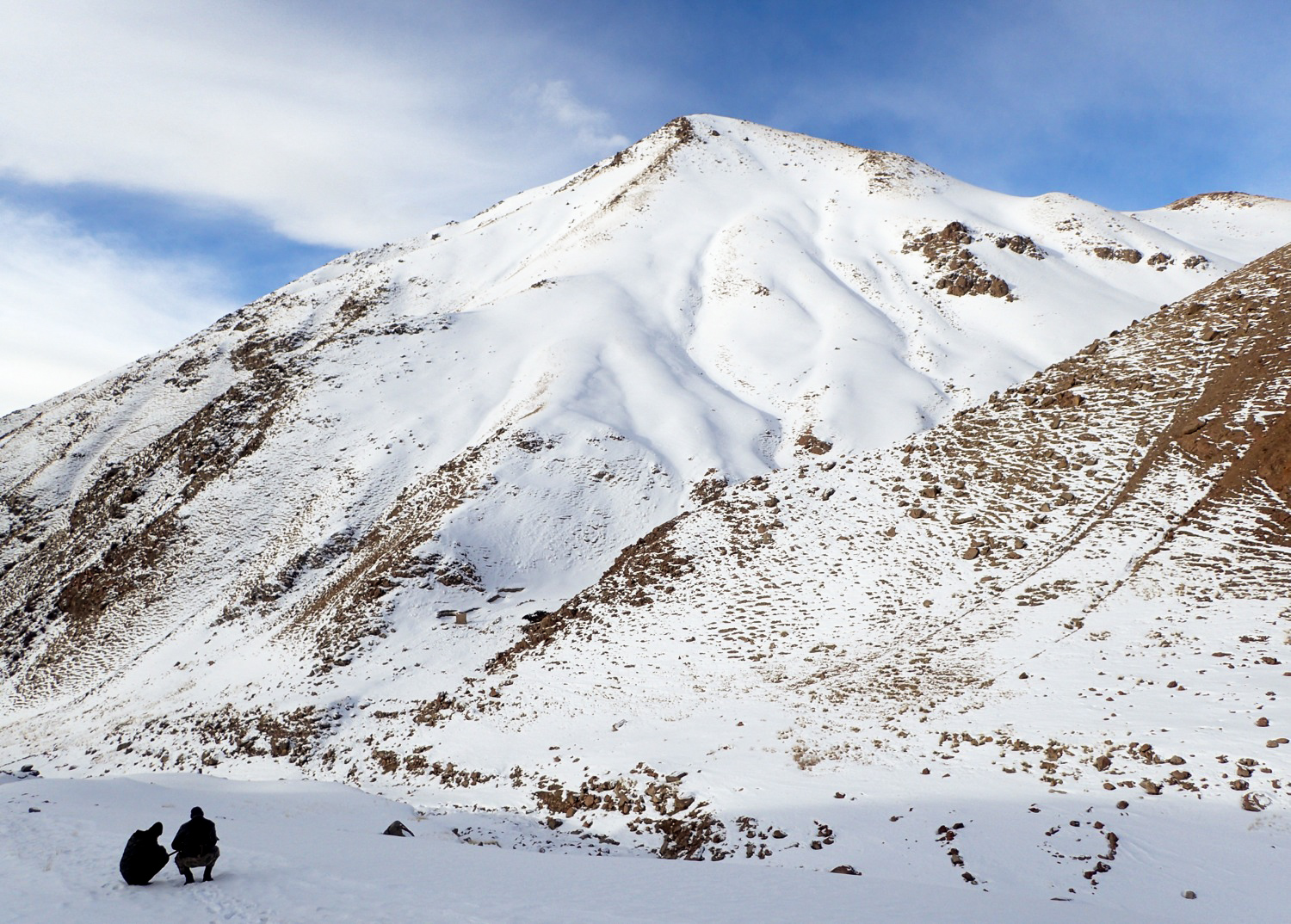
Gnezdilov on the trail’s temporary end in Kyrgyzstan—till springtime, when the mountain snows melt, and the trek resumes.
Paul Salopek
On a snow-wetted curb ahead stands a tall young man. I do not know him. But he flicks away a half-smoked cigarette as I approach. He offers a wry smile. My latest guide on a ramble across the planet.
“Hello,” I say, extending my hand. “You must be Sergei.”
I mispronounce his surname. I know it doesn’t matter.