After the long letters
have been written, read,
abandoned, after
distances grow absolute
and speech, too,
is distance, only
listening is left.
I have heard the dark hearts
of the stones
that beat once in a lifetime.
—William Pitt Root (In Winter Count, by Barry Lopez)
The drawings represent—what? A question? A plea? Perhaps a prayer?
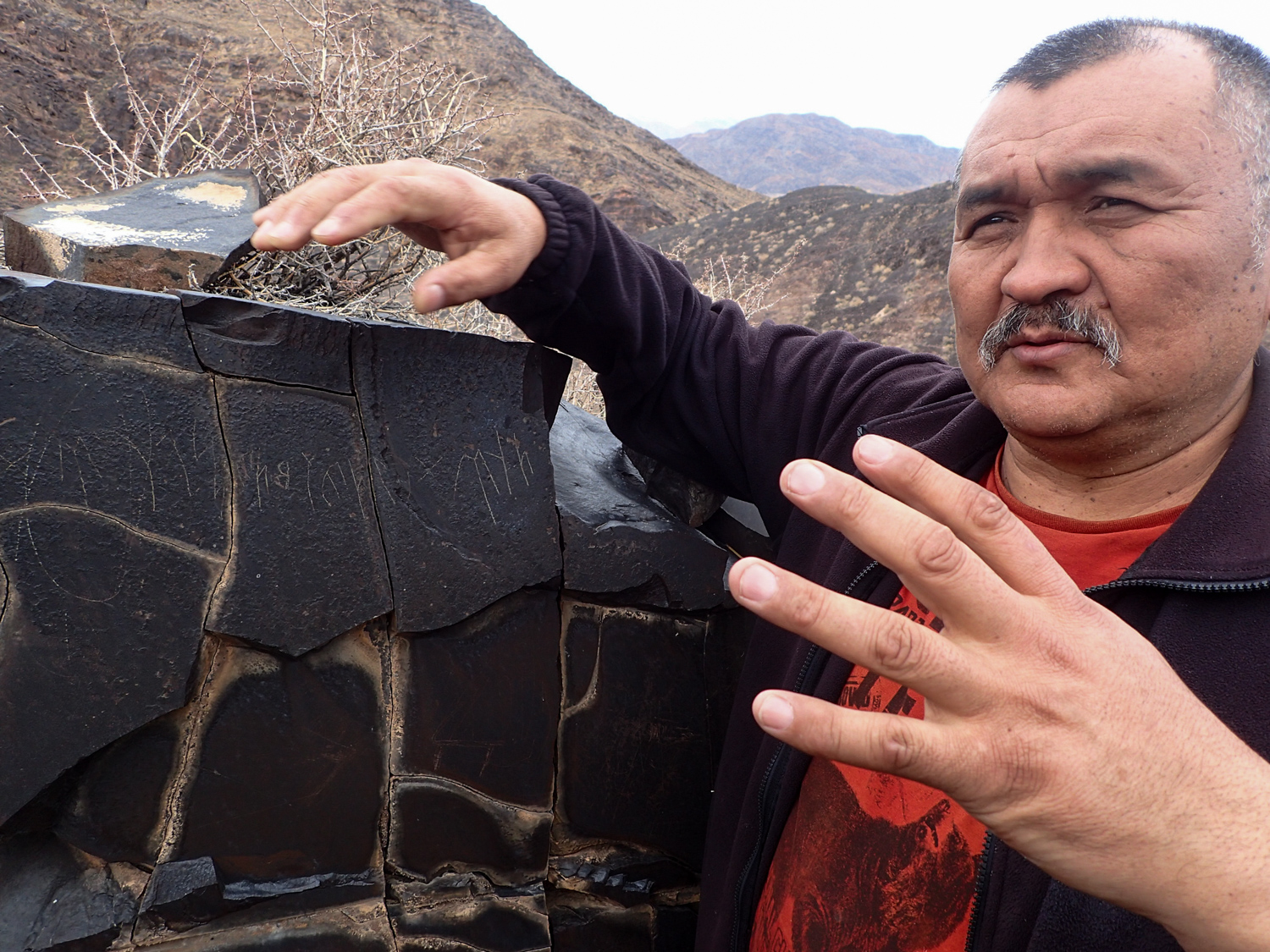
It is impossible to say. The figures carved, chipped, and rubbed into the large boulders of Cholpon Ata, a petroglyph site in far northern Kyrgyzstan, are silent. Indeed, they are steeped in such stillness that visitors whisper as they walk among them. The images are like a challenge shouted from a mountaintop—after the echo has died. They seem to await some kind of reply. They have been waiting like this for a very long time.
The etchings cover more than a hundred acres of stones. They mostly depict animals. Argali sheep (also called Marco Polo sheep). Camels. Horses. Wolves. Wild boars. Various birds. But human figures appear too. Many carry bows and arrows. There are hundreds of them, each incubating the power of a kept secret, on a glacial moraine that was deposited, pell-mell, along the shores of Issyk Kul.
Issyk Kul: A slate-blue lake—an unblinking eye that stares up at the white Central Asian sky for all eternity. A landmark. An age-old crossroads of migration, of trade. Today people from across the world come here to trek the surrounding canyons and peaks. Not so long ago, Issyk Kul was a workers’ resort under the U.S.S.R. (The first human in space, Yuri Gargarin, was rewarded with a vacation here, and Soviet leader Leonid Brezhnev used an Issyk Kul dacha, or forest cabin, as a base from which to hunt bears.) Centuries before, the lake provided a rest stop on the Silk Road. And at the beginning of its human history, when the rocks were first marked, its shore was a sacred art gallery.
Video by Paul Salopek and Sergei Gnezdilov
The oldest of the drawings date back 3,500 years, to the Bronze Age mound builders. But a newer people, the Saka-Usun, made most of the images much later, over the thousand years spanning the ninth century B.C. to the first century A.D. Ancient Greeks knew the Saka-Usun as the Scythians: aggressive cattle drovers who battled Alexander, nomads who trundled about the vast grassy heart of Eurasia on carts, living in folding tents, conquering rich pasturelands from saddleback. Expert archers, their women fought as hard as the men. (The legend of the Amazons is believed to be rooted in lost memories of Scythian encounters.) The rocks of Cholpon Ata hold their sun god symbols.
The most extraordinary of the site’s drawings are likely its most recent. One large boulder exhibits a masterpiece, a tableau from a vanished world: hunters stalking ibex with the help of tamed snow leopards.
I place my transient palm on the wind-burnished surface of this ancient moment. It is between 1,500 and 1,000 years old. I try to capture its facsimile with a digital camera—a tool whose only record, electronic valences of zeros and ones, won’t last even 20 years, much less 20 centuries.
We are the ghosts.