After pacing off 6,000 miles of trail out of Africa since 2013, the Out of Eden Walk journey continues. The new compass bearing: across the highest mountains on Earth. The western Himalayas.
From the ancient trading city of Osh, Kyrgyzstan, I look back on 1,500 miles of walked Central Asia. Those days already have the sepia quality of a waking dream.
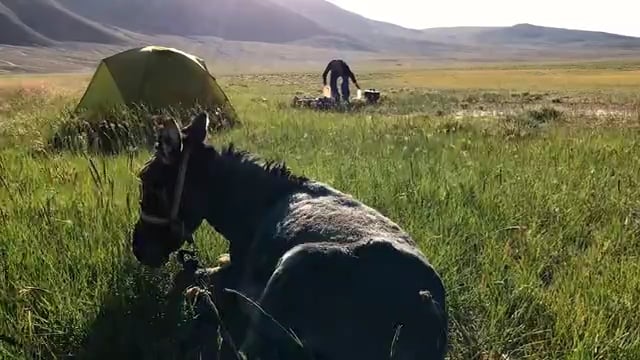
Beckoning horizon: a summer grassland at the foot of the Alai Mountains.
Video by Paul Salopek
Fourteen months ago, on the vast prairies of western Kazakhstan: Three men—my guides Talgat Omarov and Daulet Begendikov, and I—pogoed in circles around our frightened cargo horse, waving our hats to fend off attacks by fierce wild stallions. (From above, I imagine a passing satellite capturing this silent, lunatic, pagan dance: Three dots revolving in a vast ocean of grass.) Ten months ago, in the middle of the Kyzl Kum desert of Uzbekistan: Swaying thirstily atop a red sand hill, I summoned help with a satellite phone; someone had looted our precious water cache. (At my boot tips lay ancient shards of broken water vessels, the relics of some other ill-starred Silk Road caravan.) Seven months ago: A strong-handed sorceress outside the cemetery gates in old Kokand rubbed cotton ash across my chest, banishing every imaginary ailment but the real one, loneliness.
And now, following a long hiatus in Kyrgyzstan—abandoning the writer’s desk, and the harsh right angles of city life, with its sharp corners, its unnatural edges, its urban geometry that dents the mind—I re-lace my boots. I squint southeast.
The paths ahead cross the wild roof of Asia.

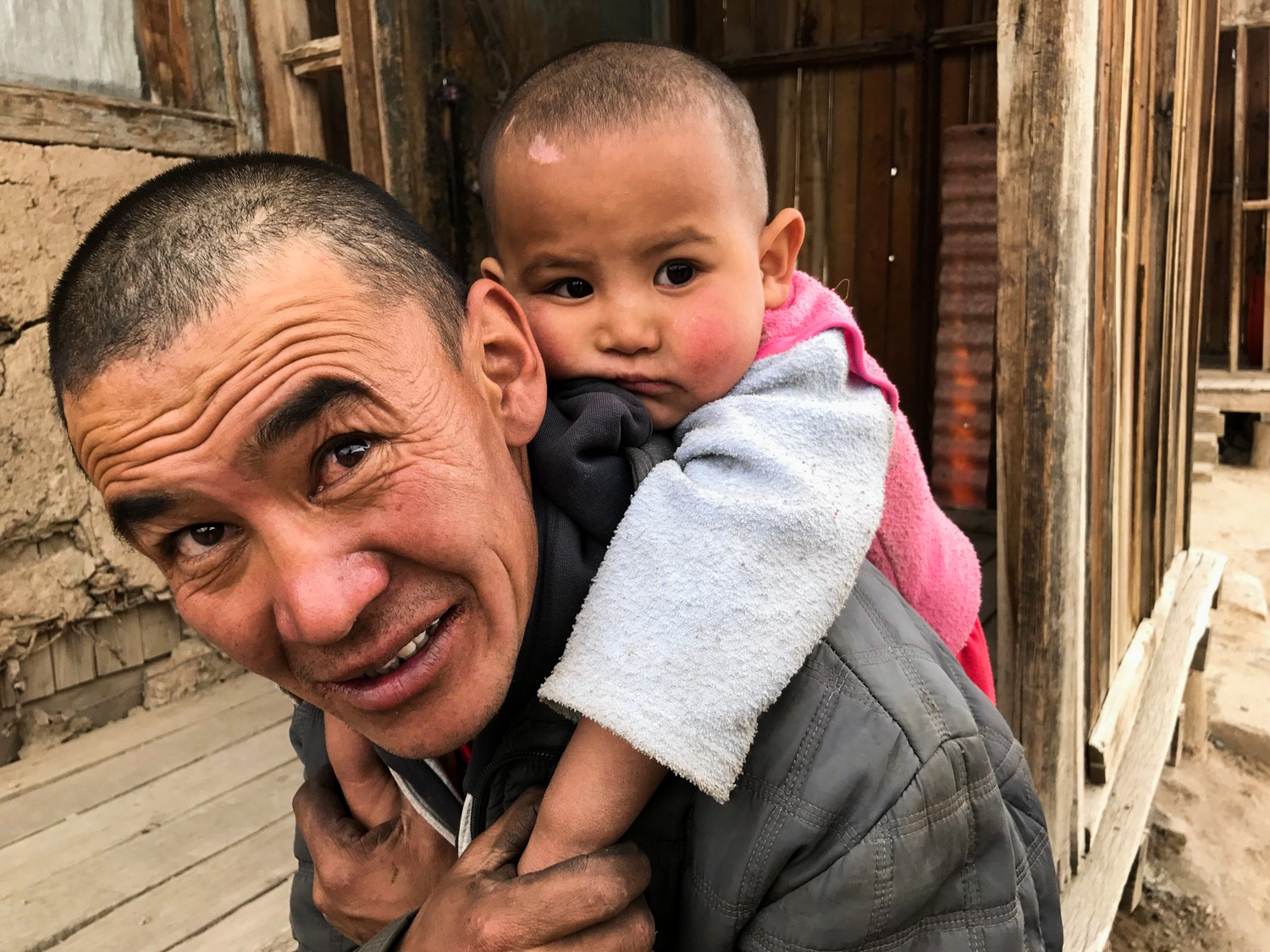
New world: A shepherd’s handmade toys for his son are cars, not horses.
Paul Salopek
The Tian Shan. The Pamirs. The Hindu Kush. The Karakoram. These ranges send their gushing rivers down to die in the barrens of western China, where Marco Polo recorded jinn—genies—who lured travelers to doom in the Lop desert. Their snows melt into the Amu Darya, the fabled Oxus River, crossed by Alexander on rafts made of his army’s inflated tent skins. I will trek the long mountain crest that forms a jagged cardiogram across the heart of a continent. To Tajikistan. To the remote Wakhan. To Pakistan. To India.
But there is a startling obstacle: a donkey shortage.
“Cargo donkeys are hard to find,” my walking partner, Sergei Gnezdilov, reports after looking for an animal near our starting city of Osh. “The farmers say they sold them all to Chinese road-building crews to eat.”
But this garbled rumor hides a deeper, more complex and troubling story.
The donkey shortage in southern Kyrgyzstan appears to be merely a small part of an obscure but booming global trade of these humble beasts of burden. Chinese alternative medicine and cosmetic dealers have been buying up burros across the developing world to harvest the pelts for a gelatin product called ejiao, purportedly a remedy for insomnia and anemia, among other ailments.
We search for donkeys all morning, Gnezdilov and I. We must finally drive 55 miles into the mountains to find one. Our rescued long-eared companion is 15 years old. He bites when being saddled. We call him Ginger. A more accurate name would be: The Slowest Donkey in Central Asia and Perhaps the World.
Joined by my brother Richard and a few local friends, we yo-yo up the mountains.

Paul Salopek's brother Richard coaxes The Slowest Donkey in Central Asia and Maybe the World toward the Alai Mountains.
Paul Salopek
People are out dragging large musical instruments with tractors across the pleated hills of grass—mechanisms they insist are haying rakes but whose tines ring out iron concertos.
We retire The Slowest Donkey in Central Asia and Perhaps the World and hire horsemen to help us carry our equipment across the Alai sub-range and to the Tajik border. These two men—Eshembay Joldoshbaev and Kudayar Nurmamatov—look like knights of the Golden Hoard. Their horses are named Mike Tyson and Jackie Chan.
We crest Jiptik Pass—scraping 13, 600 feet—to see the Pamirs unfold ahead in champagne light: serried peaks, snowcapped, swirled in clouds, rippling southward in echelon, looking like a storm-raged sea. A frozen Tethys Sea. The ocean that once covered all of Central Asia in the Cretaceous.
Dizzy with altitude, I look down at another man’s shoes.
And so it begins. I forgot my boots in Osh.