“Color is the place where our brain and the universe meet.”
—Paul Klee
Can color intoxicate? Is it possible to become drunk on light?
Once in the Arctic I awoke after a blizzard to a vast plain of cloudlike snow. The Earth looked as vaporous, as insubstantial, as gas. The actual clouds above seemed far denser, more solid—a Himalaya of rumpled white peaks, ridges, canyons, valleys. I felt giddy: like I was walking upside down, my feet planted in the sky, looking up at the surface of the material world. Light bewitches like this. In Umbria. In New Mexico. In the Congo rain forests. These are places famous for their luminosity. But none holds a photon to the Wakhan Corridor of Afghanistan.
Black
The gray cargo donkey is named Khayr Barakat—meaning goodness, welfare, happiness—or Blessing. The charcoal donkey is called Shar Barakat—meaning wickedness, depravity—or Curse. Shar bites Khayr. Shar chases every other donkey in the Hindu Kush. Shar brays like a foghorn a hundred times a day: announcing us to every Wakhi farm, to each nomad camp, to all the golden mountains of Afghanistan, to the universe. I am walking across the world. Camels, horses, mules, donkeys—great animal spirits—have made my long journey possible. Shar and Khayr eat hard cakes of pitok bread out of my hand. At a camp near 16,000-foot Irshad Pass, a lonesome, wind-sawed gateway to Pakistan, the first winter storm freezes my clothes inside my tent. I unzip the tent door a crack: Shar and Khayr stand in the white night, blurred by snow, lashed by gusts. I crawl out into the gale. I try to wrap the donkeys with flapping tarps. Shar’s eyes: two holes cut into the fabric of the world, blacker than black, sucking in all light, revealing nothing.
I never saw a wild thing / sorry for itself. / A small bird will drop frozen dead from a bough / without ever having felt sorry for itself.
Dying Lawrence wrote this.

Shar Barakat (left); Khayr Barakat (right).
Paul Salopek
Green
The old man’s eyes are bright amber-green. The vanished Tethys Sea must have shone so.
Such irises could have migrated into the Wakhan from anywhere. Rarely visited by outsiders today, Afghanistan’s remotest corner has been a travelers’ crossroads for millennia: a high, cold alpine door between the oasis city-states of western China and the lush pomegranate groves of Badakhshan. Alexander the Great’s generals supposedly planted their DNA in the Wakhan some 2,300 years ago. (The Tajiks claim the conqueror’s wife, Roxanne.) Kujula Kadphises, the Great Kushan, conquered the Wakhan in the first century A.D., leaving behind stone fortresses that stand brokenly today. The Buddhist pilgrim Xuangzan walked through in 644 A.D. He reported dragons swimming in Lake Zor Kul. Marco Polo admired the region’s Balas rubies. When the spies and rival explorers Colonel Yanov and Captain Younghusband met by accident in the desolation of the Wakhan in 1891, they shared a feast of venison and vodka and took turns toasting, in French, Queen Victoria and the Tsar of Russia. (Their governments were circling toward war.)

Villagers head to a reforestation project.
Paul Salopek
Buffered from the Taliban’s violence by ramparts of 20,000-foot peaks, the Wakhan today is an older, foot-worn, peaceful, light-struck Afghanistan.
Its people, moderate Ismaili Shiites mostly, don’t shoulder Kalashnikov rifles in the mornings but spades to repair irrigation canals. Men dig holes not to plant improvised explosive devices but to lay traps for satellite-collaring of rare snow leopards. Women veil themselves not in purdah but to protect themselves from the smoke of their clay bread ovens.
The old man’s name is Khalifa Beg Ali. He lives in the stonewalled hamlet of Ouzed. He marvels at the greening of the rocky Wakhan from reforestation projects and climate change. He mocks the frailty of the youngsters who eat new store-bought foods and complain about the pains of farm work.
“The world is getting younger,” Ali says, cackling. “And the people are getting older.”
Yellow
The high autumn pastures of the Wakhan glow aching yellow.
Umber yellow. Pantone. Gold yellow. Orange yellow. Canary. Across this fire-colored canvas of drying alpine grasses, of dying edelweiss, stretch deep parallel scars of mud: 37-year-old tank tracks left by the invading Soviets.
Villagers head to a reforestation project.
Paul Salopek
Buffered from the Taliban’s violence by ramparts of 20,000-foot peaks, the Wakhan today is an older, foot-worn, peaceful, light-struck Afghanistan.
Its people, moderate Ismaili Shiites mostly, don’t shoulder Kalashnikov rifles in the mornings but spades to repair irrigation canals. Men dig holes not to plant improvised explosive devices but to lay traps for satellite-collaring of rare snow leopards. Women veil themselves not in purdah but to protect themselves from the smoke of their clay bread ovens.
The old man’s name is Khalifa Beg Ali. He lives in the stonewalled hamlet of Ouzed. He marvels at the greening of the rocky Wakhan from reforestation projects and climate change. He mocks the frailty of the youngsters who eat new store-bought foods and complain about the pains of farm work.
“The world is getting younger,” Ali says, cackling. “And the people are getting older.”
Yellow
The high autumn pastures of the Wakhan glow aching yellow.
Umber yellow. Pantone. Gold yellow. Orange yellow. Canary. Across this fire-colored canvas of drying alpine grasses, of dying edelweiss, stretch deep parallel scars of mud: 37-year-old tank tracks left by the invading Soviets.

Golden afternoons in the Wakhan.
Paul Salopek
Yellow is the color of change, of transition, of deceleration. And not just seasons:
The bony fingers of the Wakhi shepherd who, smiling, massages my frozen feet inside a yurt at a sheep camp are smudged a dark, ashy yellow from opium. Jars of the drug are traded up from Badakhshan. The local herders lose their animals, their lands, to the narcotic. Some Kyrgyz nomads in the Little Pamirs blow the smoke into their babies’ faces. It helps ease the cold and hunger of long winter nights in the Wakhan. The true addicts aren’t seeking relief from such discomforts. They crave the transience—the narrowing yellow phase—of the thing itself: opium.
Red

White: up to Irshad Pass.
Paul Salopek
Borges wrote, “I saw a sunset in Queretaro that seemed to reflect the color of a rose in Bengal.”
High on the icy approaches to Irshad Pass, on cliff-side paths carved by the hooves of yak caravans, I stare at small bursts of red on the rock faces.
I recall a similar puff of vermilion almost 16 years ago in a village called Rabat, on the Shomali Plain outside of Kabul. Solangi troops were advancing on Taliban positions. A soldier looting a house stepped on an antipersonnel mine planted at the door’s threshold. He lost both feet in a popping circular bloom of crimson. We helped carry him part of the way back through the lines, but I doubt he made it. Many Solangis went into battle holding hands firmly, the way people falling from buildings do.
The round red clots on the Wakhan trails are wild rhubarb. Up close, the big umbrella-like leaves shine like pools of copper.
Electrum
A trickle of people still crosses the wild mountain frontier from Afghanistan to northern Pakistan.
Most are Wakhi and Kyrgyz herders. Ignoring borders, they climb passes such as Irshad to exchange the fattest yaks in the world for sacks of rice, clothing, solar panels, even small motorbikes—all strapped to the backs of their returning cargo yaks.
The photographer Matthieu Paley and I summit Irshad in electrum light: a thin, alloyed light, so delicate and yet so hard. It falls like silk on my skin. I breathe this pure light in—it cuts into my heart like razor blades.
White: up to Irshad Pass.
Paul Salopek
Borges wrote, “I saw a sunset in Queretaro that seemed to reflect the color of a rose in Bengal.”
High on the icy approaches to Irshad Pass, on cliff-side paths carved by the hooves of yak caravans, I stare at small bursts of red on the rock faces.
I recall a similar puff of vermilion almost 16 years ago in a village called Rabat, on the Shomali Plain outside of Kabul. Solangi troops were advancing on Taliban positions. A soldier looting a house stepped on an antipersonnel mine planted at the door’s threshold. He lost both feet in a popping circular bloom of crimson. We helped carry him part of the way back through the lines, but I doubt he made it. Many Solangis went into battle holding hands firmly, the way people falling from buildings do.
The round red clots on the Wakhan trails are wild rhubarb. Up close, the big umbrella-like leaves shine like pools of copper.
Electrum
A trickle of people still crosses the wild mountain frontier from Afghanistan to northern Pakistan.
Most are Wakhi and Kyrgyz herders. Ignoring borders, they climb passes such as Irshad to exchange the fattest yaks in the world for sacks of rice, clothing, solar panels, even small motorbikes—all strapped to the backs of their returning cargo yaks.
The photographer Matthieu Paley and I summit Irshad in electrum light: a thin, alloyed light, so delicate and yet so hard. It falls like silk on my skin. I breathe this pure light in—it cuts into my heart like razor blades.

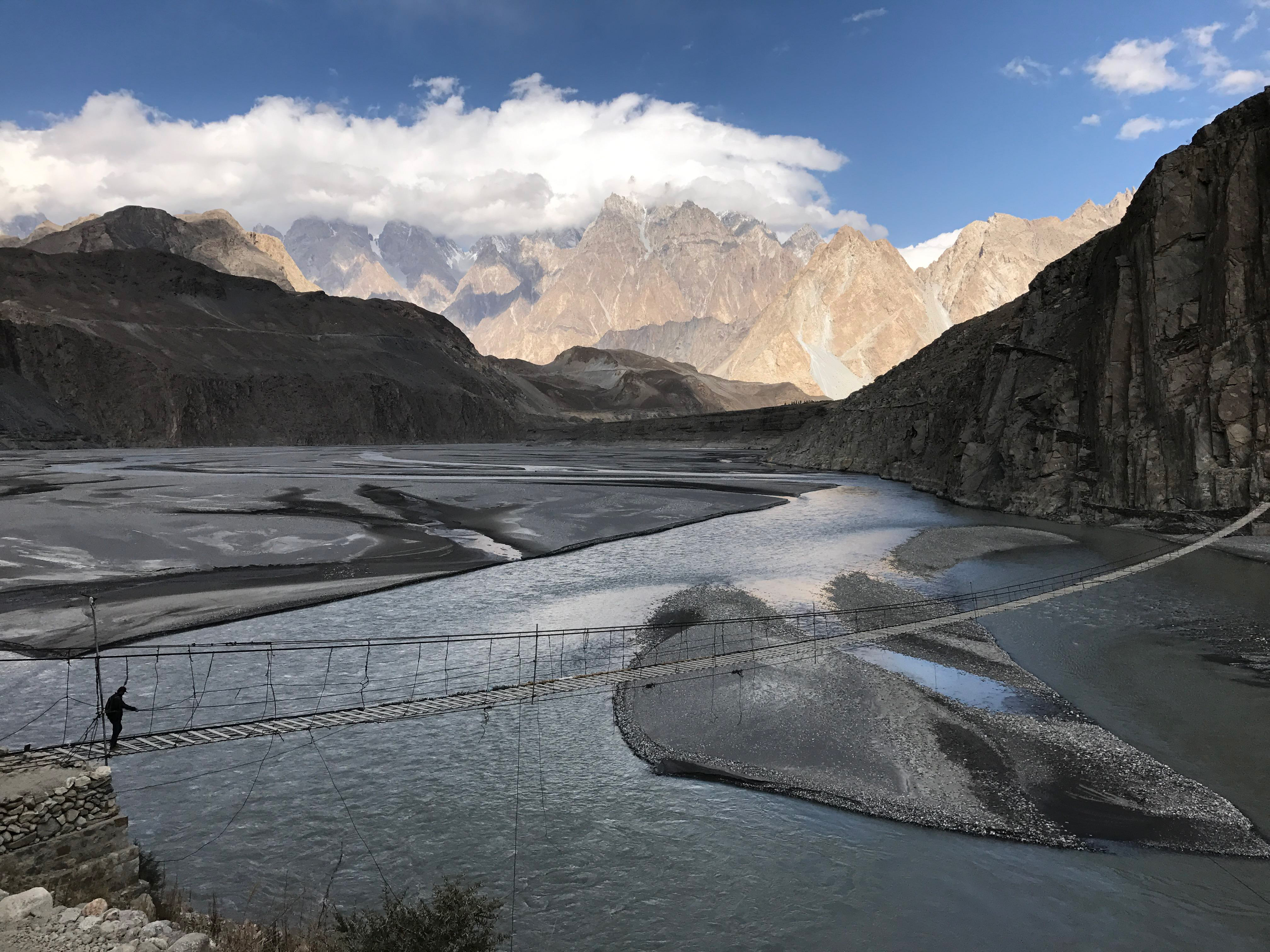
Irshad Pass—the electrum frontier between Afghanistan and Pakistan.
Paul Salopek
There are landscapes you feel you have been walking to your entire life and you only realize it after you leave. The Wakhan Corridor is one of these places. It is a country of light.
When we descend to the Pakistani base camp, security forces will be waiting. There will be some problem with our paperwork. We will be asked, with more politesse than a Pakistani caught entering my country with confusing documents ever would be, to leave Pakistan and reenter again through the capital, Islamabad. I will do this by jetting to Abu Dhabi and back—my first international flight in nearly five years of walking the world. I will land in that sweltering Arabian city still wearing snow pants and a parka mud-stained from a snowy mountain pass in the Hindu Kush. And I will remember, standing before an immigration booth under clinical white sheets of airport lighting, the radiant nimbus of silver and gold that I moved through atop Irshad. It is the sort of light through which you walk into new country with your people.