“Listen, O lord of the meeting rivers, things standing shall fall, but the moving ever shall stay.”
― Devotional poems of the Basavanna.
When Pakistan and India won independence in 1947, carving the old British Raj into two rival states, one predominantly Muslim and the other mostly Hindu, the ferocity of the split uprooted nearly 15 million people and left hundreds of thousands dead.
Much else besides was torn apart.
Colonial army units fissured along communal lines. Shared history was divided up, bead by bead, in museum artifact collections. Other public assets—locomotives, gold reserves, the musical instruments of the Lahore police department band—were grudgingly portioned out. (A fistfight erupted over who acquired the trombone.) Even mental hospital patients were swapped across a newly created frontier. “Two or three years after Partition, the governments of Pakistan and India decided to exchange lunatics in the same way that they had exchanged civilian prisoners,” the writer Saadat Hasan Manto begins his caustic short story Toba Tek Singh about the bitter Indo-Pakistani divorce. “I can't say whether this decision made sense or not. In any event, a date for the lunatic exchange was fixed after high level conferences on both sides of the border.”
In this way the mighty 2,200-mile-long Indus River too got sawed in half.

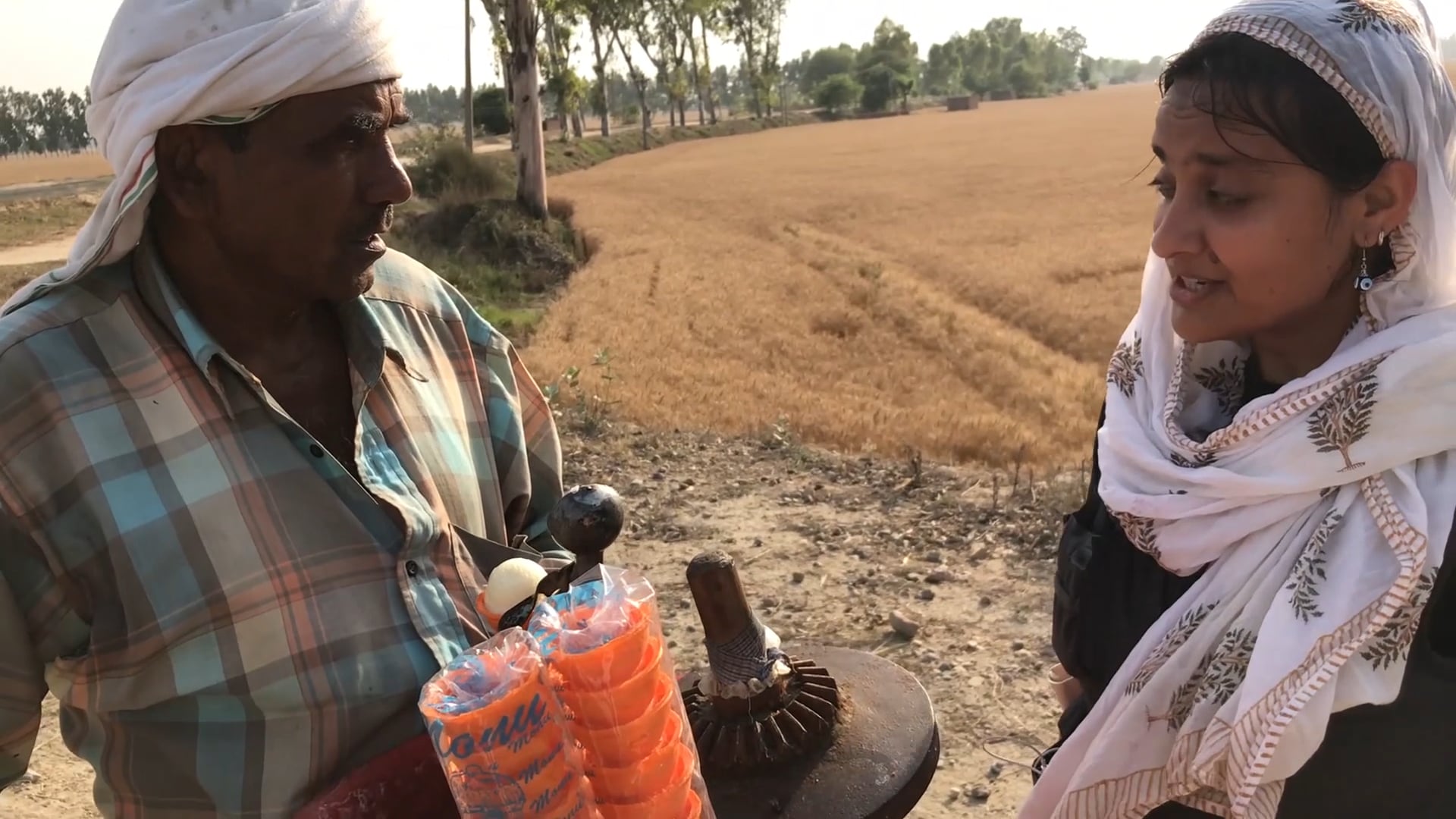
Resham Singh, an Indian farmer whose fields abut the Pakistan border.
Paul Salopek
Three eastern tributaries—the Sutlej, Beas, and Ravi—were allocated to India. Two western branches and the main channel—the Jhelum, Chenab, and Indus—were transferred to Pakistan. To the Muslim, Sikh, and Hindu farmers who once shared the river’s fertile lowlands watershed, this was more lunacy. How could any government parse a vast, supple, liquid entity that sprawled across half a million square miles of the Earth? One might as well try halving the air, or rain, or God.
I am walking across the world.
For weeks I rambled down the green Indus catchment on foot, moving at the pace of a slow trickle among the wheat fields of Pakistan. At Lahore I turned left and crossed the militarized border into India. In a parking lot beyond the immigration booths waited Arati Kumar Rao.
Who is Arati Kumar Rao?
My new walking partner. A holder of three masters degrees: biophysics, instructional design, and business administration. A onetime corporate executive who abandoned the machined surfaces of a global life for the dripping forests, icy peaks, furnace deserts, and salt swamps of her native India. An accomplished photographer of the plight of her country’s imperiled rivers. A painter. A poet. A hiker. Kumar Rao kept a brisk four-mile-an-hour pace under the murderous Punjabi sun. She identified every animal and many of the plants encountered along our path. She hailed all the wild birds—bulbuls, parakeets, francolins, drongos, owls, egrets—with, “You cutie!” She wanted to find a river dolphin.
Freshwater dolphins are close cousins of the famed sea mammal.
In this case, our quarry was Platanista gangetica minor, the endangered Indus River dolphin. Weighing about 200 pounds, it is a quicksilver creature as fickle and shifting as the five-million-year-old channels of the Indus itself. Its ancestors crawled from primordial seas, then morphed into a four-legged land carnivore that prowled Eocene riverbanks, before re-committing itself once more to water. Dams and pollution have pushed the Indus dolphin to the edge of extinction. Fewer than 2,000 remain in the wild. Virtually all cling to life in Pakistani rivers. Seeking out vestigial specimens in Indian waters, where dolphins surface mostly in dimming folk memory, is like searching for a unicorn.
* * *
Kumar Rao and I walked east to Amritsar.
Amritsar is home to the famous Golden Temple, the holiest shrine of the Sikhs. It is also associated with the Jallianwala Bagh massacre, probably the most notorious crime in the history of the British Raj. On April 13, 1919, inside a walled field with blocked escape routes, troops under General Reginald Dyer shot down hundreds of unarmed citizens protesting colonial rule. “The British have never apologized,” said Deepak Seth, a young tour guide at the memorial site. Seth’s great grandfather was killed that day. “They offered families compensation,” he said. “Mine never took it. Blood money.”
Resham Singh, an Indian farmer whose fields abut the Pakistan border.
Paul Salopek
Three eastern tributaries—the Sutlej, Beas, and Ravi—were allocated to India. Two western branches and the main channel—the Jhelum, Chenab, and Indus—were transferred to Pakistan. To the Muslim, Sikh, and Hindu farmers who once shared the river’s fertile lowlands watershed, this was more lunacy. How could any government parse a vast, supple, liquid entity that sprawled across half a million square miles of the Earth? One might as well try halving the air, or rain, or God.
I am walking across the world.
For weeks I rambled down the green Indus catchment on foot, moving at the pace of a slow trickle among the wheat fields of Pakistan. At Lahore I turned left and crossed the militarized border into India. In a parking lot beyond the immigration booths waited Arati Kumar Rao.
Who is Arati Kumar Rao?
My new walking partner. A holder of three masters degrees: biophysics, instructional design, and business administration. A onetime corporate executive who abandoned the machined surfaces of a global life for the dripping forests, icy peaks, furnace deserts, and salt swamps of her native India. An accomplished photographer of the plight of her country’s imperiled rivers. A painter. A poet. A hiker. Kumar Rao kept a brisk four-mile-an-hour pace under the murderous Punjabi sun. She identified every animal and many of the plants encountered along our path. She hailed all the wild birds—bulbuls, parakeets, francolins, drongos, owls, egrets—with, “You cutie!” She wanted to find a river dolphin.
Freshwater dolphins are close cousins of the famed sea mammal.
In this case, our quarry was Platanista gangetica minor, the endangered Indus River dolphin. Weighing about 200 pounds, it is a quicksilver creature as fickle and shifting as the five-million-year-old channels of the Indus itself. Its ancestors crawled from primordial seas, then morphed into a four-legged land carnivore that prowled Eocene riverbanks, before re-committing itself once more to water. Dams and pollution have pushed the Indus dolphin to the edge of extinction. Fewer than 2,000 remain in the wild. Virtually all cling to life in Pakistani rivers. Seeking out vestigial specimens in Indian waters, where dolphins surface mostly in dimming folk memory, is like searching for a unicorn.
* * *
Kumar Rao and I walked east to Amritsar.
Amritsar is home to the famous Golden Temple, the holiest shrine of the Sikhs. It is also associated with the Jallianwala Bagh massacre, probably the most notorious crime in the history of the British Raj. On April 13, 1919, inside a walled field with blocked escape routes, troops under General Reginald Dyer shot down hundreds of unarmed citizens protesting colonial rule. “The British have never apologized,” said Deepak Seth, a young tour guide at the memorial site. Seth’s great grandfather was killed that day. “They offered families compensation,” he said. “Mine never took it. Blood money.”

The Golden Temple of the Sikhs, in Amritsar.
Paul Salopek
All accounts come due in the end. Such is karma. Within a generation the British ran—not walked—out of South Asia.
At independence, a London lawyer named Cyril Radcliffe unveiled the 1,200-mile boundary between the new nations of Pakistan and India. This ethnic line was supposed to separate the mixed populations of the Punjab, the region’s breadbasket, which was cut in half. Radcliffe took only 40 days to complete his survey. He had never set foot in South Asia before. (Ignorance, the colonial authorities argued, guaranteed impartiality.) Aghast when his makeshift border inflamed riots and mass killings in both countries, Radcliffe declined his 40,000 rupee payment, burned his papers, and left India, never to return.
Since then, the two neighbors have waged half a dozen wars, most revolving around contested frontiers.
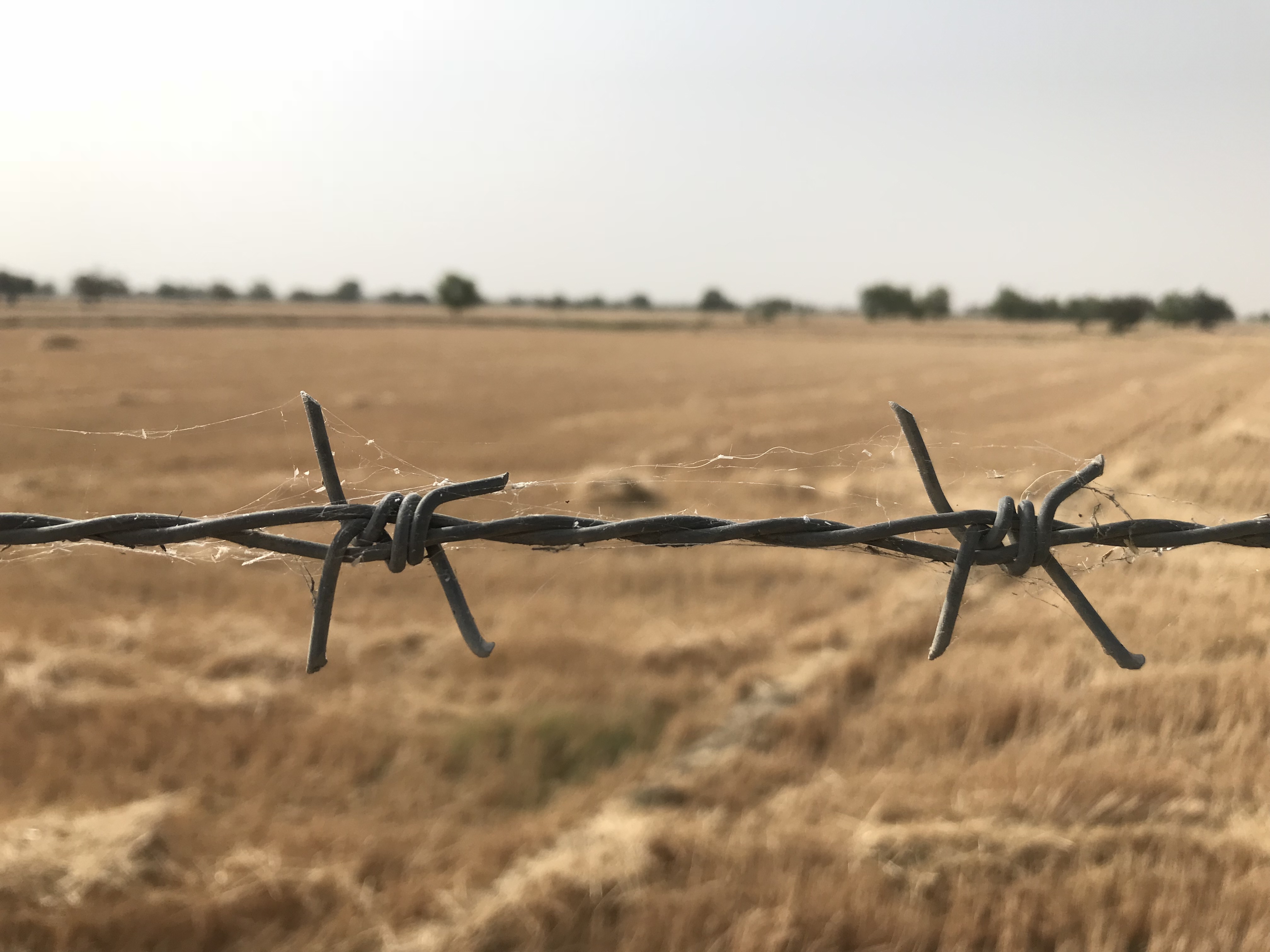
“Until about two years ago, we were able to talk to Pakistani farmers across the fence,” said Resham Singh, a friendly Indian wheat grower whose fields near Amritsar are now sliced by a 22-foot-wide no-man’s-land fortified by pillboxes and razor wire. “Soldiers from both sides come out when the Pakistanis and I are harvesting. Now we can’t say anything.”
* * *
Each morning grew hotter. Temperatures hit, then passed, 100 degrees. Kumar Rao and I sweated south.
Around endless quadrangles of cloned wheat.
Past dozens of Sikh temples topped with airy white domes, where volunteers offered simple meals of dal and rice to all passersby.
Among deafening armadas of tractors that blasted Punjabi pop music into the sky via disco-size speakers lashed to the drivers’ chairs. Why? It is difficult to say. Aliens visiting the Punjab would look on in wonder—with fingers plugging their ears. It was as if a cult of deaf humans had invented powerful, wheeled machines not to grow food, not to plow and harvest, but instead to transect the landscape in manic patterns, performing a strange and tireless ritual—pumping gonging, chanting, peppy devotional songs to some unseen god, to the entire cosmos. But no: They were Punjabi farmers at work.
The Golden Temple of the Sikhs, in Amritsar.
Paul Salopek
All accounts come due in the end. Such is karma. Within a generation the British ran—not walked—out of South Asia.
At independence, a London lawyer named Cyril Radcliffe unveiled the 1,200-mile boundary between the new nations of Pakistan and India. This ethnic line was supposed to separate the mixed populations of the Punjab, the region’s breadbasket, which was cut in half. Radcliffe took only 40 days to complete his survey. He had never set foot in South Asia before. (Ignorance, the colonial authorities argued, guaranteed impartiality.) Aghast when his makeshift border inflamed riots and mass killings in both countries, Radcliffe declined his 40,000 rupee payment, burned his papers, and left India, never to return.
Since then, the two neighbors have waged half a dozen wars, most revolving around contested frontiers.
“Until about two years ago, we were able to talk to Pakistani farmers across the fence,” said Resham Singh, a friendly Indian wheat grower whose fields near Amritsar are now sliced by a 22-foot-wide no-man’s-land fortified by pillboxes and razor wire. “Soldiers from both sides come out when the Pakistanis and I are harvesting. Now we can’t say anything.”
* * *
Each morning grew hotter. Temperatures hit, then passed, 100 degrees. Kumar Rao and I sweated south.
Around endless quadrangles of cloned wheat.
Past dozens of Sikh temples topped with airy white domes, where volunteers offered simple meals of dal and rice to all passersby.
Among deafening armadas of tractors that blasted Punjabi pop music into the sky via disco-size speakers lashed to the drivers’ chairs. Why? It is difficult to say. Aliens visiting the Punjab would look on in wonder—with fingers plugging their ears. It was as if a cult of deaf humans had invented powerful, wheeled machines not to grow food, not to plow and harvest, but instead to transect the landscape in manic patterns, performing a strange and tireless ritual—pumping gonging, chanting, peppy devotional songs to some unseen god, to the entire cosmos. But no: They were Punjabi farmers at work.

A shepherd nudges his animals past arid fields in the Indus River watershed, a region where water use is huge—and not sustainable.
Arati Kumar Rao
India was an early and successful warrior in the Green Revolution.
High-yield seeds, fertilizers and pesticides, tractors and motorized well pumps, all have quadrupled the nation’s crop yields since the 1960s. Today India’s 1.2 billion people are self-sufficient in food. Its farmers export grains and fruits. Yet such gains are increasingly qualified by steep and worrying environmental costs. Agricultural chemicals pollute the aquifers of the vital Indus. Industrial agriculture consumes staggering and finite quantities of water. Nationally, up to half of Indians—600 million people—face “high to extreme water stress,” the government says.
“It’s hard not to feel overwhelmed,” Kumar Rao said, marching along a molten farm road that howled with tractors pulling house-size loads of wheat chaff. She had spent years documenting the strip-mining of India’s water resources. “Our denial is a form of mass blindness.”

Nomadic fishermen seine the muddy currents of the Beas River, home to the last Indus River dolphins in India.
Arati Kumar Rao
To stalk a river dolphin one must first locate a river.
On foot, this was no simple task in the Punjab. Kumar Rao and I navigated a maze of canals, weirs, pipelines, and various water ducts. This human-built capillary system rendered the ancient green channels of the Indus tributaries largely irrelevant as geographical entities. When we bumped into the junction of the Beas and Sutlej Rivers, a wall of concrete greeted us: the Harike Dam. It poured impounded irrigation water, foaming white as the snows of the Indus source in Tibet, into the brown Thar Desert of Rajasthan.
The Indus River dolphin is a blind hunter.
After swimming for millions of years in the silty currents of the Indus, the dolphins lost their eye lenses. They can differentiate only light and dark. They spot prey fish using echolocation. They are side swimmers, using their fins to dredge up river-bottom clams and crustaceans. Mother Indus dolphins have been known to carry calves on their backs.
“There are no bhulan here anymore!” a muscular Punjabi calling himself Major Hindustan informed us confidently at a Beas River village a few miles above the Harike Dam. Bhulan is the local name for Indus River dolphins.
Major Hindustan worked with a small traveling circus. He was a trick motorcycle rider. With shirtsleeves rolled to show bulging biceps, he performed a few stunts—perching one-legged atop the seat of his Royal Enfield—for Kumar Rao and me as we stood on a quiet, muddy bank of the river. Walking India is like this. You meet all sorts of characters in unlikely places. But Major Hindustan was blind too. Arati Kumar Rao found dolphins on that stretch of the Beas.
She spent three days visiting them while I lay at a guesthouse stricken with fever. I tottered out of my sickbed twice to spot them and failed. Then I saw them.
Out of Eden Walk
It was a cow and her calf. They rose and fell in the glossy brown river currents, breaking the surface with a sound like a soft kiss. Then they dipped back under the water and were gone.
I imagined how the Beas must seem to them.
Floating inside the glacial melt of the river, the dolphins didn't experience the river as a conveyor at all. It was a stationary world past which streamed a slowly moving landscape of people and motorbikes and borders and dams. I thought how ultimately you could no more stop a river than you can will your own pulse to cease. And how nothing in the universe is utterly motionless, dead.
A recent survey indicates that in India there are five to eleven Indus river dolphins left.