He looked at the walls,
Awed at the heights
His people had achieved
And for a moment—just a moment—
All that lay behind him
Passed from view.
—The Epic of Gilgamesh, author unknown, written ca. 2100 B.C.
When it’s all said and done, what essence of our days will survive?
What shard of human experience endures past the shallows of memory—beyond one generation? Or at most, two?
Walking through the world it is impossible not to ask such questions. Crossing the continents on foot, moving within nature’s eternal rhythms year after year, one begins to step into a long-wave mental state that might be called ceremonial time. Even the towering megacities of our age, sliding by your shoulders at three miles an hour, start to seem ephemeral. Quivering Xanadus. Hives of concrete, glass, and noise that flicker, that lose their materiality, under the X-rays of a timeless sun. Blink and they will be gone. As, of course, they one day shall be.
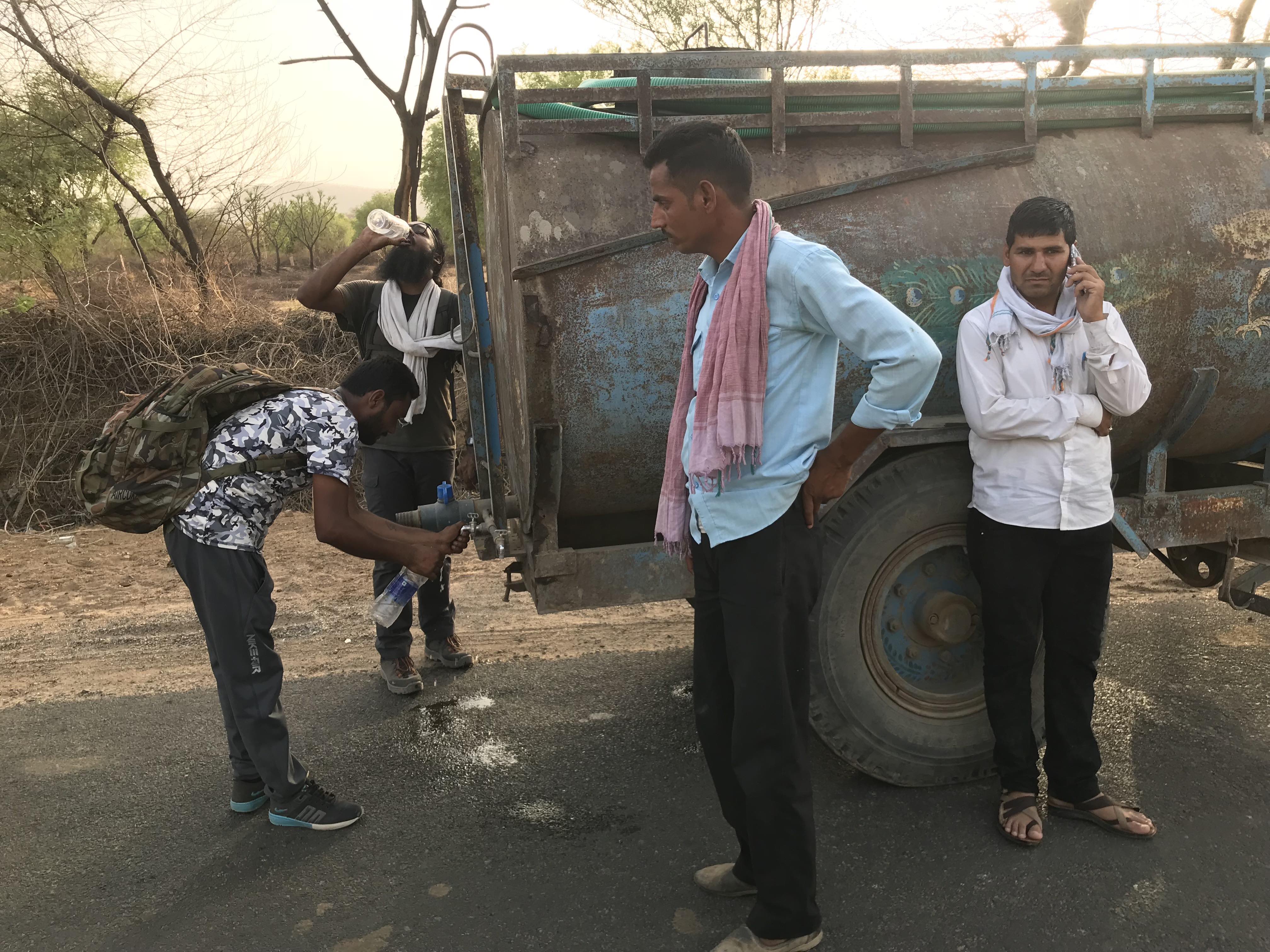
This summer I tramped for several weeks atop the glowing, yellow-ocher sands of Thar Desert of western India. Ruins of the oldest cities in Asia—indeed, among the first cities in human history—lay slumped in dust there.
Out of Eden Walk
The Indus Valley Civilization, also called the Harappan culture, was both extraordinarily old and fantastically advanced. It was a Bronze Age network of walled urban centers that bloomed between 4,600 and 3,700 years ago. Its boundaries remain a mystery, but at its peak it encompassed at least a thousand cities scattered across Pakistan and Afghanistan and the shared watershed of the Indus River system into India. Harappan technology rivaled that of more famous empires of the time such as Egypt and Mesopotamia. Its scribes recorded cryptic messages with seals pressed into clay. Its merchants traveled by caravan and ship as far away as Arabia, Central Asia, and Persia to trade in copper and tin, semi-precious stones and cotton. Harappan cities were beautifully planned. Two-story houses contained flush toilets, and the public enjoyed the tidy order of brick-lined wastewater channels, communal baths, and septic tanks—hydraulic engineering features still lacking in many modern Indian towns. Apart from bronze tools, archaeologists have unearthed perfectly usable terracotta dice for gaming and an abundance of children’s toys: miniature ox-carts, spinning tops, whistles, rattles, and marbles. Harappan sculpture depicts women going about their daily tasks, breastfeeding goddesses and dancing girls, but features almost no representations of royalty or warriors. This puzzles historians.
“Some people think it was a less hierarchical civilization than other ancient empires,” said Niran Jan Purohit, the superintendent of archaeology at the museum in Bikaner, a city in India’s arid Rajasthan state. “Maybe it wasn’t really even an empire but more like a bureaucracy, a federation of trading cities.”
The biggest Harappan metropolis ever found is located at Mohenjo-Daro, in Pakistan. In India I visited a smaller and less known site in the desert called Kalibangan.
Walking across it today, Kalibangan doesn’t look like much. Flat-topped mounds of cobbles and broken bricks rise where the city walls once stood. The sand is littered with millions of 4,000-year-old pottery shards. It is impossible not to step on them. Local shepherds push their cows through the ruin.
Kalibangan has architectural features typical of most Harappan cities. A citadel ringed by 20-foot-thick walls protects a complex of fire altars. Most of the population lived, organized in neighborhoods of artisans, on a nearby grid of streets where wooden bumpers once were installed at the corners, presumably to shield buildings from clumsy cart traffic. Kalibangan’s most famous relic is an anonymous-looking patch of earth: the oldest plowed field in the world, believed to date back 4,800 years. Even here the technology is elegant: The furrows are crossed-plowed at 90-degree angles, presumably allowing intercropping with different seeds, most likely cereals and mustard.
Swaying dizzily under the white desert sun, I dripped sweat from each fingertip, and marveled at humankind’s capacity for forgetting.

Niranjan Purohit, superintendent of archaeology at the museum in Bikaner, a city in arid Rajasthan state, shows off his Harappan artifact collection.
Paul Salopek
Why is the Indus Valley civilization—by any measure, one of the most accomplished ancient societies in the world—so little known?
Was it because a world-class culture vanished so utterly and mysteriously? By 1800 B.C., Harappan cities were being abandoned. Theories explaining their demise range from climate changes that unleashed flooding on the Indus to invasions from Central Asian tribes to an earthquake that may have shifted the course of vital rivers, such as the Saraswati, which exists today only as a ghostly channel of cobblestones in the waterless Thar desert.
Or maybe Harappan culture was simply too peaceful.
The Harappans did not appear to have left us any horror stories, the way violent colonizers like Alexander and the pharaohs did. Instead, the pioneers of urban living bequeathed to us the most efficient brick size, whose dimensional ratio of 1:2:4 is still favored in construction today. Harappa was an antique Switzerland.
“This is not a ‘spectacular’ civilization,” writes Michel Danino in The Lost River, a book on the vanished Saraswati River. “[A]s a matter of fact, early archaeologists, especially European ones, complained at times of its ‘monotony’: no great pyramid, no glorious tomb, no awe-inspiring palace or temple, no breathtaking fresco or monumental sculpture.”
I walked on.

Fields of long-forgotten dreams. A pavement of broken 4,000-year-old pottery at the ancient Harappan city of Kalibangan, one of the earliest urban centers in the world.
Paul Salopek
Hemingway supposed that the only thing that outlives any civilization is not its political power or military glory, or its monuments or laws or kings: “A country, finally, erodes and the dust blows away, the people all die and none of them were of any importance permanently, except those who practiced the arts . . .” But this sounds self-serving.
In our own case, it is virtually certain that modern civilization’s incidentals, our accidental byproducts, our trash, will outlast us. In his book The World Without Us, Alan Weisman consults engineers, architects, and physicists. What would happen, he asked the experts, if 21st- century humans simply vanished from the face of the Earth tomorrow? The answer: Within days, old rivers would flood New York’s subways, and the city would begin to collapse. Our old urban companions the cockroaches would die of cold. Radio waves unintentionally broadcast into space starting about a century ago likely will echo on forever. Plastic waste in the oceans is practically eternal. So are the bronze sculptures of horse-mounted generals occupying our traffic roundabouts. But what of meaning?
As I plodded through the now invisible Harappan world, I met their Indian descendants.
One small-town police chief was named Baljit Sidhu: tall, gentle, a mustachioed man who seemed uneasy in uniform. He wrote satirical stories on his smart phone while being chauffeured between crime scenes. The bookshelf at his tiny official quarters held Dostoevsky. For the long desert crossing, Sidhu procured me a cargo donkey whose ears had been lopped off by a former owner hoping to default on an livestock bank loan. (The ears were a cruel proof of “death.”) Weeks later, next to a stone quarry, this indefatigable animal, called Raju, would die on his side, heaving under my hands with nameless fever. A local nomad woman, Shreemati Singh, would console my walking partner, a tough human rights journalist named Priyanka Borpujari. “Don’t cry,” Singh quietly urged Borpujari, “your tears extend his pain in the afterlife.”
Archaeologists have yet to crack the hieroglyph script of the mysterious Indus Valley Civilization.
Doubtless, this has kept the amazements of Harappan life so distant—unfathomable, elusive, almost opaque. No matter. If ever deciphered, the old Bronze Age seals, etching out our usual journeys to the end through heartache and kindness, must tell similar stories.