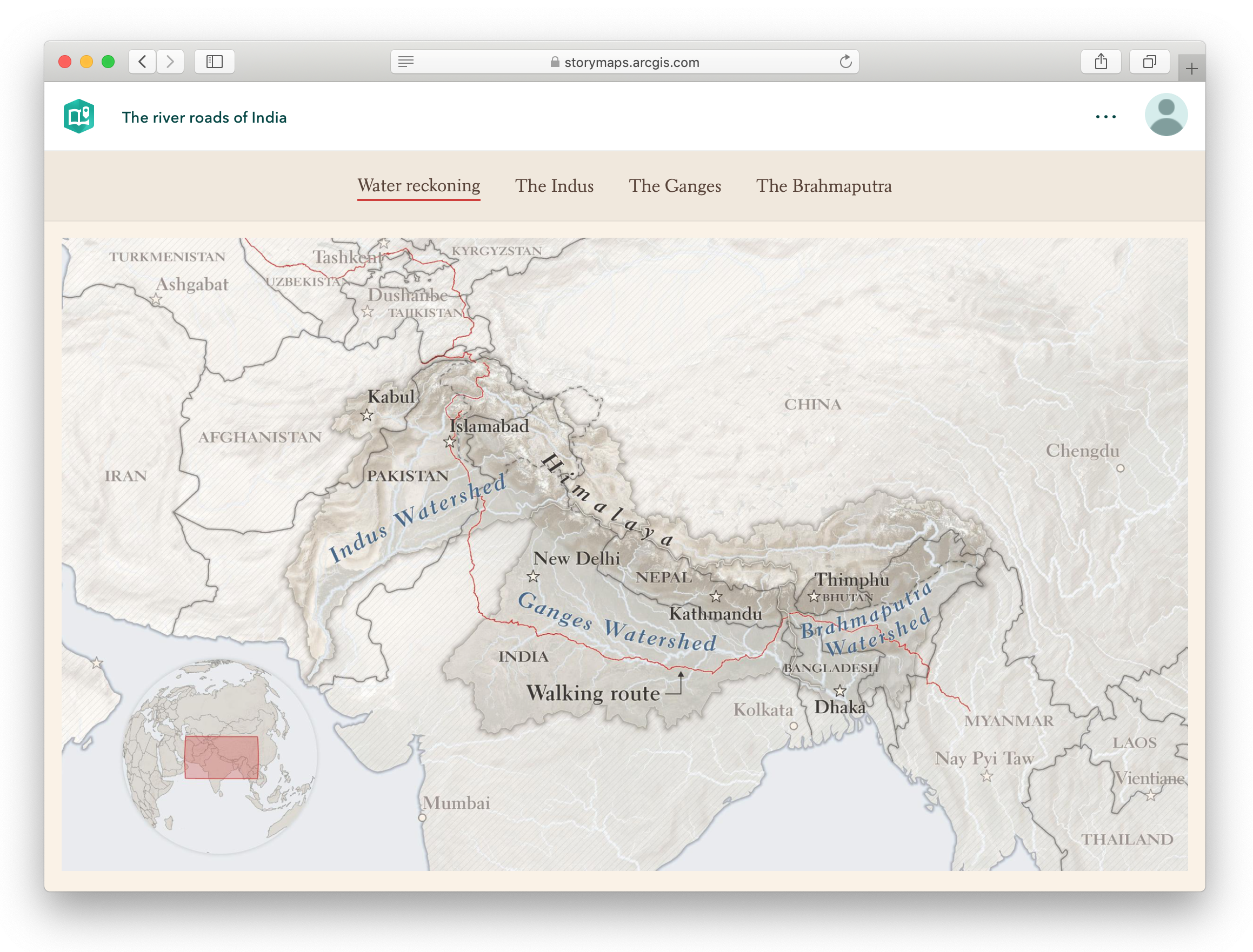
I spotted my first Asian elephants in the Buxa Tiger Reserve, in far northeastern India, along a railway line where speeding trains sometimes cut the foraging animals in half.
There were a dozen or so. Cows. Bulls. Juveniles. Babies. They screened themselves in the tall undergrowth, shaking the tree trunks with their passing bulk, hiding from motorists who’d parked their cars to gawk. One driver, a potbellied man in city shoes, got out and approached the animals on foot. He was showing off for friends. The matriarch false-charged him. The man scampered back to the road, giggling. I was aggrieved that she hadn’t ironed him flat.
I am walking across Asia. I am following, west to east, the pathways of the first ancient people who colonized the Earth during the Stone Age, when we dreamed of large animals.
I first saw the big, round, piston-like tracks of Elephas maximus in West Bengal, on the sandy banks of the Dina River. I came across their spoor again, stamped into the mud in the Karbi Hills of Assam. The Karbi guides frowned, blinking in silence at the colossal footprints. The last bulls in that forest were deranged by human encroachment. They often attacked. The guides sprinted ahead, up sheer mountain trails, all but abandoning me. After that: nothing more for 300 miles. (“Our parents used to see them.”) Rice farming had chewed into wild habitat. The animals had been hunted out long ago. I only encountered elephants once again across the border of Myanmar—of Burma—in the cloud forests of the Chin Hills.

“We can know their moods,” Sai Tun Tun, assistant director at Pyar Swe Elephant Camp, in Myanmar, says of his animal guests.
Paul Salopek
“We don’t know their language,” Sai Tun Tun, the friendly assistant director at the Pyar Swe Elephant Camp, said. “We can know their moods. Like humans they sigh loudly, they shake their heads, they play, they sulk.”
Sai Tun Tun’s elephants were not wild.
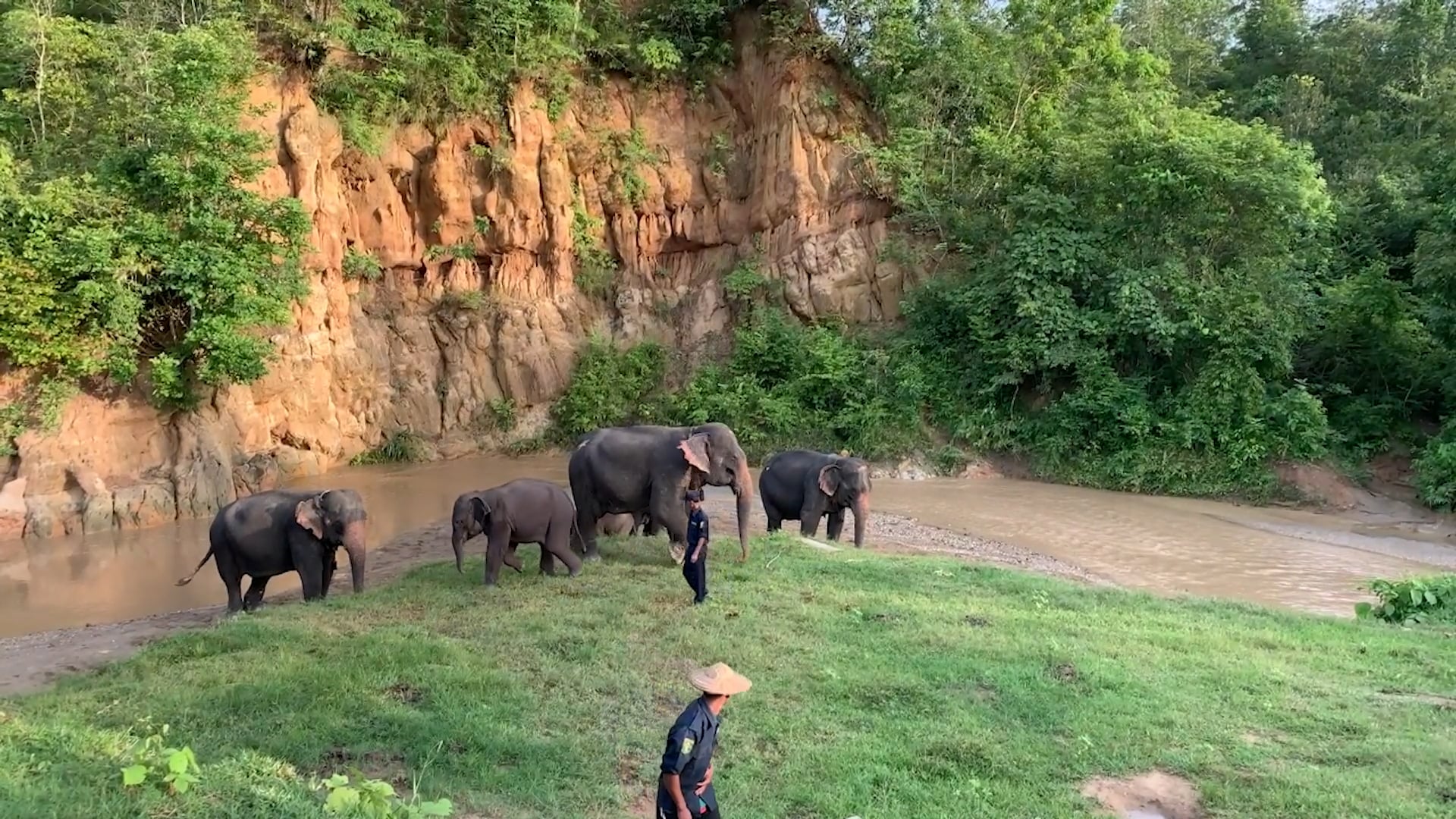
They were among Myanmar’s 3,000 to 4,000 timber elephants trained as living bulldozers to extract valuable hardwoods such as teak. Most of the animals were old. They had retired to the camp at age 55. Bare-legged forest rangers straddled their necks, washing them by hand in a muddy stream. The men, it was clear, liked their hulking charges. They patted the corrugated hides, splashing the animals with buckets. But the elephants’ eyes were hard to look at. Fist-size globes of amber in which ghost jungles curved in dark reflection. Awaiting the next command. A comprehension wrung from months of breaking.
It is a terrible thing, the docility of a tame elephant.
* * *
“We can know their moods,” Sai Tun Tun, assistant director at Pyar Swe Elephant Camp, in Myanmar, says of his animal guests.
Paul Salopek
“We don’t know their language,” Sai Tun Tun, the friendly assistant director at the Pyar Swe Elephant Camp, said. “We can know their moods. Like humans they sigh loudly, they shake their heads, they play, they sulk.”
Sai Tun Tun’s elephants were not wild.
They were among Myanmar’s 3,000 to 4,000 timber elephants trained as living bulldozers to extract valuable hardwoods such as teak. Most of the animals were old. They had retired to the camp at age 55. Bare-legged forest rangers straddled their necks, washing them by hand in a muddy stream. The men, it was clear, liked their hulking charges. They patted the corrugated hides, splashing the animals with buckets. But the elephants’ eyes were hard to look at. Fist-size globes of amber in which ghost jungles curved in dark reflection. Awaiting the next command. A comprehension wrung from months of breaking.
It is a terrible thing, the docility of a tame elephant.
* * *

Elephants can use their hypersensitive trunks to wipe a grain of sand from their eyes.
Paul Salopek
Obligatory factoids.
Humans possess about 600 muscles in their bodies. The trunks of elephants contain more than 40,000.
Elephants can use their powerful and hypersensitive trunks to uproot half-ton trees and wipe a grain of sand from their eyes. They can smell water—or other individual elephants—from great distances.
They pick up seismic or infrasonic signals through their feet. In this way, they can “hear” the rumble of a summer thunderstorm vibrating the earth’s surface 150 miles away, or the rotor beat of an elephant-culling helicopter flying 90 miles away.
They are fading rapidly from the planet. The population of Asian elephants, which garner less attention than the African subspecies, is endangered, and has declined by half since the 1950s, to between just 20,000 and 40,000 individuals.
They remember.

The old mountain road through the Chin Hills to Pyar Swe Elephant Camp. It was in these hills during World War II that Englishman James Howard Williams—"Elephant Bill"—led a force of 1,600 bridgebuilding, supply-carrying elephants against the Japanese in what was then Burma.
Paul Salopek
Now an obscure and potholed track, the jungle road to the Pyar Swe Elephant Camp, in northern Myanmar, near the Indian border, was once the scene of world events.
The British army had retreated pell-mell along this route during World War II, barely escaping capture or annihilation by the advancing Japanese. One of the fleeing Englishmen was James Howard “Billy” Williams, a teak logger who had moved to the region in the 1920s and indulged a life of colonial adventure.
Williams spent years roving from forest camp to forest camp, working with Burmese mahouts, or elephant trainers, to animal-haul logs to rivers for floating to distant sawmills. His wife, Susan Rowland, from Rangoon, soon joined him. She set each of their dinner table legs into tins of kerosene to stave off the ants. In the logging outstation of Mawlaik, on the Chindwin River, the couple patronized a country club that included polo grounds and a golf course. (The golf course is still there, waist-high grass clogging its fairways.) Billy Williams fell hard for his behemoth work partners.
“He called his elephants ‘the most lovable and sagacious of all beasts,’ ‘the most magnificent of animals,’ and ‘God’s own,’” writes his biographer, Vicki Croke, in Elephant Company. ‘His time in the logging camps of Burma was spent studying them, healing them, learning from them, and, he was never ashamed to admit, loving them. ‘The relationship between man and elephant,’ he would say later, ‘is nine-tenths love.’”
Williams became famous during and after the war as “Elephant Bill.” He joined the British re-invasion of Burma, leading a force of 1,600 elephants against the Japanese: The faithful animals helped build military bridges and carried supplies. Both sides strafed elephant trains. Men and beasts died bloodily together.
How old is this story?
On the Irrawaddy plains near Mandalay, the old Burmese imperial capital, I plodded through the ruins of the ancient city of Halin. Archaeologists have found hundreds of caltrops—small tetrahedral iron spikes—scattered outside its fallen walls. They were tossed there to slow charging war elephants more than 2,000 years ago.

A forest ranger rides a retired logging elephant to a stream for a bath at Pyar Swe Elephant Camp, in northern Myanmar.
Paul Salopek
The lumberjack elephants at the Pyar Swe retirement camp know about 20 terse human commands:
Mah means lift a log.
Ang means roll a log.
Tae means go.
Glistening from their baths, with startling pink patches on their hides, they amble with saintly tread back to the surrounding forests to sleep standing up.
Timbering with elephants is less destructive to tropical forests than using heavy machinery, environmentalists concede. But the government of Myanmar began restricting tree harvesting in its depleted teak forests in 2014. Since then, hundreds of work elephants have been unemployed. The idled animals are warehoused, for now, at dozens of elephant old-age camps across the country, such as Pyar Swe.
“Feeding elephants is expensive. It requires revenue,” admitted Ko Ni Ang, the camp manager, who cares for 13 animals old and young. “Local people aren’t that interested in our elephants. We’re hoping foreign tourists come here. We can be like a living museum.”
One alternative, according to recent news reports, has been the illicit export of Myanmar’s logging elephants to service an often cruel Southeast Asian animal tourism industry, in this case to lodges in neighboring Thailand . With the collapse of global tourism because of the COVID-19 pandemic, however, even that dubious work has dried up. Hundreds of captive Thai elephants were herded back to their forest homes last month and freed. In Myanmar, which the UN lists as one of world’s hot spots of deforestation, that’s not an option.
"White elephant / (noun) /ˌwaɪt ˈel.ɪ.fənt/": a thing that has no use and is no longer needed, although it may have cost a lot of money."
Etymology: "From the story that in Siam (now Thailand) the king would give a white elephant as a present to somebody he did not like. That person would have to spend all their money looking after the rare animal." —Oxford Learner’s Dictionaries.

A barge nudges a load of teak logs down the Chindwin River in Myanmar. Much timber is still extracted from forests by elephants.
Paul Salopek
Back in England after the war, Elephant Bill wrote books about his Burma exploits. He visited circuses, tending to their elephants. He died of a burst appendix in 1958.
I walked on: east from the Pyar Swe Elephant camp to Mawlaik, on the Chindwin River.
Barges pushed a few loads of teak down from the relict forests on the big brown current. I saw no more Asian elephants.
The giant animals once had roamed, ecologists believe, across the entire southern expanse of the continent, from India to the Pacific coast. Their original range has shrunk by almost 90 percent. Seeing them up close, it was possible to imagine them everywhere. And their absence rang over the green landscapes the way the American West rings with the absence of buffalo.
A barge nudges a load of teak logs down the Chindwin River in Myanmar. Much timber is still extracted from forests by elephants.
Paul Salopek
Back in England after the war, Elephant Bill wrote books about his Burma exploits. He visited circuses, tending to their elephants. He died of a burst appendix in 1958.
I walked on: east from the Pyar Swe Elephant camp to Mawlaik, on the Chindwin River.
Barges pushed a few loads of teak down from the relict forests on the big brown current. I saw no more Asian elephants.
The giant animals once had roamed, ecologists believe, across the entire southern expanse of the continent, from India to the Pacific coast. Their original range has shrunk by almost 90 percent. Seeing them up close, it was possible to imagine them everywhere. And their absence rang over the green landscapes the way the American West rings with the absence of buffalo.
The elephants at Pyar Swe Elephant Camp are among Myanmar’s 3,000 to 4,000 timber elephants trained as living bulldozers to extract valuable hardwoods such as teak. Most of the animals retired to the camp at age 55.
Out of Eden Walk