When I was six years old, vacant lots untouched by urban development were my happiest playgrounds. Mantises hung and danced on the tips of artemisia leaves. Grasshoppers jumped over the backs of my feet into piles of dry grass. When I roamed among the greenery, invisible cobwebs would stick to my face.
I wonder if this early sense of wonder is what drives me to go walking.
When I got older, I rambled farther. I have walked in the remotest corners of my home province of Yunnan.

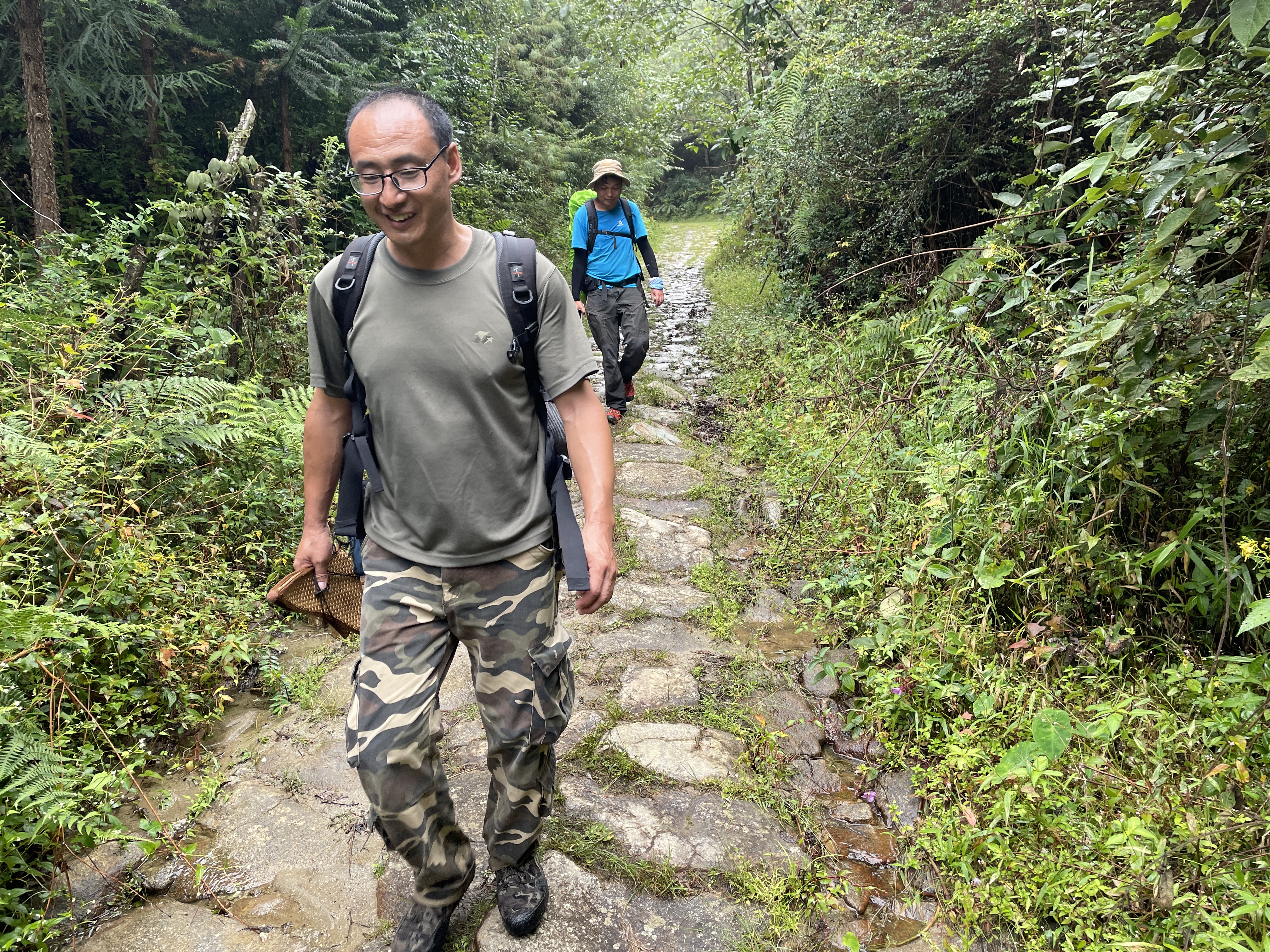
Walking partners Li Zheng Kang and Zhang Qing Hua pause to identify plants along the trail.
Paul Salopek
I’ve seen rime ice hanging from the branches of endemic bamboo (Gaoligongshania megalothyrsa), after hiking to the top of the Gaoligong Mountains. It looked like silver flowers, or a cloud of solidified fog that would break apart at the slightest touch.
I’ve seen the seaweed flowers (Ottelia acuminate var. crispa) that swirl on the surface of Lugu Lake, with their crystalline, white petals that look like pure glass blown delicately around their yellowish stamens. Softly, they poked out of the lake one by one, rising and falling with the ripples.
I have walked around the famous Baihualing forest hot spring, where carbon dioxide gas rises from the bottom of its pool. Strings of bubbles burst out from the cracks between the sand grains at the bottom, rocking a fallen, floating leaf from a hog plum fruit tree (Choerospondias axillaris).
I’ve looked down on the shining back of the white-tailed harrier (Circus cyaneus) hovering over the deep valley of Jinsha River. Its black feathers on the wingtips, one, two, three, were clutching at the air currents and shaking gently.
I wonder if these things are what drive me to go walking.
And then, there are the people and human perspectives you meet while traveling on foot.
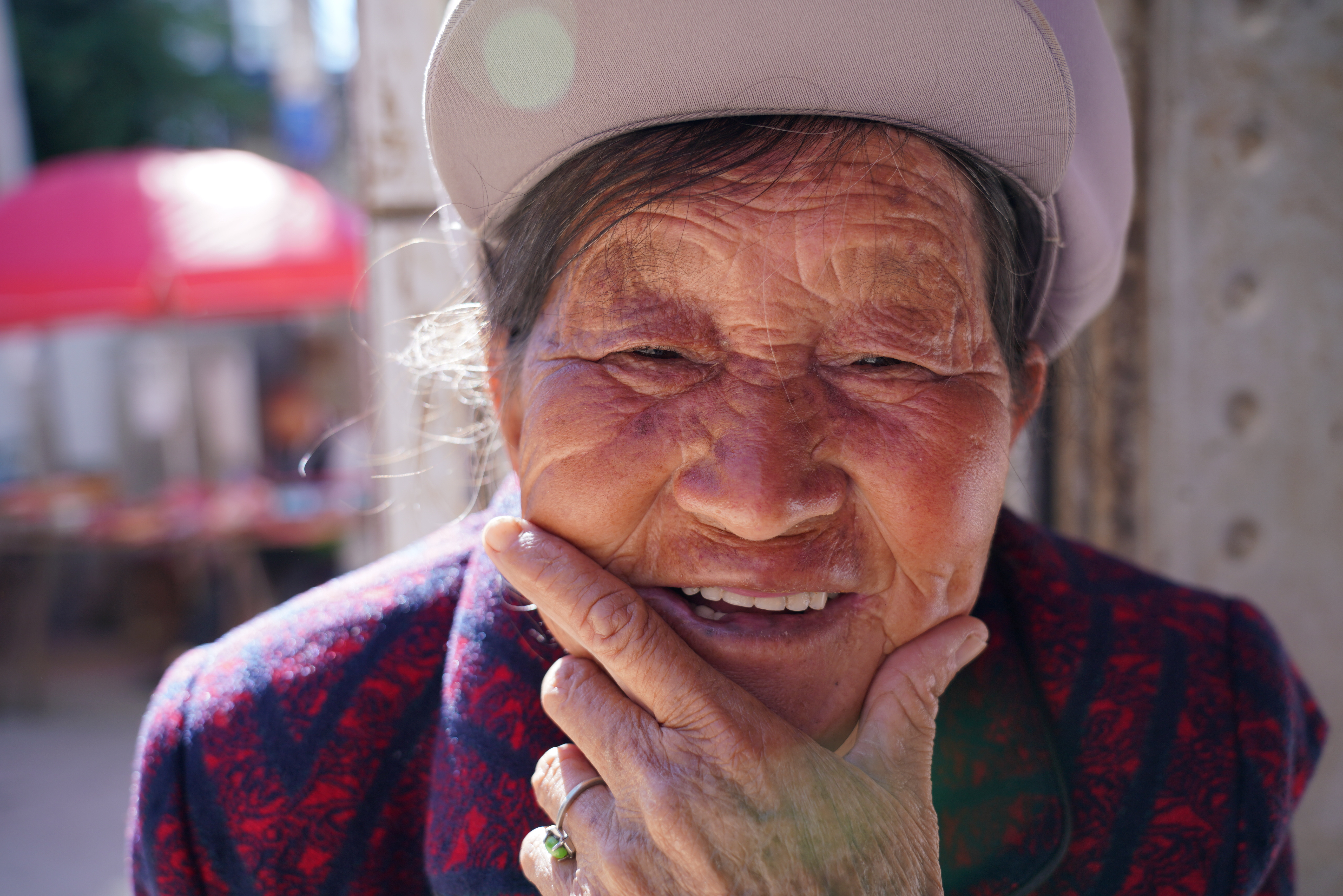
A small village I walked through one recent morning in the Longchuan Grand Canyon was peaceful and quiet. There were green trees, mossy roads, and an old woman living in a tiled house with earthen walls. I liked the place immensely. This is what my dream home would look like. And yet, the granny said she hoped there could be a concrete road to make it easier for her to travel elsewhere. This was a useful surprise. It turns out that what you like may not be what others like at all.
Walking partners Li Zheng Kang and Zhang Qing Hua pause to identify plants along the trail.
Paul Salopek
I’ve seen rime ice hanging from the branches of endemic bamboo (Gaoligongshania megalothyrsa), after hiking to the top of the Gaoligong Mountains. It looked like silver flowers, or a cloud of solidified fog that would break apart at the slightest touch.
I’ve seen the seaweed flowers (Ottelia acuminate var. crispa) that swirl on the surface of Lugu Lake, with their crystalline, white petals that look like pure glass blown delicately around their yellowish stamens. Softly, they poked out of the lake one by one, rising and falling with the ripples.
I have walked around the famous Baihualing forest hot spring, where carbon dioxide gas rises from the bottom of its pool. Strings of bubbles burst out from the cracks between the sand grains at the bottom, rocking a fallen, floating leaf from a hog plum fruit tree (Choerospondias axillaris).
I’ve looked down on the shining back of the white-tailed harrier (Circus cyaneus) hovering over the deep valley of Jinsha River. Its black feathers on the wingtips, one, two, three, were clutching at the air currents and shaking gently.
I wonder if these things are what drive me to go walking.
And then, there are the people and human perspectives you meet while traveling on foot.
A small village I walked through one recent morning in the Longchuan Grand Canyon was peaceful and quiet. There were green trees, mossy roads, and an old woman living in a tiled house with earthen walls. I liked the place immensely. This is what my dream home would look like. And yet, the granny said she hoped there could be a concrete road to make it easier for her to travel elsewhere. This was a useful surprise. It turns out that what you like may not be what others like at all.

Zhang Qing Hua encountered an idyllic village—with a new concrete road.
Illustration by Zhang Qing Hua
Walking the pine forest at the top of Nu Shan Mountain in the late afternoon, the trails felt cool and wet. The purple anemone flowers were like groups of mischievous children, clumped by threes or fives, as if holding hands and hiding behind tree trunks. Some of the blossoms surrounded my walking partner named Paul, who had hiked to Yunnan from Africa. At that moment, I wasn’t thinking of his curious experiences or great aspirations. Rather, I saw nothing more and nothing less than a tree that is growing here, a flower, or a warm boulder. I felt touched. Fine sand can grow into a tower. Small steps can lead to greatness.

A mountain meadow where Paul Salopek was photographing anemone flowers.
Illustration by Zhang Qing Hua
And more on-foot encounters:
In December, the weather in Wumu village along the Jinsha River had cooled down. After dinner, the firepit was the place to be for the locals. Huddled among them, watching the dancing flames and listening to them slowly talking about their lives and hopes, I reached out my hands and leaned toward the fire. The mood was so warm, intimate, friendly, comforting. Walking reveals this too. Everyone can be a hearth, each one of us warming the other.

A village campfire sketched by Zhang Qing Hua.
Illustration by Zhang Qing Hua
I wonder if this too is what drives me to go walking.
Breathing heavily, I recently climbed to the high, rocky, entrance of the Taiziguan Mountain tunnel and looked back. The plants growing in the valley below were blooming in brilliant colors: red, yellow, green, at once chaotic and harmonious. Such beauty: a bit more would be too much, a bit less would be too little.
Suddenly my heart clenched.
Ah! So these are the forces that drive me to walk, to slowly pass through these mountains, by these waters, among these people, and into this chaotic and beautiful world! A balance achieved only on foot: a bit more would be too much, a bit less would be too little.

A balance achieved only on foot: Zhang Qing Hua celebrates the details of a slowed-down world.
Illustration by Zhang Qing Hua
Zhang Qing Hua is a mountain guide, amateur field biologist, self-taught artist, and walking partner from Tengchong who joined the Out of Eden Walk trail for more than 200 miles through his biodiverse and culturally rich home province of Yunnan.