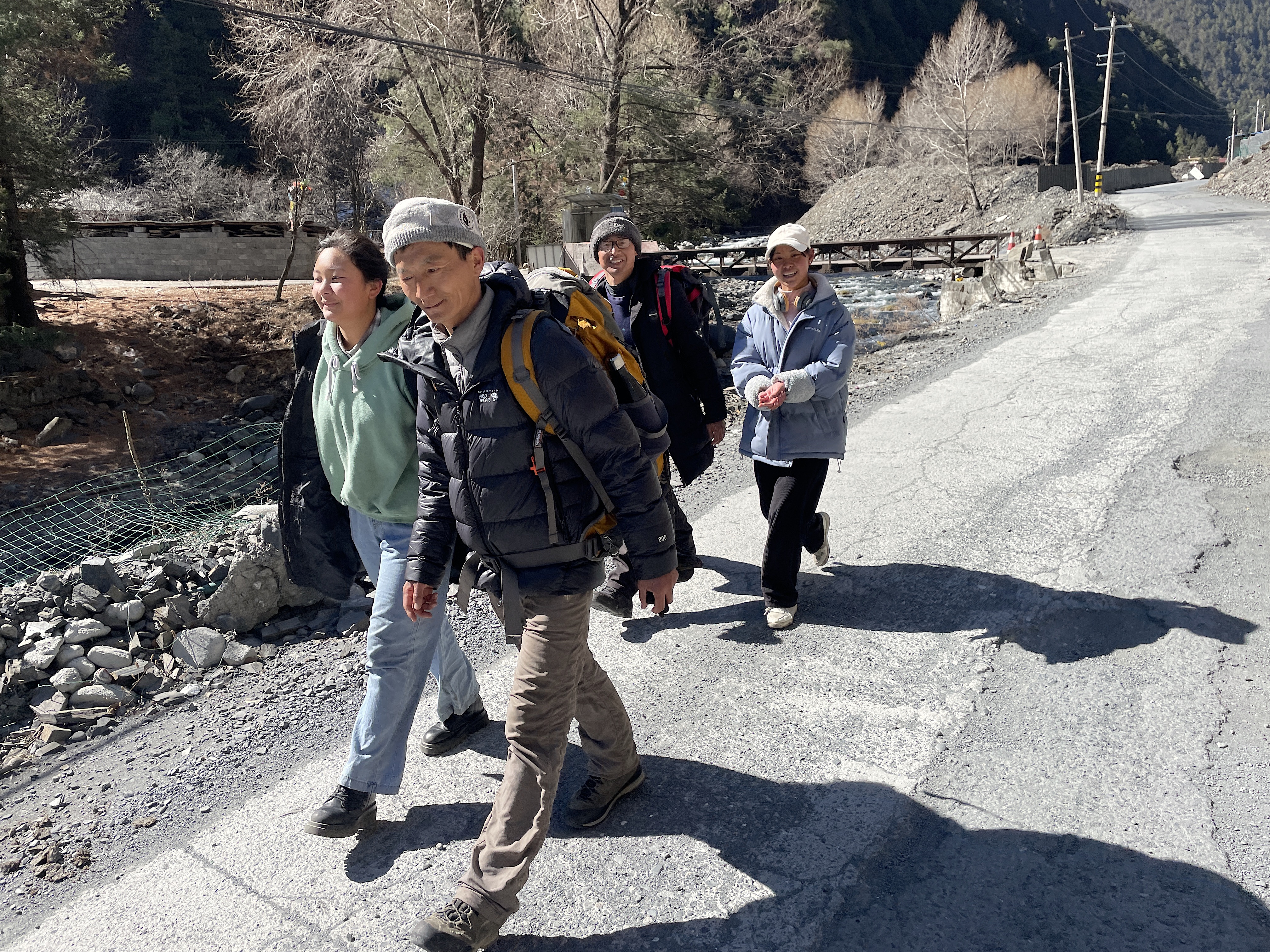
The first person I met in Lijiazui, a traditional matriarchal village in the highlands of Sichuan, and one of rare places on Earth presumably run by women, happened to be a man.

Author Liu Kankan is guided through the backcountry of Sichuan by Yang Du Ji, a member of a community that maintains an ancient matriarchal culture.
Paul Salopek
Yang Du Ji was in his 40s. I was hiking toward his isolated valley in the Hengduan Mountains when Yang drove up the steep trail on his motorcycle to greet me. I had arranged to stay at his family’s rustic guesthouse, which was a clutch of log cabins tucked among fallow fields of potatoes and wheat. Yang indeed looked manly in his brown leather coat and blue jeans. But if he seemed like any other typically rakish mountaineer in this rugged part of China, my introduction to his household told me differently. His home was occupied exclusively by women relatives. And Yang wasn’t only outnumbered. He was out-talked.
“It sounds like you’ll be talking about woman’s topics only,” he said, grinning and stepping out the door, leaving me alone with a bustling feminine clan that included his sisters, nieces, and cousins. “Let me excuse myself.”
Women’s topics come naturally in Lijiazui.
The village is one of scores of ethnic minority Mosuo communities in southwest China—some also call themselves Mongol or Na—that many Chinese refer to as the Kingdom of Women. For roughly 2,000 years, the 40,000 or so Mosuo have pursued a matrilineal lifestyle, meaning property is passed down through women, and children take the mother’s surname. Mosuo marriages aren’t arranged by parents as in other conservative societies but are usually love matches where both the women and men involved wed by consent. Most famously, some Mosuo people still practice a custom called “walking marriage”: nocturnal visits where both sexes are relatively free to have multiple partners and break off unsatisfactory relationships. Unlike in much of mainstream China, Mosuo “divorces” carry no stigma.
I was curious about all these stories.
Author Liu Kankan is guided through the backcountry of Sichuan by Yang Du Ji, a member of a community that maintains an ancient matriarchal culture.
Paul Salopek
Yang Du Ji was in his 40s. I was hiking toward his isolated valley in the Hengduan Mountains when Yang drove up the steep trail on his motorcycle to greet me. I had arranged to stay at his family’s rustic guesthouse, which was a clutch of log cabins tucked among fallow fields of potatoes and wheat. Yang indeed looked manly in his brown leather coat and blue jeans. But if he seemed like any other typically rakish mountaineer in this rugged part of China, my introduction to his household told me differently. His home was occupied exclusively by women relatives. And Yang wasn’t only outnumbered. He was out-talked.
“It sounds like you’ll be talking about woman’s topics only,” he said, grinning and stepping out the door, leaving me alone with a bustling feminine clan that included his sisters, nieces, and cousins. “Let me excuse myself.”
Women’s topics come naturally in Lijiazui.
The village is one of scores of ethnic minority Mosuo communities in southwest China—some also call themselves Mongol or Na—that many Chinese refer to as the Kingdom of Women. For roughly 2,000 years, the 40,000 or so Mosuo have pursued a matrilineal lifestyle, meaning property is passed down through women, and children take the mother’s surname. Mosuo marriages aren’t arranged by parents as in other conservative societies but are usually love matches where both the women and men involved wed by consent. Most famously, some Mosuo people still practice a custom called “walking marriage”: nocturnal visits where both sexes are relatively free to have multiple partners and break off unsatisfactory relationships. Unlike in much of mainstream China, Mosuo “divorces” carry no stigma.
I was curious about all these stories.

Cousins Yang Da Wa Zhuoma and Yang Nan Ka Lamu share a light moment while preparing a meal in their matriarchal village of Lijiazui.
Zhang Hongyi
They have become the fodder for countless articles, books, film documentaries, and even “feminist”-tinged cultural tourism in China. I’m no anthropologist. And my visit to Lijiazui was brief. But I wondered how matriarchal communities functioned at daily level.
“Many Chinese people think that walking marriage means free love,” I ventured cautiously to Yang Da Wa Zhuoma, Du Ji’s niece, a confident young woman in her 30s. I was worried about being too intrusive. “Are these two the same thing?”
“Ah, I have heard nonsense like this before,” Zhuoma huffed. “It is just different type of marriage.” Stretching contentedly beside the family’s wood-fired hearth, she reeled off a lesson in Mosuo gender relations:
“Unlike Han marriages,” she said, referring to China’s majority ethnic group, “couples here don’t live together in a 24-hour-a-day, 7-days-a-week kind of married life. Husbands stay at their own villages and take care of their own immediate families during the day and come back in the evenings to their wives’ villages, where they stay with their wives’ families. They depart again the next morning back to their villages. We bring up the kids equally. Though the father is not here with the family during the daytime, he cares for his kids and pays for whatever is needed for the kids.”
Yang Du Ji himself later reminded me that he grew up without initially knowing the identity of his biological father. He remembered a friendly, helpful man who came to his mother’s house constantly. Like most Mosuo children, he called the man shushu, or uncle, until he discovered the truth in his teenage years. Like most Mosuo fathers, Du Ji’s dad was largely responsible for his children’s education.
To me, this sounded more like gender equality than the “female superiority” trumpeted in so many shallow media reports.
Lijiazui was a beautiful place.

Lijiazui nestles in the mountain region that is the homeland of the Mosuo people, who sometimes identify themselves as Mongols or Na. They adhere to a matriarchal culture.
Zhang Hongyi
The Yang family’s compound occupied a shelf of land that overlooked a fairytale valley of plowed soil and pine forests. A wall of 13,000-foot peaks ringed the small village. The immediate family had 14 members and owned 1.5 acres of land, where they grew barley, corn, potato, beans, and cabbage. The extended family incorporated 30 people, with each branch organized under a biological mother. They all shared in the exhausting labors of collectively maintaining their fields. Zhuoma told me that when an important decision was to be made, every family member—men as well as women—had a say, but usually the grandma’s opinion carried the most weight. This was different from a Han village, where usually the most powerful man in the family makes the final decision.
I listened to stories for hours in the Du’s cozy kitchen, which also served as a living room.
Smoke from a cookfire wafted through a ceiling hole. As the women chatted and worked, the smell of their bacon and chili dishes was quite inviting. Swastikas, an ancient Buddhist symbol of auspiciousness, decorated the cupboard. I sat on a long bench next to the fireplace that was padded with colorful cushions. With a mischievous smile, Zhuoma joined me there because her uncle Du Ji was absent; it was usually reserved only for men and guests. She added more firewood to the hearth, and soon the kettle was bubbling, ready to prepare yak-butter tea. Some women were out tending goats. Others were taking care of toddlers. But in the evening, another niece, Yang Nan Ka Lamu, arrived. She was a 21-year-old folk dancer who had worked with a tourism company until the COVID-19 pandemic stalled the business.
I asked Lamu about rumors I’d heard: How some male tourists came to Mosuo villages hoping to fool around with “liberated” Mosuo women.

Villager Yang Nan Ka Lamu decries bogus stereotypes about her matriarchal culture’s practice of free love. "It’s all nonsense!" she says. "That’s never the situation in my village."
Zhang Hongyi
“You never know,” she joked. “People make up these stories to get the tourism business going.” But then, with anger shining in her eyes, Lamu told this story:
“I heard a tour guide introducing local customs saying that tourists who come to Lugu Lake"—an epicenter of Mosuo culture—"to enjoy dancing, singing, and partying with the local Mosuo girls can take a girl’s hand and gently scratch her palm with their index finger. This signals free sex for that night. It’s all nonsense! That’s never the situation in my village, to say the least. Walking marriage does not mean free sex!”
I spent two wonderful days in Lijiazui. The high mountain nights were especially memorable. It was freezing cold outside, and I gazed in awe up at Orion in the star-speckled sky on the way back to my guesthouse room. The room was cold, but an electric blanket warded off the chill.
Are the women in Lijiazui village happier or stronger than the women from other villages—a Han village, for example?
In my opinion, probably.

Three generations of a matriarchal household in remote Lijiazui, Sichuan, China: From left to right, Yang Bian Ma Lamu, niece Yang Nan Ka Lamu, and a granddaughter.
Zhang Hongyi
Both my parents come from Han villages. In Han villages, a woman’s position is in most cases constrained by an ethos of obedience. A divorced woman is looked down on in the community, and she also loses her right to own land for herself when she returns home. There is an old saying in Han culture: “A daughter married is like water poured out from a barrel”—meaning you don’t have to care for her anymore and she now belongs to somebody else. Women, in such cases, are never treated as independent beings but like objects to be gained or bought. Also, in Lijiazui, the people didn’t place special value on boys, as is often the case in Han communities.
On the other hand, do the Mosuo live in some sort of feminist utopia, as so many popular accounts would have us believe? And would the world be a better place if it was governed by a matriarchal system? Honestly, I don’t know the answers. I spent too little time in the Mosuo’s isolated mountain home. I was just walking through. But I do remember this:
“Why are boys are more important than girls? For what?” Zhuoma had asked me one morning, as she prepared a breakfast of pancakes to be shared—equally—by all genders in her tight-knit family.
Liu Kankan is a freelance editor who lives in Dali, Yunnan. She hiked over 13,000-foot passes in the Hengduan Mountains of Sichuan Province with the Out of Eden Walk.