Editor’s note
Hiking in the pathways of ancient migrations, Paul Salopek and his local walking partners bump into modern-day farmers, shopkeepers, migrant laborers, retirees, police, refugees, traveling merchants, beekeepers, monks, and more. Often though, it is young people, whose curiosity makes the world new, who greet the walking team first.
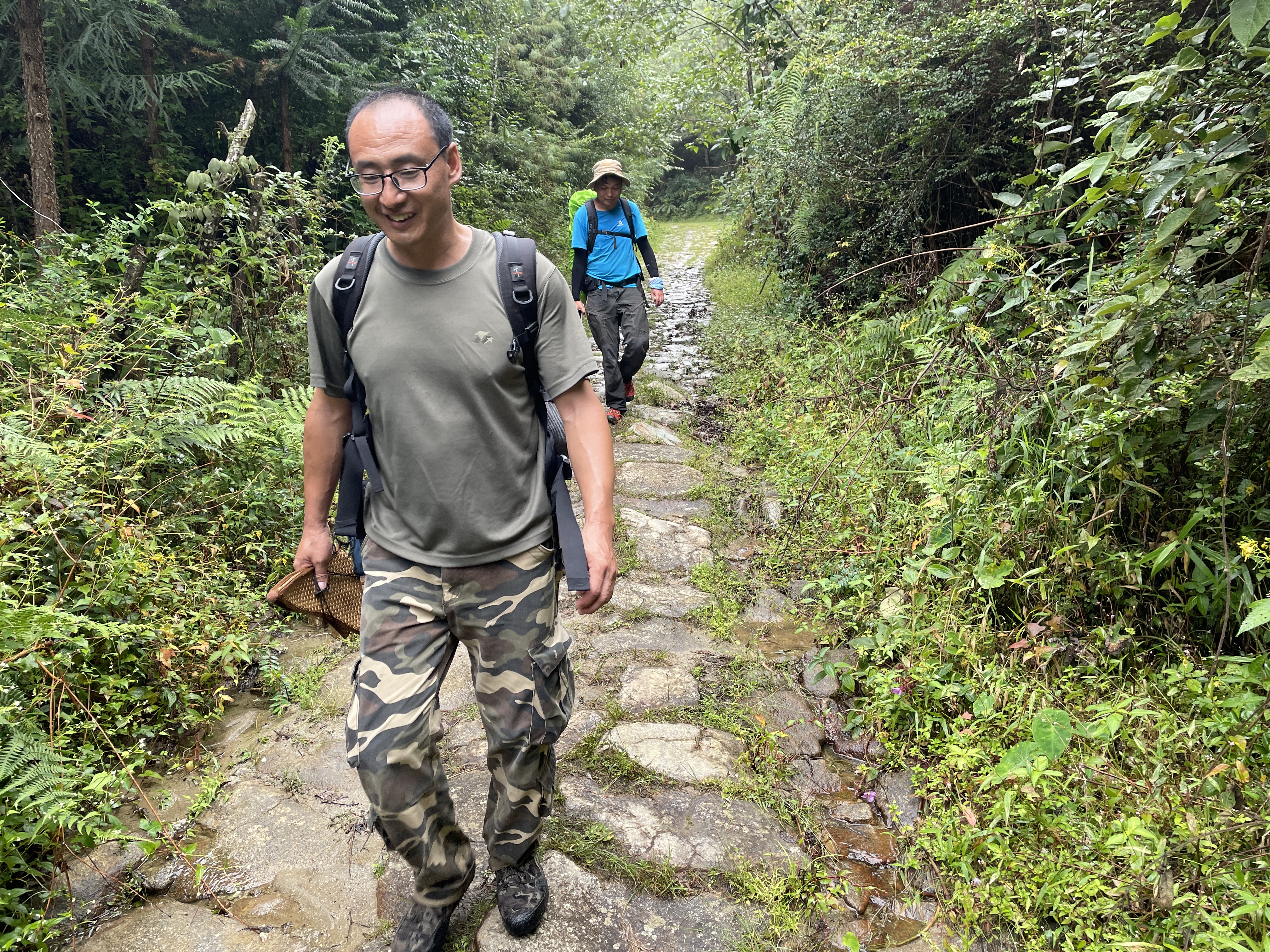
This happened recently in the rugged Hengduan Mountains of southwestern China, where Paul and partners Yang Wendou and Sonam Gelek met middle-school student, Yixi Zhuoma, 13, and high schooler Hu Xiangxiang, 17, from Jiulong, a remote town in Sichuan Province. Both are members of China’s ethnic minorities. Yixi is ethnic Tibetan. Hu is ethnic Yi. Their parents gave them permission to walk along with the team for about seven miles. The two friends write about that experience below.
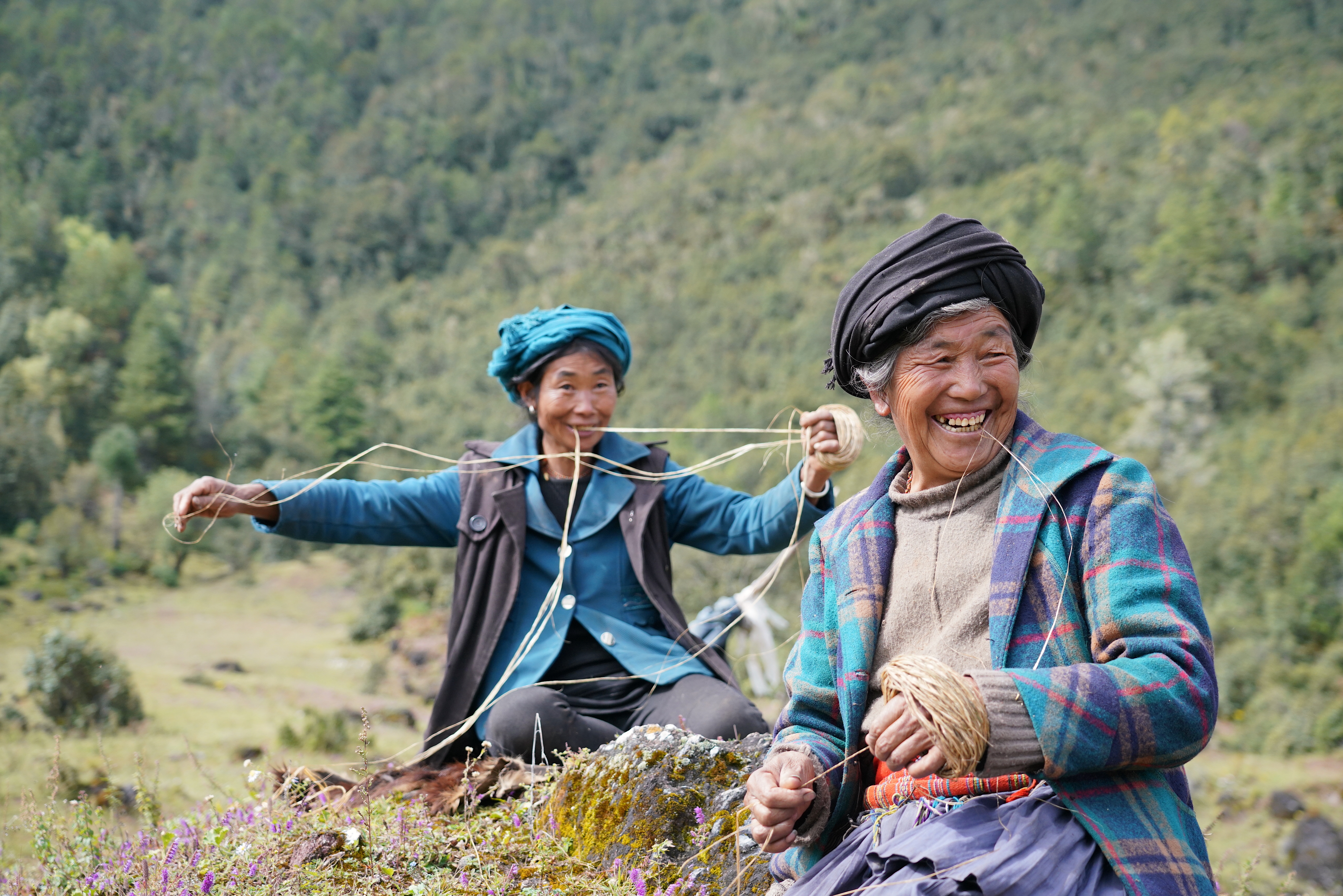
When contacted recently, the girls were roaming the pine forests of their home landscape, harvesting caterpillar fungus—a mushroom delicacy—with their community.

Yixi Zhuoma's family hosted Paul Salopek in their farmhouse. They are joined by Yixi’s friend Hu Xiangxiang.
Paul Salopek
Yixi Zhuoma: Rediscovering my mountains on foot
From the beginning of my hike, there was an excitement in my heart to walk with Mr. Paul in our mountains. But honestly, when he asked us to write an essay, I hesitated. I was overwhelmed with a mixture of emotions.
At first, when we set out, I couldn't even imagine that I could finish the 12 kilometers into Jiulong. We walked together as a group, chatting about our daily lives in the villages as well as about various abstract ideas. Although there was a language barrier, we could sense each others' enthusiasm. A hiking trip like this used to be unimaginable for us, but as I walked, I began feel what it’s like to slow down. It let me discover the beauty of the world and experience the harmony and warmth of nature.
We hiked on a road and looked at the scenery through our camera lenses, and we discovered that the mountains and lakes were also looking back at us.
The mossy stone steps of the hills stretched up, and the bells of yaks rang from deep in the mountains. We saw the prayer flags dancing over the white towers of stupas, and we wished to invite people from the outside to experience our culture here! There are many rivers in our mountains. Walking along them, you will be delighted by the freshness and cleanness of them all. The mountains themselves are magnificent and steep. Look into the distance, and you will see the blue sky and white clouds. And after you experience the traditions and customs of our area, you won't wish to leave this welcoming place, with all the singing and dancing that goes on here.
There are ancient legends handed down by the older generation. This is the home of the descendants of the Yi and Tibetans. This is a fascinating place with a heritage of culture and history. All of this makes me proud of my hometown!
Time here passes particularly slowly.
When I was about to reach the end of our hike, I realized the deeper significance of the trip was not in the scenic spots, and not in the destination, but on the footsteps we planted along the road itself.

The rugged Hengduan Mountains: home to the student-walkers.
Paul Salopek
Hu Xiangxiang: Walking to remember
Bright moonlight is shining through my window, and my family has already fallen asleep, but I am writing under a house lamp. I feel both excited and hesitant writing about my recent walk in the mountains near Jiulong, worrying that I can’t write well.
As the saying goes, everything is difficult at the beginning. This is exactly the case when I made up my mind to walk the mountain road. In fact, at first, I didn't expect to go with Mr. Paul at all. I was curious about his journey. But when my mother suggested I join his team, I changed my mind immediately and decided to make an attempt.
In the mornings, our roads in the mountains can seem terribly quiet, but in fact there are sounds everywhere. Bees buzz in the bushes, and birds fly under the eaves of tin roofs. Along our route, we talked a lot about human geography and our different lives, all accompanied by the sounds of local rivers. I realized then, as the old saying goes, that “It is better to travel 10,000 miles than to read 10,000 books.”
One idea that lingers from the walk is about appreciating the past.
What did the road we were walking along look like in the time of my parents and grandparents? How many people can still remember its original appearance? Maybe it only exists in the memory of the older generations. Just as the singer Mao Buyi's lyrics say: “Those who are too young do not know satisfaction. They are too stubborn, and they are unwilling to pause their steps while hurrying towards distant places.” Maybe we are all trapped in the endless routine of trying to walk upwards to our goals, while gradually forgetting what we were like originally, and what we had in our mind and heart originally.
After this walk, I made similar reflections: Whether it is worth remembering the original appearance of that road, and whether I still remember the original dreams of my own.
We also talked about the issue of national cultural heritage. While learning what is good in foreign cultures, we should also make commitments to not forget the splendid 5,000-year culture left by our own ancestors. This is one of the sources of strength for our modern achievements and our wealth. In practice, for example, we pass on our cultural riches every year through the Spring Festival, Lantern Festival, and other traditional celebrations. This is the responsibility and obligation of all sons and daughters of China, and as one myself, I am also duty-bound. There are also other cultural gifts that we need to never forget, such as Tang poetry, Song Ci poetry, Yuan opera, the novels of the Ming and the Qing Dynasties, and the Four Great Inventions of ancient China.
Traveling with Mr. Paul is a valuable experience in my life. I wish to thank the Out of Eden Walk for giving me this opportunity and the inspiration it has brought to me.