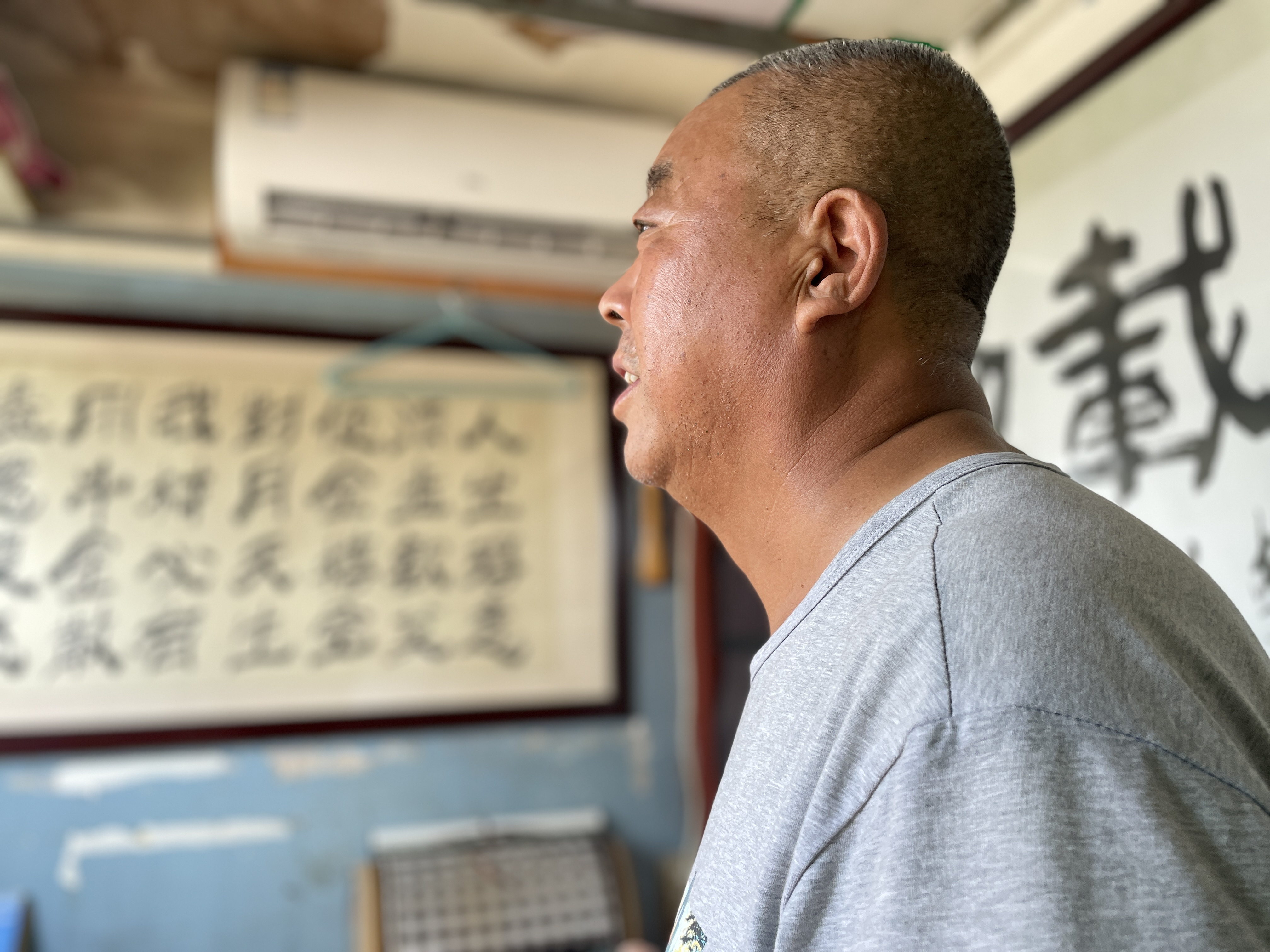
“I saw them when I was a young boy. They were always bent over.”

At his small museum in Sichuan, village historian Chen Shoukang shows how a porter would use a sweat scraper.
Paul Salopek
“They were poor. They had no other choice,” old Chen explains. “By the 1950s they were replaced by trucks.”
Rummaging through his backroom museum, Chen suddenly grins. He holds up an object made of bamboo: a strange, bladelike tool. It is an antique “sweat wiper” designed to scrape perspiration from the brows and eyes. A long time ago, it once dangled by a string from the wooden pack frame of a tea porter. An artifact from an emphatically bygone era. From a different planet. A relic of extreme human experience—of boggling endurance—that today is virtually impossible to access or comprehend.
I am walking across the world. The heaviest item in my rucksack is a laptop computer weighing two pounds. On this segment of my trek through China, I am joined by three philosopher friends. Li Mengchi is a seeker who guides tourists into the deserts of Arabia. Yang Wendou is a sage who teaches schoolchildren Yunnanese culture. And Cheng Xinhao is the brilliant maker of conceptual art videos. Walking, they argue the merits of idealism over realism, of memory over forgetting. They sing the Mandarin version of “The Internationale” in the driving rain.
Together we hike over Erlang Shan, a stormy, 11,200-foot massif that once tested the old tea porters’ will. The colossal peak looms over fading trading paths between Kangding—a historic Tibetan outpost of tea markets and icy winters—and Ya’an, a lush, lowland hub of tea production in Sichuan Province, some 130 miles to the east.
This rugged borderland is notorious for its hazards.
At his small museum in Sichuan, village historian Chen Shoukang shows how a porter would use a sweat scraper.
Paul Salopek
“They were poor. They had no other choice,” old Chen explains. “By the 1950s they were replaced by trucks.”
Rummaging through his backroom museum, Chen suddenly grins. He holds up an object made of bamboo: a strange, bladelike tool. It is an antique “sweat wiper” designed to scrape perspiration from the brows and eyes. A long time ago, it once dangled by a string from the wooden pack frame of a tea porter. An artifact from an emphatically bygone era. From a different planet. A relic of extreme human experience—of boggling endurance—that today is virtually impossible to access or comprehend.
I am walking across the world. The heaviest item in my rucksack is a laptop computer weighing two pounds. On this segment of my trek through China, I am joined by three philosopher friends. Li Mengchi is a seeker who guides tourists into the deserts of Arabia. Yang Wendou is a sage who teaches schoolchildren Yunnanese culture. And Cheng Xinhao is the brilliant maker of conceptual art videos. Walking, they argue the merits of idealism over realism, of memory over forgetting. They sing the Mandarin version of “The Internationale” in the driving rain.
Together we hike over Erlang Shan, a stormy, 11,200-foot massif that once tested the old tea porters’ will. The colossal peak looms over fading trading paths between Kangding—a historic Tibetan outpost of tea markets and icy winters—and Ya’an, a lush, lowland hub of tea production in Sichuan Province, some 130 miles to the east.
This rugged borderland is notorious for its hazards.
Trekking the old trading trails in Sichuan is no stroll in the park—let alone if you had to shoulder 250 pounds of tea.
Out of Eden Walk
The ramparts of the Tibetan Plateau knife up from the Sichuan Basin into an austere world of heavy fogs, ice, snow, and strong winds. Landslides and rockfalls are common. We slip, crazy-legged, up and down steep goat trails greased by wet mud. We hopscotch along abandoned roads that are chopped to pieces by flash floods. Dripping cedars loom out of the heavy mists. Rotten snow clings to the blue pine shadows. At rest stops, we sometimes spot curious holes drilled into flat bedrock. These small cavities were worn by the action of thousands of wooden guaizi: the indispensable walking sticks of a vanished army of tea porters. Catching their breath, the tough beifu would fit their t-shaped alpenstocks into such sockets to prop up their enormous packs, which they rarely removed on the trail.

People were more economical than packhorses. At the peak of this commerce, they moved nearly 16 million pounds of tea a year.
Photograph courtesy A. L. Shelton
By the early 1700s, say historians, the expanding Qing Dynasty had pushed into Sichuan’s ethnic Tibetan regions, and began exporting vast consignments of the region’s cheap, dark tea to the peoples of the Himalaya. At its peak, this commerce moved nearly 16 million pounds of tea a year, all of it pressed into dry bricks, and the bulk of it transported from the plantations on human backs. People were more economical conveyances than packhorses. Most of the carriers were men. But women and children sometimes portered too. Their thousands of cargoes ended up steeping in millions of cups of yak butter tea.
“Heavy, long-distance carrying is well-known elsewhere in the world, particularly in Nepal,” writes Patrick Booz, an expert on the Chinese tea trade at Columbia University, in New York, “but nowhere else—ever—did porters carry loads of such awful weight, with such little time for rest.”
The beifu traversed the length of Sichuan’s tea roads in about 20 days. Their burdens were so crushing they averaged just seven miles a day. Two hundred and fifty pounds was considered a moderate load, Booz notes. But packs tipping 400 pounds weren’t unusual.
“I can still feel the pain,” says Wang Shikang, 89, among the last living beifu in the village of Kang Zhi. “I have rheumatism in my knees and back.”
People were more economical than packhorses. At the peak of this commerce, they moved nearly 16 million pounds of tea a year.
Photograph courtesy A. L. Shelton
By the early 1700s, say historians, the expanding Qing Dynasty had pushed into Sichuan’s ethnic Tibetan regions, and began exporting vast consignments of the region’s cheap, dark tea to the peoples of the Himalaya. At its peak, this commerce moved nearly 16 million pounds of tea a year, all of it pressed into dry bricks, and the bulk of it transported from the plantations on human backs. People were more economical conveyances than packhorses. Most of the carriers were men. But women and children sometimes portered too. Their thousands of cargoes ended up steeping in millions of cups of yak butter tea.
“Heavy, long-distance carrying is well-known elsewhere in the world, particularly in Nepal,” writes Patrick Booz, an expert on the Chinese tea trade at Columbia University, in New York, “but nowhere else—ever—did porters carry loads of such awful weight, with such little time for rest.”
The beifu traversed the length of Sichuan’s tea roads in about 20 days. Their burdens were so crushing they averaged just seven miles a day. Two hundred and fifty pounds was considered a moderate load, Booz notes. But packs tipping 400 pounds weren’t unusual.
“I can still feel the pain,” says Wang Shikang, 89, among the last living beifu in the village of Kang Zhi. “I have rheumatism in my knees and back.”

Wang Shikang, 89, once carried bricks of tea across the mountains of Sichuan to Tibet. “I have rheumatism in my knees and back,” he says of the physical toll it took.
Paul Salopek
Wang’s eyes glitter in the leather shield of his face as he recalls his days as a teenager in the twilight of the foot trade, before paved roads penetrated the region during World War II. He slept on plank beds with scores of other rag-wrapped carriers at porters’ inns. He gulped cold dumplings to fuel his outraged muscles. Each trek to the alpine tea markets earned a palmful of coins: a survival wage that bought a sackful of corn or rice.
“There used to be many robbers between Kangding and Luding,” Wang says loudly, in the way of the hard of hearing. “The bandits couldn’t care less about our tea. They always attacked us on the return trip, after we’d been paid. We walked in groups of 20 for protection.”
The wretched beifu faced other hardships.
Some were press-ganged into the armies of China’s civil war between communists and nationalists. Porters collapsed of hunger or exposure on frozen mountain trails. Others fell to their deaths. The corpses were rolled into anonymous graves. Their loads were carried on.
“But there was happiness even in bitter times,” old Chen, the village historian, tells me. “My grandfather carried a flute along with his heavy load. He played music on rest stops.”

Statues at the modern tea-growing center of Ya’an, in Sichuan, honor the porters of old.
Paul Salopek
Tottering onward in slow columns, Chen says, the beifu swapped jokes and stories to ease their suffering. In mixed groups there was flirting. Such human resilience isn’t reflected in the somber statues honoring the porters in Ya’an, still a tea-growing center.
We plod a noisy highway down from the drizzly mountains.
Our small party samples tea at modern plantations that pack their harvests into souvenir versions of the bamboo-wrapped tea bricks hauled by the old-time carriers. My colleagues Yang and Cheng debate the role of imagination. (“Dreamers end up with hard lives.”)
And on the last miles of the ghostly tea trails of Sichuan, we encounter our first human being on foot: a lone young woman filming herself on a phone, chatting with her followers on social media, as she pushes a cart to Tibet.
Statues at the modern tea-growing center of Ya’an, in Sichuan, honor the porters of old.
Paul Salopek
Tottering onward in slow columns, Chen says, the beifu swapped jokes and stories to ease their suffering. In mixed groups there was flirting. Such human resilience isn’t reflected in the somber statues honoring the porters in Ya’an, still a tea-growing center.
We plod a noisy highway down from the drizzly mountains.
Our small party samples tea at modern plantations that pack their harvests into souvenir versions of the bamboo-wrapped tea bricks hauled by the old-time carriers. My colleagues Yang and Cheng debate the role of imagination. (“Dreamers end up with hard lives.”)
And on the last miles of the ghostly tea trails of Sichuan, we encounter our first human being on foot: a lone young woman filming herself on a phone, chatting with her followers on social media, as she pushes a cart to Tibet.