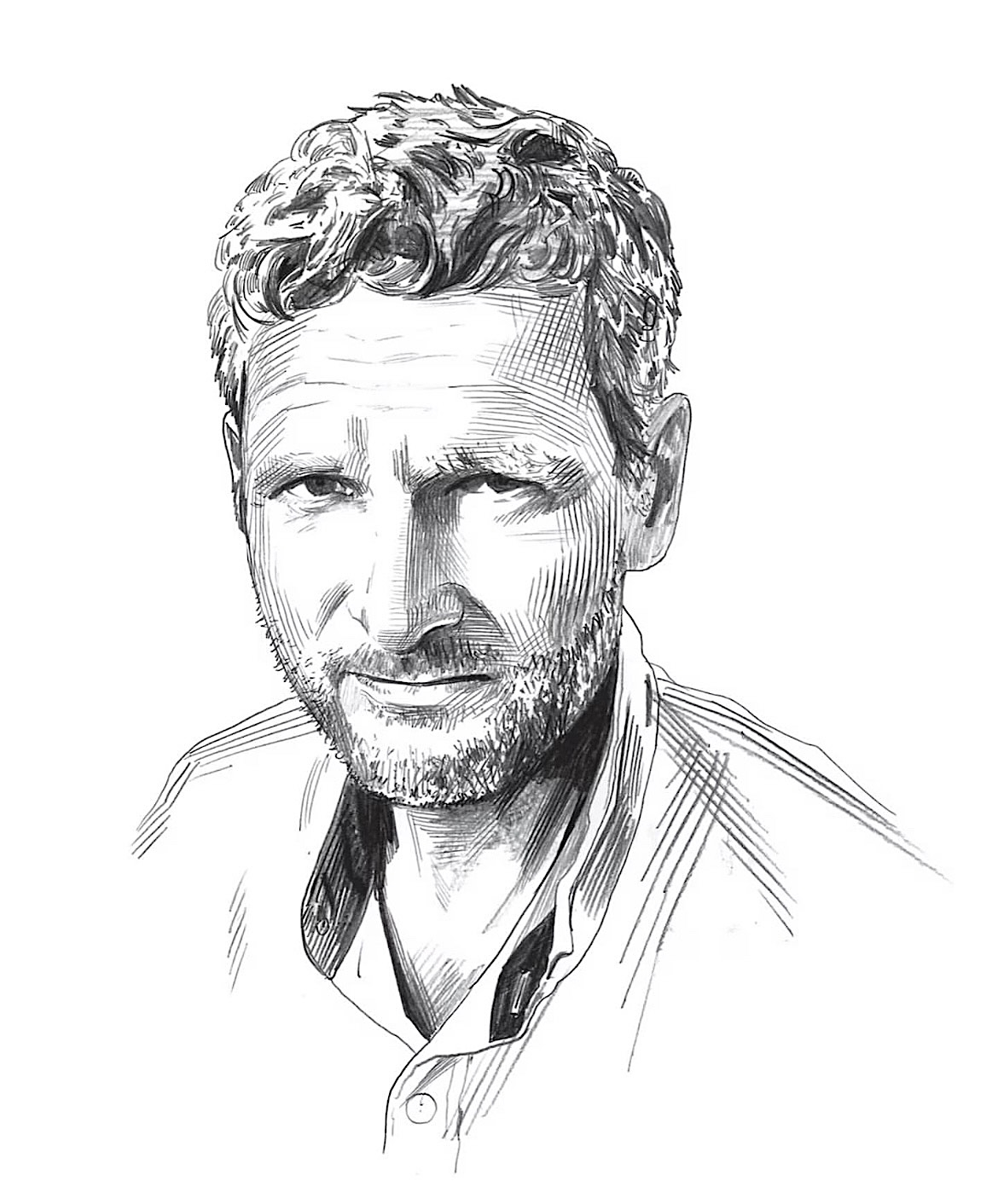
Meet Frank Geng.
Easygoing. Quiet. An athletic man endowed with a fine analytical mind. (Geng works for a blue-chip investment firm in Shanghai). He is my walking partner in China. At this moment, he is walking backwards into the Qinling Mountains in Shaanxi Province.
This is no small exploit.
Topping out above 12,000 feet, the Qinling’s chilly peaks scrape the sky. They form the fulcrum point of China. A colossal barrier. A vast geographical frontier. Their east-west-running ramparts of marble and gneiss, stretching across a thousand miles, divide the nation into north and south. Every Chinese schoolchild knows this. To the south of the range: Citizens are stereotypically shorter, more introverted, and prefer to eat rice. To the north: People are frequently taller, more garrulous, and partial to noodles. The weather is hot and steamy south of the Qinling, where each inhalation feels like breathing through wet cotton balls. The air north of the mountains is cooler and drier, gritty with the dust of Central Asia. Etcetera.
“Clouds envelop Qinling Mountain and I do not know where my home is,” lamented the Tang Dynasty poet Han Yu as he rode across the huge massif into exile. “The snow covers Languan Pass and the horses will go no further.”
Haunting lines. But the Qinling Mountains also wreck the knees of poor Frank Geng.
Out of Eden Walk
Up and down back roads we plod. Geng is a stoic. He never complains. Yet I glimpse him in the early mornings as he discreetly performs knee exercises. I notice with growing concern his lagging pace. It is the brutal pounding of the downhills: Each footfall strikes a blow on his patellas. But Geng does not give up. He discovers that walking backwards is easier. It relieves pressure on his knees. In this way, he strides blindly, in reverse, for six long miles through the Qinling foothills.
“Have you ever walked backwards this far?” I ask him. (It is raining: We are on the south side of the mountains.)
“No. Not at all,” Geng says from beneath his umbrella.
“But it seems like it involves a lot of trust,” I say. “You don’t know where you’re going.”
“I turn around roughly every hundred meters,” Geng explains mildly. “This is a wide road. There are no cars.”
Geng is a son of the Enlightenment. A rationalist. A believer in the laws of thermodynamics and gravity. A follower of logic. By contrast, the grizzled old innkeeper in the next village who refuses us shelter at night is none of these things. He blinks in amazement at the lunatics tottering about in the rain. One of whom walks backwards. During a pandemic. He is polite but will not relent. We must press onward into the sodden dark. We end up pausing the walk and hitching a ride to a hotel.
Such is Frank Geng’s own Qinling divide: a false summit, separating the north of relief from the south of pain.
* * *

Walking partners Li Huipu and Frank Geng navigate storm damage on country roads in the Qinling's foothills in Shaanxi Province.
Paul Salopek
Meet Li Huipu.
Li is an education program developer from Chengdu, the capital of Sichuan. In Qinling terms, a southern woman. Li is also my walking partner in China. She is resourceful, utterly game, and strategically honest. (“I told you before we started that I had lots of hiking experience,” she tells me after concluding our walk. “I’d never hiked in my life.”) She has earned a degree from Burn Maw.
“What’s Burn Maw?” I ask.
“Bryn Mawr!” Li rolls her eyes. “Bryn Mawr College!”
We scale the Qingling through broadleaf forests. We slide down, down, down past herds of grazing takin—the strange, cow-size, shaggy-haired goat-antelopes of alpine Asia—to follow swoon-cold rivers where five-foot salamanders doze. We walk the hard rims of concrete highways that plummet to the flatlands of the Anthropocene. Li is tough. I extoll her strength to a beekeeper, a middle-aged man, in a Qinling village.
“Even in the worst bamboo thickets,” I say, “she never gives up. She never turns around.”
“If a car was available to carry her home,” snorts the beekeeper, exhaling cigarette smoke, “she’d turn around.”
At the beekeeper’s farm, we saw the armored carcasses of fierce insects scattered atop the wooden hives: the exoskeletons of giant hornets ("murder hornets").
Walking partners Li Huipu and Frank Geng navigate storm damage on country roads in the Qinling's foothills in Shaanxi Province.
Paul Salopek
Meet Li Huipu.
Li is an education program developer from Chengdu, the capital of Sichuan. In Qinling terms, a southern woman. Li is also my walking partner in China. She is resourceful, utterly game, and strategically honest. (“I told you before we started that I had lots of hiking experience,” she tells me after concluding our walk. “I’d never hiked in my life.”) She has earned a degree from Burn Maw.
“What’s Burn Maw?” I ask.
“Bryn Mawr!” Li rolls her eyes. “Bryn Mawr College!”
We scale the Qingling through broadleaf forests. We slide down, down, down past herds of grazing takin—the strange, cow-size, shaggy-haired goat-antelopes of alpine Asia—to follow swoon-cold rivers where five-foot salamanders doze. We walk the hard rims of concrete highways that plummet to the flatlands of the Anthropocene. Li is tough. I extoll her strength to a beekeeper, a middle-aged man, in a Qinling village.
“Even in the worst bamboo thickets,” I say, “she never gives up. She never turns around.”
“If a car was available to carry her home,” snorts the beekeeper, exhaling cigarette smoke, “she’d turn around.”
At the beekeeper’s farm, we saw the armored carcasses of fierce insects scattered atop the wooden hives: the exoskeletons of giant hornets ("murder hornets").

The carcasses of Asian giant hornets ("murder hornets") at a bee farm in the Qinling Mountains.
Paul Salopek
Big as a thumb and a ferocious predator of bees, the giant hornets were felled by “bee balls”—dense agglomerations of sister bees who furiously swarmed the hornets and by vibrating their wings, raised their collective body temperature to 115 degrees Fahrenheit (46 Celsius). In effect, the bees smother and cook their larger enemies to death. Li chewed gum listening to this tale. Now she stares at the beekeeper the way I imagine bees appraise giant hornets.
One of Li Huipu’s divides in the Qinling: a ridge between bone-headed underestimation and transparent virtuosity.
* * *
Meet Liu Lifeng.
A cultural tourism expert from Beijing: A savvy problem-solver. Liu has traveled the world. She is my next walking partner in China. She agrees to join me beyond the Qinling, trekking into the arid plateaus of north China proper.

Walking partner Liu Lifeng leads the way from the Qinling Mountains to the Silk Road city of Xi’an, in Shaanxi.
Paul Salopek
The Qinling—the great hinge of China—recedes behind us: A mountain wall holding back a sea of subtropical clouds. We seesaw down its last rumpled northern foothills. We buy water in drowsy villages where shop doors are curtained with plastic against blowing sand from Mongolia. New dryland crops appear in fields. Millets. Plums. Cabbages. These are the last days of China’s zero COVID policy. The farmlands look empty, almost eerily so. Cities are flipping between lockdowns and reopenings. We reach Louguantai, the famous Daoist temple where, according to legend, the philosopher Lao Tzu wrote down the Tao Te Ching, his metaphysical map of The Way. But this walled shrine too is shuttered by quarantines. So we slog on—to Xi’an, the ancient Silk Road metropolis of Shaanxi.
Miles of exurbs bristle with hundreds—no, thousands—of apartment towers. These monoliths soar like gigantic dominoes into a dust-whitened sky. The area was hand-tilled cornfields when Lui grew up in Xi’an in the 1980s.
“Local trains sometimes only had old cargo cars available for passengers,” she recalls of her childhood in the city. “There was no seating of any kind. You just stood up in them.”
It is always strange to walk into a city with a rucksack. We use hiking apps on our phones to steer to a downtown Starbucks. Sitting at a table with her coffee in her hands Liu says, to nobody in particular: “There were coupons for meat when I was a child. You got it once a week. And ration cards for other foods.”
The Qinling divide that courses through Liu runs through many other Chinese. Especially those who have lived 40 or so years through the most radical economic upshift in human history. It is an unscalable pass between generations of memory and generations of forgetting.
* * *

“Whenever you put a shovel into the ground in Xi’an you always hit something old,” says archaeologist Zhang Jianlin.
Paul Salopek
Meet professor Zhang Jianlin.
Zhang raises a glass of wine in a French restaurant near the Old City wall in Xi’an. The wine is a black-eyed merlot.
“Gān-bēi!” says Zhang.
“Salud!” I toast back.
“Welcome to Xi’an,” Zhang says.
“To history,” I respond. “Our teacher.”
Zhang is an archaeologist emeritus from the Shaanxi Provincial Institute of Archaeology. He is an honorary walking partner—friendly, unpretentious and wry, and a true scholar. (That is, he is generous with his learning.) He wears rumpled dungarees, the international uniform of archaeologists. He chain smokes. His specialties are the Sui and Tang dynasties.
“There is too much archaeology here,” Zhang complains. “Whenever you put a shovel into the ground in Xi’an you always hit something old.”
Xi’an was one of the original capitals of China, once called Chang'an. With more than a million inhabitants in the eighth century, it was the largest city in the medieval world. A multicultural bazaar. A gateway of trade to Europe and beyond. The wandering Buddhist monk Xuanzang departed from Chang’an in the seventh century to walk to India. He was away for 17 years. Marco Polo allegedly rode through Chang’an on horseback, noting the abundance of non-Han foreigners. By this he meant Arabs, Koreans, Indians, Turkish nomads, Japanese, Mongols, Tibetans, Jews, and Persian Christians. Today the city remains a storehouse of historical treasure. There is the famous Nestorian stele at the Beilin museum and the 8,000 terracotta warriors buried in Lintong.
“Whenever you put a shovel into the ground in Xi’an you always hit something old,” says archaeologist Zhang Jianlin.
Paul Salopek
Meet professor Zhang Jianlin.
Zhang raises a glass of wine in a French restaurant near the Old City wall in Xi’an. The wine is a black-eyed merlot.
“Gān-bēi!” says Zhang.
“Salud!” I toast back.
“Welcome to Xi’an,” Zhang says.
“To history,” I respond. “Our teacher.”
Zhang is an archaeologist emeritus from the Shaanxi Provincial Institute of Archaeology. He is an honorary walking partner—friendly, unpretentious and wry, and a true scholar. (That is, he is generous with his learning.) He wears rumpled dungarees, the international uniform of archaeologists. He chain smokes. His specialties are the Sui and Tang dynasties.
“There is too much archaeology here,” Zhang complains. “Whenever you put a shovel into the ground in Xi’an you always hit something old.”
Xi’an was one of the original capitals of China, once called Chang'an. With more than a million inhabitants in the eighth century, it was the largest city in the medieval world. A multicultural bazaar. A gateway of trade to Europe and beyond. The wandering Buddhist monk Xuanzang departed from Chang’an in the seventh century to walk to India. He was away for 17 years. Marco Polo allegedly rode through Chang’an on horseback, noting the abundance of non-Han foreigners. By this he meant Arabs, Koreans, Indians, Turkish nomads, Japanese, Mongols, Tibetans, Jews, and Persian Christians. Today the city remains a storehouse of historical treasure. There is the famous Nestorian stele at the Beilin museum and the 8,000 terracotta warriors buried in Lintong.

Some 8,000 terracotta warriors are arrayed for battle at the burial tomb of Qin Shi Huang, the first emperor of China, near Xi’an. The funerary army is 2,200 years old.
Paul Salopek
Zhang takes me to the Wei River valley outside Xi’an.
Eighteen Tang emperors lay buried here, in China’s version of the Valley of the Kings on the Nile. I climb ahead. I see farmers below at work in fallow fields under a good sun. The fields are brittle gold. I see Professor Zhang inching happily up a miles-long spirit path lined with tomb guardians—columns of 1,300-year-old, life-size stone animals, officials, and soldiers. I look for but don’t see the Qinling Mountains. Perhaps they are too far. No matter. Their inevitable divide cleaves me too, regardless. A frontier between aloneness and belonging. I feel it, squinting down at the backs of my weather-beaten hands, at the halfway mark of my walk across the world.