Near Danyang, South Korea: 36° 57' 38" N, 128° 19' 57" E
I am walking to Suyanggae, South Korea, an archaeological zone that holds rare and precious relics of the peoples I am following on my insane walk across the globe: early Homo sapiens, the first Stone Age wanderers out of Africa who explored the farthest rims of our planet. I have been plodding after these ghostly pioneers, on foot, for 11 continuous years. I so far have paced off 27,000 kilometers through the Ethiopian Rift Valley, Middle Eastern deserts, the oases of Central Asia, Himalayan snowcaps, the flooded alluvial plains of India, and all of China. I have read books. I have pored over scientific papers. I have interviewed experts in many countries. Still, I must admit, I know almost nothing of my quarry. They remain strangers.
Along a highway near the town of Jecheon, I meet a man in a faded ballcap harvesting tobacco by hand. His name is Oh Sewon. He is 72.

Oh Sewon, 72, hand-harvests his tobacco crop near Jecheon, South Korea—a Neolithic activity carried out next to a buzzing highway.
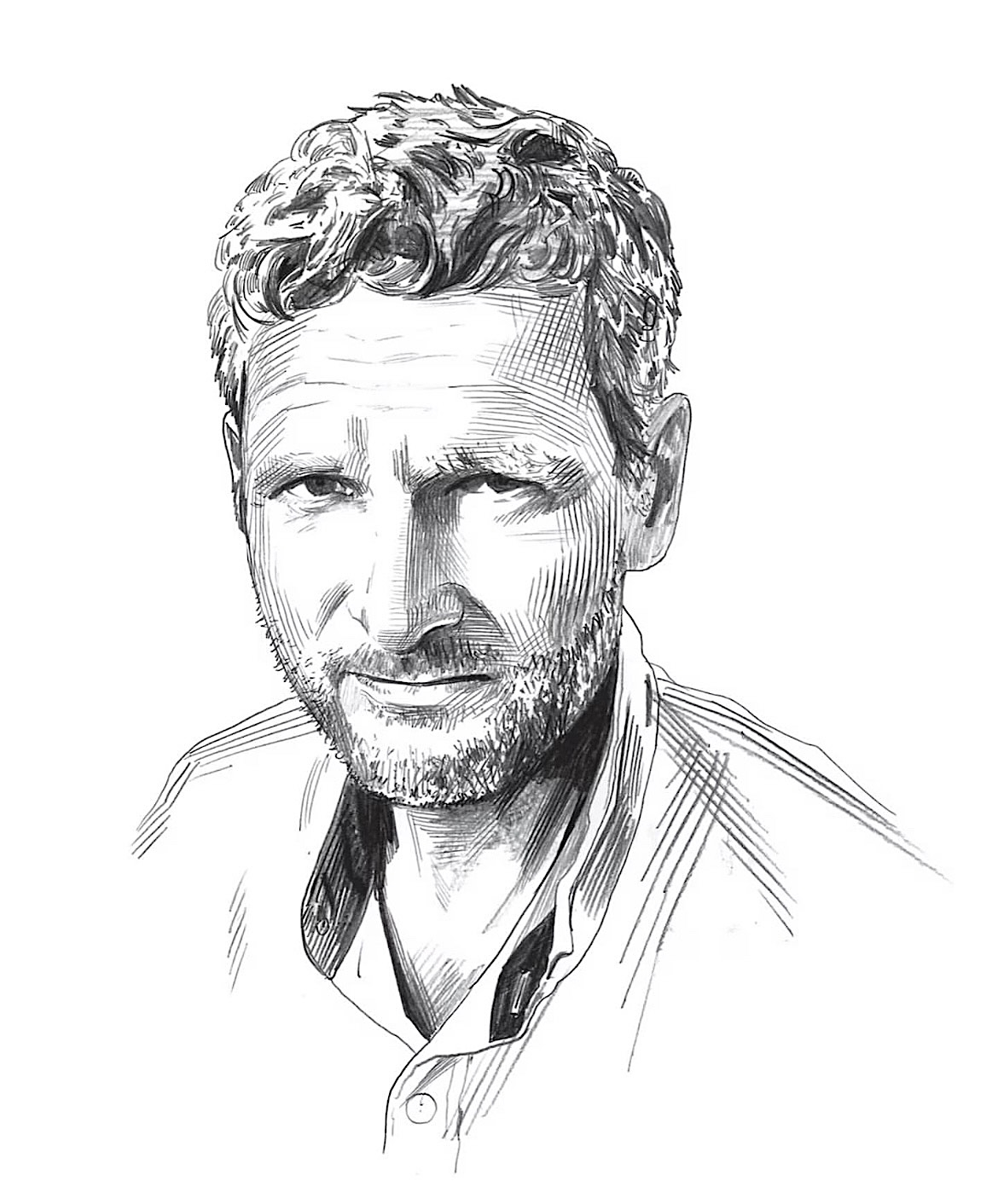
Paul Salopek
“I’ve been smoking since day one. My mother smoked when she was pregnant with me,” growls Oh, above the traffic booming past his scraggly field. “I still smoke two packs a day. I don’t believe what TV says—about smoking being about death. They tell you, ‘No cigarettes, no alcohol,’ . . .” His voice trails off.
Two young Koreans appear in the afternoon heat. They stroll by on the sidewalk, holding hands. I blink with astonishment: a pair of teenagers, a boy and a girl. They wear Hip Hop baggies. The boy with an earring. The girl in chunky platform sneakers. They are the first human beings I have witnessed engaged in the act of walking, outside the big cities, across 300 kilometers of Korea. Are they lost? A mirage? Oh follows my stare. His face puckers into a mocking grin. “Hah!” he snorts. “Those don’t smoke.”
I want to call out to the kids, who pay us no mind:
Here we are! Can’t you see us? Reeling under the sun? Among these wilted leaves? Clinging to our antique vices? Two bonafide cavemen?
The Stone Age gets a disco twist in South Korea.
Out of Eden Walk
The archaeological sites at Suyanggae are between 40,000 and 10,000 years old.
This places them at the grand turning point of the Paleolithic-Neolithic divide. Roughly 300,000 years of nomadism, a golden era of footloose hunting and gathering across open landscapes, was ending. Agriculture and its attendant routines of settlement were taking root. Genesis 3:19: “By the sweat of your brow you shall eat bread.” In other words, the birth of daily 9-to-5 toil.
Suyanggae includes caves and terraces with pleasant views above the green-brown Namhan River, which slides among lushly forested limestone hills, very nearly at the center of the Korean peninsula. Scientists carrying out salvage digs before dams flooded the region in the 1980s were agog at numbers of artifacts emerging from their pits. More than 30,000 stone cores, blades, and cobble hammers were unearthed at one campsite. Such volumes of relics suggest that Suyanggae was one of the world’s major Stone Age tool-making centers. The cave floors hid vast piles of stone-hacked deer bones. Other fossils show that extinct lions, tigers, and monkeys once lived in nearby forests.

Suyanggae’s famous prehistoric “measuring tool” is featured in a timeline at the site’s museum. It is the elongated object at the middle right.
Paul Salopek
“Among all the stone tools, we found one unlike anything else in Asia,” says Jong Yoon Woo, the senior archaeologist at the site. “It reflects our earliest psychology.”
Woo refers to a strange, elongated, hand-size cobble found incised with 23 precisely spaced notches. Perhaps it served as an incredibly ancient measuring stone, Woo conjectures—a dawn instrument conceived to somehow parse our world. In its stark simplicity and utter muteness, the rock has mystified scholars for years.
“Maybe it measured seasonal activity like berry ripening or the annual trout migrations in the river,” suggests archaeologist Hyeong Woo Lee, at Chonbuk National University. “It may have been a type of calendar.”
I consider these hypotheses as I slog the sweltering banks of the Namhan River, passing under the soaring concrete buttresses of modern highway bridges. I ponder them gazing at the Google maps on my phone screen. All the zeroes and ones of our coded lives. The ticking of our atomic clocks. Did our human rage for order start here, in Suyanggae?
Suyanggae’s famous prehistoric “measuring tool” is featured in a timeline at the site’s museum. It is the elongated object at the middle right.
Paul Salopek
“Among all the stone tools, we found one unlike anything else in Asia,” says Jong Yoon Woo, the senior archaeologist at the site. “It reflects our earliest psychology.”
Woo refers to a strange, elongated, hand-size cobble found incised with 23 precisely spaced notches. Perhaps it served as an incredibly ancient measuring stone, Woo conjectures—a dawn instrument conceived to somehow parse our world. In its stark simplicity and utter muteness, the rock has mystified scholars for years.
“Maybe it measured seasonal activity like berry ripening or the annual trout migrations in the river,” suggests archaeologist Hyeong Woo Lee, at Chonbuk National University. “It may have been a type of calendar.”
I consider these hypotheses as I slog the sweltering banks of the Namhan River, passing under the soaring concrete buttresses of modern highway bridges. I ponder them gazing at the Google maps on my phone screen. All the zeroes and ones of our coded lives. The ticking of our atomic clocks. Did our human rage for order start here, in Suyanggae?

The Namhan River in central South Korea, an ancient corridor of human migration.
Paul Salopek
“Suyanggae is so precious yet so submerged. If you look at our species’ time on Earth as a single day, we’re living only inside the last five minutes—that’s recorded history. Prehistory, which we know little about, is the 23 hours and 55 minutes that went before.”
It is archaeologist Woo. He seems in a melancholy mood. In passing, he hints at troubles at home. His wife is a history teacher.
“So,” I say, cheerily. “You have the past in common”
“The past isn’t the issue,” replies Woo. “It’s the future.”

Archaeologists Jong Yoon Woo (foreground) and Hyeong Woo Lee take in a Stone Age diorama at the Suyanggae museum in South Korea.
Paul Salopek
A stocky, sun-weathered man with a greying mop of hair, Woo takes me to the Suyanggae museum. The facility is a head-spinning mashup of science and K-pop culture. There are dioramas of typically hirsute, spear-clutching early humans jabbing at wild pigs along the Namhan River. An old railway tunnel then guides the sparse visitors—through artificial fog, colored lasers, and stirring, credits-rolling, orchestral Muzak—to a garden where effigies of cave people stand about frozen in various poses: tool-making, baby-nursing, hurling weapons. The ancestors’ expressions are jut-jawed and brainless. Interspersed with these musty 19th-century stereotypes stand gaudy cut-outs of modern ballerinas, hearts, and stars. The garden is decorated with light-emitting diodes fashioned as plastic flowers.
“We fought this,” sighs Woo, rubbing his brow. “The local government thought that prehistory was boring.”
Woo and his colleague Lee, two collectors of time united by the obscurity of their pursuits, invite me to a goodbye meal. We sit at a gigantic table inside a diner specializing in garlic-infused Korean dishes. They toast history with the national grain alcohol, soju. Woo finally asks me, clapping down his glass, what single lesson has emerged from my global walk. I tell him there is no lesson. “Aha,” he says, nodding vigorously in assent. “That’s the lesson.”
I walk south toward the Sea of Japan.
And the enigmatic measuring stone of Suyanggae? What does it mean? I believe it may have ticked off dreams. It was, most likely, a personal accounting of heartbreak. It measured off the gutting toll of goodbyes, the promise of hellos.