Mungyeong Saejae, South Korea: 36° 43' 52" N, 128° 06' 40" E
Many countries tout historic byways.
Italy boasts its Appian Way. The nations of Central Asia celebrate the Silk Road. India and Pakistan hail the Grand Trunk Road. In South Korea, the honor falls to the Yeongnamdaero, or Great Yeongnam Road.
Like similar transportation projects built across centuries, the Great Yeongnam Road was birthed by empire and expanded by war and trade. Merged from older, fragmented tracks in the 14th century by the Joseon Dynasty, it spanned the Korean Peninsula, from the capital of Seoul in the northwest to the nation’s second city, the port of Busan, in the southeast. It climbed mountains and zigzagged down valleys. It hopped rivers (via hand-poled barge) and bored through medieval city walls. It was paved by flagstones. It was knobbled with river cobbles. It was suspended from pylons hammered into sheer cliff faces. Mostly, though, it was just a crude track of dust and mud. This neglect was by design. The Joseon emperors thought it imprudent to make travel within the kingdom too easy in often-invaded Korea.
Maybe that’s why Lee Junseok and I can rarely find the Yeongnamdaero.

Been there: A porter staggers under a heavy load in a museum depiction of the muscle-powered trade that once shuttled crops, silks, porcelain, and other goods along the rugged Yeongnamdaero foot trail across South Korea.
Paul Salopek
We are walking, Lee and I, along the same general route as the ancient road: a jiggly, 650-kilometer-long transect from Seoul to Busan. Yet the famous pathway is elusive. It is long since overgrown from disuse. It is buried under modern highways, pipelines, canals, reservoirs, and pedestrian crosswalks—zebra crossings cursed by what must be the longest red lights in the world.
Actually, the worst crosswalk on the planet has been pegged (naturally) to the car-besotted United States. An intersection in New Jersey obliges pedestrians to cool their heels for more than 300 seconds. Indonesian crosswalks approach this degree of motorized tyranny. In sunstruck Taiwan, traffic officials were forced to dial back crosswalk waiting times after citizens marooned at intersections began fainting from heatstroke. Interminable waits at crosswalks are just another index of the powerlessness of walkers in a car-subjugated world. South Korea, I’m sorry to report, adds to this abusive pattern with a vengeance. Standing meditatively at a random Seoul intersection, you can watch the seasons change. Jaywalking is illegal.
“I’m gonna cross,” I growl to Lee, my walking partner, at one corner gulag.
“Better not,” he cautions mildly.
I peer left and right. Not a single car is visible as far as the eye can see, maybe all the way to China. Yet the red light for pedestrians glares on. And on. And on. For how long? For an eternity. I disappoint Lee. I jaywalk. I defy motorized Big Brother.
Under the spotlight of police interrogation, I will have my historical alibi ready: There were no damn traffic signals on the glorious Great Yeongnam Road.
Sadly, however, the Yeongnamdaero did feature other roadblocks. Rather harsher ones as it turns out.
Plodding along remnants of an ancient conveyor of empire: South Korea's Yeongnamdaero, or Great Yeongnam Road.
Out of Eden Walk
The stupendously long Joseon Dynasty of Korea was founded by a ruthless general in 1392 and only fell after Japanese annexation in 1910. It can claim many accomplishments.
Its line of kings ruled over a unified country, introduced Confucian government, developed a national script, and boosted harvests with irrigation projects. Its leaders also tried to thwart colonial onslaughts (from China, Japan, Western powers) with a “hermit kingdom” policy of extreme isolationism.
But like all medieval societies, life was straitjacketed. The dynasty’s brand of neo-Confucianism locked its subjects into particularly rigid prisons of caste. There were nobles and plebes, of course. But an even lower stratum, called cheonmin, were condemned at birth to lifetimes as untouchables and slaves. This “unclean” group comprised most of the fun people in the kingdom: butchers, shamans, shoemakers, metalworkers, prostitutes, magicians, sorcerers, and entertainers. None of these subjects were permitted to set foot on the Great Yeongnam Road.
“Women weren’t either, at least independently, ” says Gwinam Kim, a cultural interpreter at Mungyeon Pass, a monument in the Sobaek Mountains where last fragments of the imperial road are preserved for hiking. “Women were supposed to stay at home. If you saw a woman traveling on the Yeongnam Road back then, she was probably a courtesan moving with the retinue of a powerful person.”

A movie set reconstructs the atmosphere of a Joseon-era village at Mungyeongsaejae Pass, next to the old Yeongnamdaero, a historic foot road once plied by merchants and scholars during the Joseon dynasty.
Paul Salopek
Apart from aristos, soldiers, diplomats and wealthy merchants, adds Kim, the most prominent travelers plodding this elite conveyor of empire were scholars.
Almost every year, graduates from Confucian academies across Korea would strike out for Seoul, on foot, to take civil service exams—called gwageo—which could secure coveted lifetime jobs within the imperial bureaucracy. Thousands of these learned pilgrims slogged for weeks on the Great Yeongnam Road, braving heat and snow, each wagering his future on essays about classical poetry, medicine, geography, astronomy, and military science.
“I hope you obtain the book titled Chaekmunkyusik to help you with your studies,” one proto-tiger dad wrote his student son in 18th-century Korea, sending along a bag of coins for a cram-school. “I assume that will sustain you for a few months. Do you think you can make it on that for the summer?”
Most didn’t make it. Thousands sat for the grueling tests. Usually, dozens passed.
“If you passed, you were given a diploma and colorful paper flowers to wear in your hat,” Kim says. “If you didn’t, you walked back home in shame.”

Walking partner Lee Junseok and guide Kim Gwinam soak in the history (and solar radiation) at Mungyeongsaejae Pass, a major waypoint on the 15th-century “scholar's road” through South Korea.
Paul Salopek
Wearing a summery blue dress, pearls, and open-toed mules—and holding a parasol against the brutal sun—Kim leads the way up a restored, two-kilometer stretch of the Great Yeongnam Road.
The road surface is packed clay. There are colonnades of maples and pines, and higher up, stone battlements are pocked by artillery from the Korean War. Kim cheerfully warns barefooted tourists about pit vipers. Lee and I have stepped around many of these poisonous little serpents while bush-bashing our way across the central ranges of Korea. We were lost on what we first assumed were game trails, hard by the main line of the Yeongnamdaero. But they were the old paths used by commoners.
All roads are iterative.
Walking them you see new things by definition. But you also spot the same sorts of things again and again.

Walking partner Lee Junseok tramps along a rural road to the next small town in South Korea—marked, as usual, by white apartment towers set amid lush green hills.
Paul Salopek
In the Joseon Dynasty, the government measured roads using a girigocha, a horse-pulled wagon designed, using the rotation of its wheels, to click off distance. A wooden doll inside the cart, connected by levers, banged a drum every 10 ri (four kilometers). A mechanical bell rang every ri. In this way, the royal engineers carefully spaced out road infrastructure. Travelers’ inns on the Yeongnamdaero were erected a precise day’s walk apart. So were direction signs carved into boulders and the corrals of cart horses.
Walking in modern South Korea I notice similar patterns. What is there. What is not.
There is, for example, a total absence of public waste bins. Every citizen and company in the nation is responsible for recycling their trash. Free waste disposal would be philanthropy. Lee and I jam our empty drink bottles and rice-roll wrappers into our packs and carry them for 25 kilometers each day, looking for a garbage can.
Or take the hypnotic rise and fall of Korea’s central foothills.
In summer, the landscape is sizzling green. Farm roads lead to sleepy towns that can be seen from kilometers away, pinpointed by white, high-rise apartment blocks that jut into a hot sky like exclamation points. One mini-Oz after another. Even the smallest, ghostly hamlet—much of rural Korea has been emptied by urban migration—has its own golf driving range. The soaring nets built to capture whacked balls remind me of aviaries.
As for the medieval way stations that once served soju, Korea’s vodka-like national drink, to anxious scholars, they are replaced by 7-11 convenience stores. Or any one of the 100,729 coffee shops operating in Korea. These become our caravanserais.
Still, we stumble occasionally across hints of the authentic Yeongnamdaero.

A Korean battlefield along the Yeongnamdaero trail is commemorated by giant statues of Harry Truman and Rhee Syngman, allies in the country’s brutal civil conflict in 1950.
Paul Salopek
A line of footworn and hoof-worn rocks marks the Tokkibiri, or “rabbit road,” an old imperial shortcut on a cliffside above the Yeong River. And beside the muddy banks of the Nakdong River, carefully piled stones elevate the narrow roadbeds where Koreans in silk gowns and gats—traditional black top hats—once picked their way through a forgotten world.
My walking partner Lee wears a blue boonie cap.
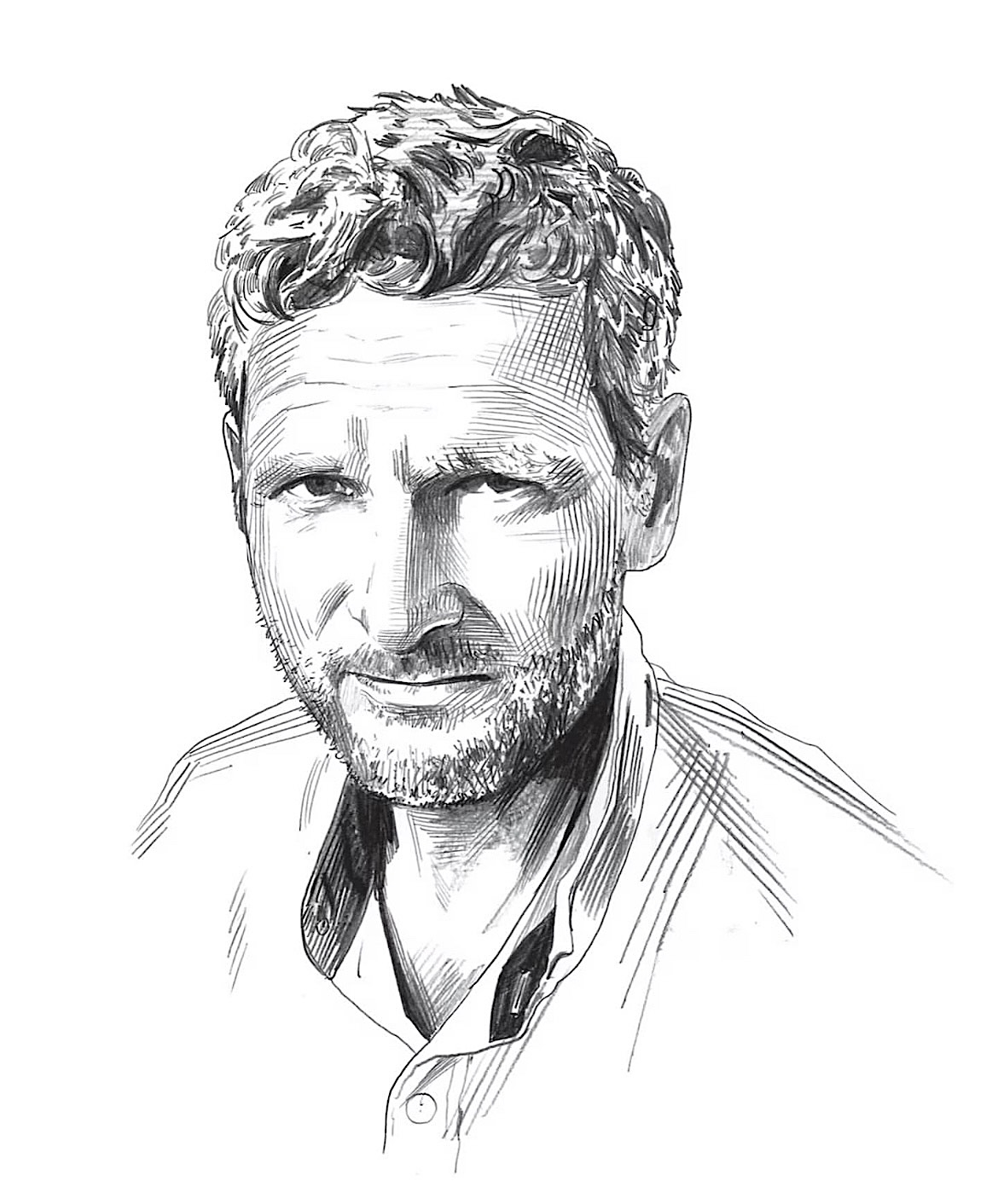
He is a kind of traveling scholar, too. A rangy teacher. An entrepreneur who publishes a magazine for Korean youth. A quiet and thoughtful man, Lee can draw from his sleeve a hidden stiletto wit. I convert him, barely, to the rebellion of jaywalking. He converts me to the wonders of ojima, a Korean berry tea. I watch him as he slowly rediscovers his homeland with a boyish sense of wonder. Indeed, his awe is even shinier than mine: Rambling the world on foot primes you for constant surprise, while finding newness in the familiar is a marvel of a different order. Walking does this.
Lee is a Busan boy. He is walking toward home. When we reach his port at last, after two months of trekking through South Korea, I will see him weep silently beside the Sea of Japan. No crown of paper flowers could be better.