“How are you today?” I greet Shakhzukhmilzzo Ismailov.
I am in the Mamun Academy of Khiva, Uzbekistan. I have never been to Khiva before. I am meeting Ismailov for the first time in my life.
The young museum curator furrows his brow. Clearly, he is thinking. “Not so good. Not so bad,” he replies. “It is complicated. I am somewhere in the middle.”
I am not surprised by this answer. Ismailov is a historian—a connoisseur of precision, of facts, obscure dates, dead names, dusty events, vanished geographies: the ultimate detail man. And the Mamun Academy, founded a thousand years ago, is a repository of ancient Islamic wisdom. Ismailov has agreed to show me some old manuscripts. We stare down at a table stacked with antique volumes, each hand-inked in Arabic and Persian script. The day’s heat, even indoors—Khiva is a walled oasis in the Kyzyl Kum desert—is dizzying. We try not to drip asterisks of sweat onto the yellowed pages.

Ancient libraries abounded in medieval Central Asia. These 19th-century manuscripts are preserved at the modern Mamun Academy, in Khiva.
Paul Salopek
Khiva.
To many outsiders, the name conjures anything but museums, scholarship, libraries. In the Western imagination, the city’s reputation is usually mired in the 19th century, when it was a declining Silk Road khanate, a caravanserai at the remote frontiers of vast empires (Russian, British, Persian, Chinese), a medieval enclave ruled by despots who sealed off their people from the outside world. It was a dangerous place then: Beheading was a default punishment, and Khiva trafficked in thousands of slaves. British and Russian agents, vying for control of Central Asia, courted the city’s khans at their peril. (In 1904 a swashbuckling Harvard archaeologist named Langdon Warner bluffed his way through Khiva’s colossal gates, carrying only “a change of underclothing, a tooth-brush, and a revolver.”) But my interest stretches back much earlier—to the region’s dazzling apex in the Middle Ages.
“Central Asia was a major center of learning at that time,” Ismailov says. “We produced many world-class scientists.”
Indeed, the famous “Arab Golden Age” of science—a period lasting roughly from the eighth through the thirteenth centuries, when the Islamic world far outstripped Europe in intellectual achievement—flowered in large part thanks to an influx of geniuses from the Khwarezmian kingdom at the eastern rim of the caliphate, what today are the “stans” of Central Asia and parts of Iran.
The famous Einsteins of that era:
Ancient libraries abounded in medieval Central Asia. These 19th-century manuscripts are preserved at the modern Mamun Academy, in Khiva.
Paul Salopek
Khiva.
To many outsiders, the name conjures anything but museums, scholarship, libraries. In the Western imagination, the city’s reputation is usually mired in the 19th century, when it was a declining Silk Road khanate, a caravanserai at the remote frontiers of vast empires (Russian, British, Persian, Chinese), a medieval enclave ruled by despots who sealed off their people from the outside world. It was a dangerous place then: Beheading was a default punishment, and Khiva trafficked in thousands of slaves. British and Russian agents, vying for control of Central Asia, courted the city’s khans at their peril. (In 1904 a swashbuckling Harvard archaeologist named Langdon Warner bluffed his way through Khiva’s colossal gates, carrying only “a change of underclothing, a tooth-brush, and a revolver.”) But my interest stretches back much earlier—to the region’s dazzling apex in the Middle Ages.
“Central Asia was a major center of learning at that time,” Ismailov says. “We produced many world-class scientists.”
Indeed, the famous “Arab Golden Age” of science—a period lasting roughly from the eighth through the thirteenth centuries, when the Islamic world far outstripped Europe in intellectual achievement—flowered in large part thanks to an influx of geniuses from the Khwarezmian kingdom at the eastern rim of the caliphate, what today are the “stans” of Central Asia and parts of Iran.
The famous Einsteins of that era:

Painting of the polymath Al-Biruni in Mamun Academy.
Paul Salopek
Muhammad Al-Khwarizmi—the word “algorithm” is a Latin garbling of his name—was born in ninth-century Uzbekistan. Al-Khwarizmi helped invent algebra. He calculated the length of the Mediterranean (correcting Ptolemy) and popularized the use of the astrolabe in early astronomy.
Abu al-Rayan Muhammad ibn Ahmad al-Biruni, also from Uzbekistan, devised a method of estimating the Earth’s radius by observing the heights of mountains, compiled a definitive catalog of pharmaceuticals, and penned an extraordinarily detailed encyclopedia on the anthropology of India. (A typical title of one of al-Biruni’s briefer works: “The Exhaustive Treatise on Shadows.”)
And perhaps the most celebrated sage of all, Abu Ali al-Husayn ibn Sina, or Avicenna, born in 980 in a village near the khanate of Bukhara, was Islam’s first philosopher and a source of medical information tapped by European doctors for centuries.
How did this intellectual explosion—a time of towering advances, of questioning, of analysis, of free-thinking—spring from the Islamic heart of Asia? How did Muslim thinkers compile the knowledge of the Greeks and Indians, and then expand on it, writing on optics, botany, mathematics, hydrology, and other topics, while in Dark Ages Europe the few remaining libraries moldered in monasteries? (A century after al-Biruni authored 146 scientific books, Saint Æbbe of Coldingham, the abbess of a Scottish nunnery, obliged her nuns to slice off their noses and lips to disgust Vikings bent on rape. It worked. But the nuns were killed anyway.)
The answers, as Ismailov might say, are complicated.
Painting of the polymath Al-Biruni in Mamun Academy.
Paul Salopek
Muhammad Al-Khwarizmi—the word “algorithm” is a Latin garbling of his name—was born in ninth-century Uzbekistan. Al-Khwarizmi helped invent algebra. He calculated the length of the Mediterranean (correcting Ptolemy) and popularized the use of the astrolabe in early astronomy.
Abu al-Rayan Muhammad ibn Ahmad al-Biruni, also from Uzbekistan, devised a method of estimating the Earth’s radius by observing the heights of mountains, compiled a definitive catalog of pharmaceuticals, and penned an extraordinarily detailed encyclopedia on the anthropology of India. (A typical title of one of al-Biruni’s briefer works: “The Exhaustive Treatise on Shadows.”)
And perhaps the most celebrated sage of all, Abu Ali al-Husayn ibn Sina, or Avicenna, born in 980 in a village near the khanate of Bukhara, was Islam’s first philosopher and a source of medical information tapped by European doctors for centuries.
How did this intellectual explosion—a time of towering advances, of questioning, of analysis, of free-thinking—spring from the Islamic heart of Asia? How did Muslim thinkers compile the knowledge of the Greeks and Indians, and then expand on it, writing on optics, botany, mathematics, hydrology, and other topics, while in Dark Ages Europe the few remaining libraries moldered in monasteries? (A century after al-Biruni authored 146 scientific books, Saint Æbbe of Coldingham, the abbess of a Scottish nunnery, obliged her nuns to slice off their noses and lips to disgust Vikings bent on rape. It worked. But the nuns were killed anyway.)
The answers, as Ismailov might say, are complicated.

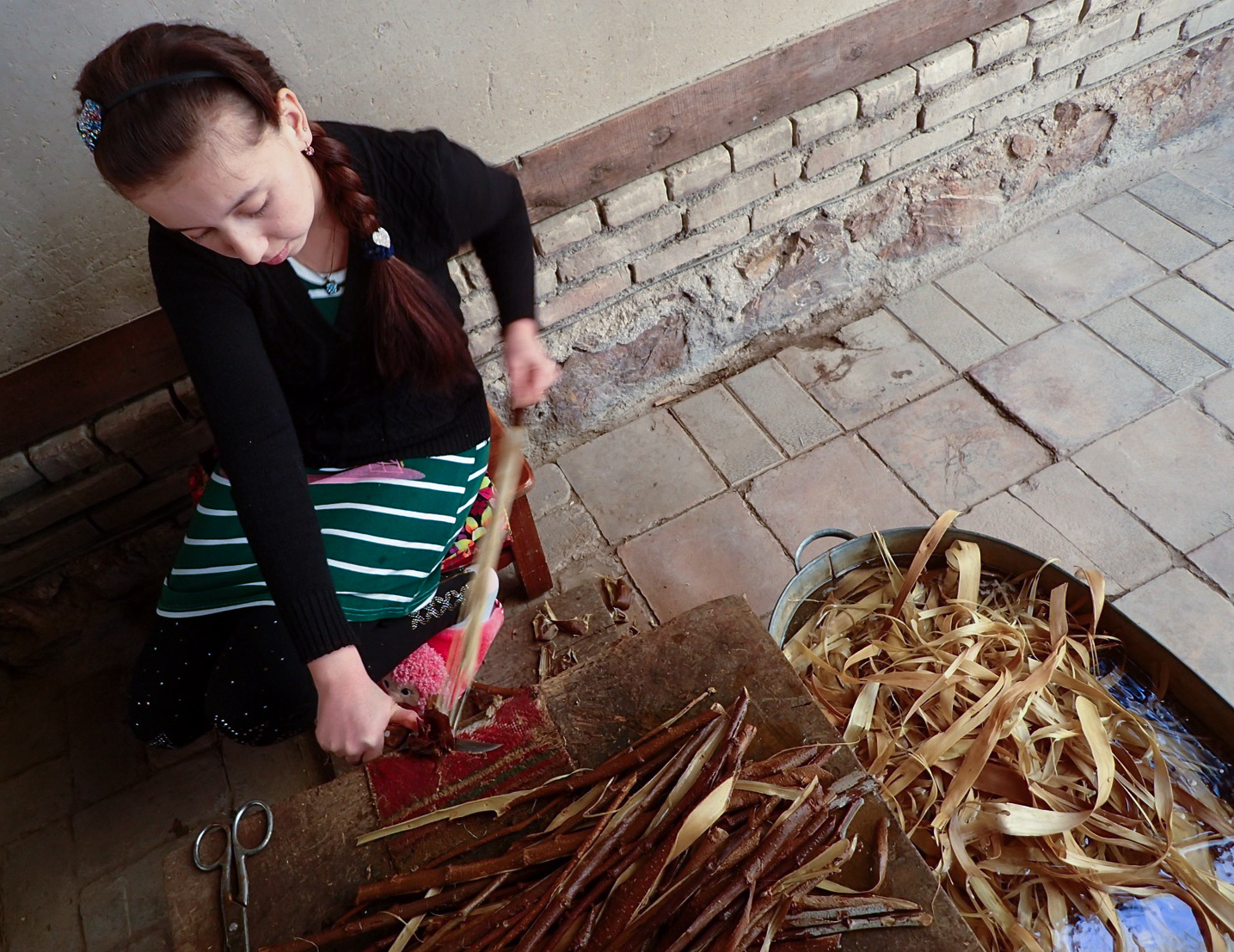
Khiva’s woodworkers are renowned.
Paul Salopek
The concentration of so much wealth, trade, and brainpower under the sprawling Abassid Caliphate, headquartered in faraway Baghdad, was key. (Most of Central Asia’s scholars eventually toiled in a “House of Wisdom” in Baghdad.) So was the adoption of Arabic as a common language among thinkers from realms as far flung as Tunisia and India. The use of paper, a Chinese innovation traded through the Silk Road, invigorated book writing and translations. And most important of all, a new school of religious thought called Mu’tazilism injected rationalism and logic into Islamic religious thought, fanning scientific inquiry.
“There were practical reasons too,” says Gavkhar Jurdieva, an architect at the modern Mamun Academy. “To survive in this desert you need farming. And to farm you need to understand irrigation, and that requires engineering. We used math to feed ourselves.”
If the blossoming of the Islamic Golden Age was complex, so was its decline.
Weakened by dynastic struggles, the power of the caliphate began to crack at its edges. A purifying movement called Ash’arism took root against “outside elements” of thought. This smothered most fields of scientific research outside of religious study. The Mongols sacked Baghdad in 1258. The light of a gilded era flickered.

The minaret of the Juma Mosque towers over the Old City of Khiva.
Paul Salopek
I flee the sweltering archive of the Mamun Academy and wander the palaces, courtyards, and mosques of Khiva—a jewel of Central Asian architecture.
The massive-roofed verandas of the Old City face north, catching the cooling desert winds in the summer. Small living rooms keep the oasis dwellers warm in the winter. Khiva is a masterpiece of thermodynamics.
Searching for a cappuccino machine—an Italian invention—I find one near the Ark-Darvoza gate. It is the fortress door that Warner, the foolhardy American archaeologist, must have banged on to gain entrance a century ago. (Indiana Jones is said to be based partly on Warner.) He smugly called the khan “evil, gross, and stupid” and galloped back to a long career in academia. Sipping caffeine, I think about how few people today even know how a lightbulb works. About climate change denial. And I imagine the lions outside the New York Public Library preserved one day as museum artifacts, much like all of Khiva.