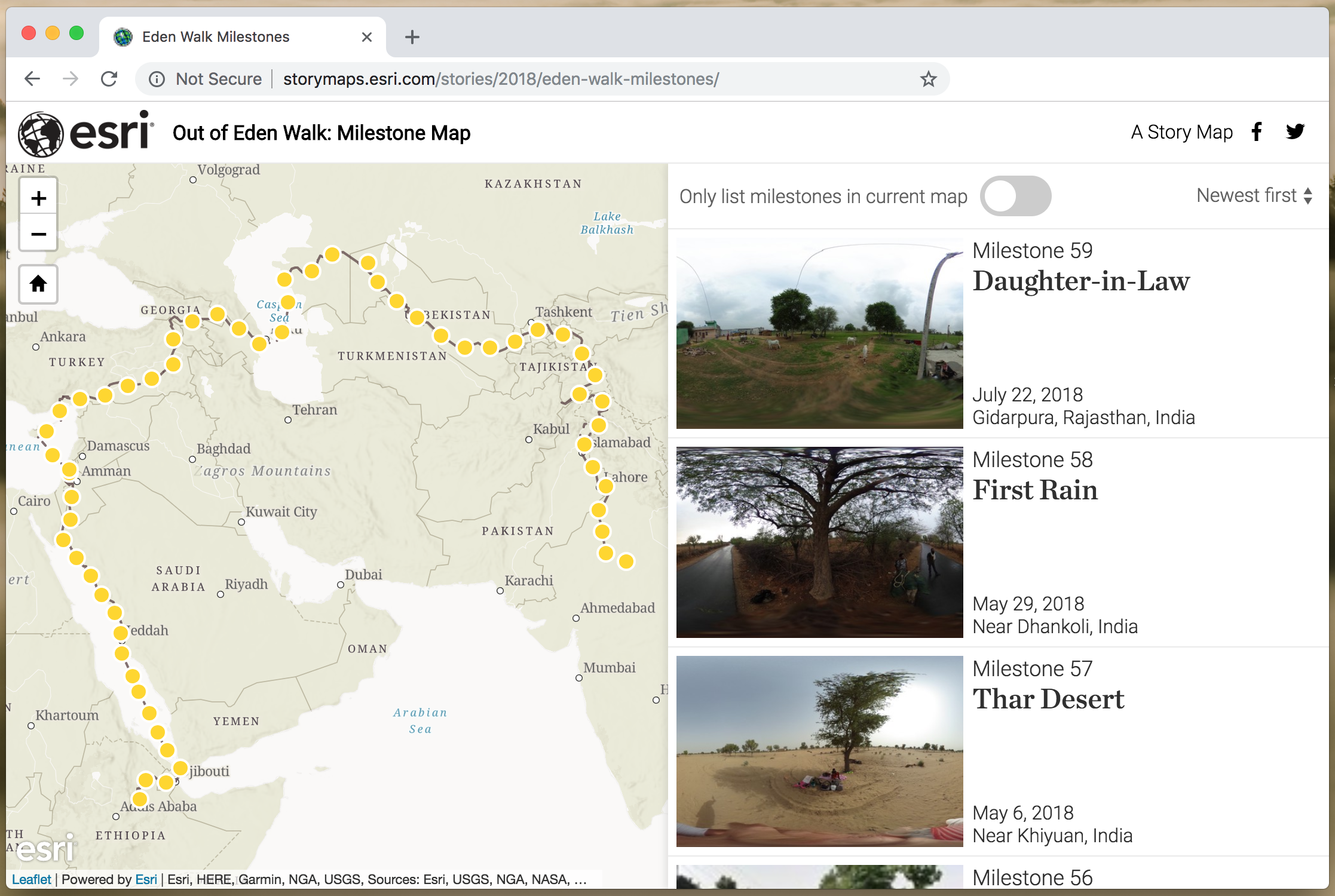
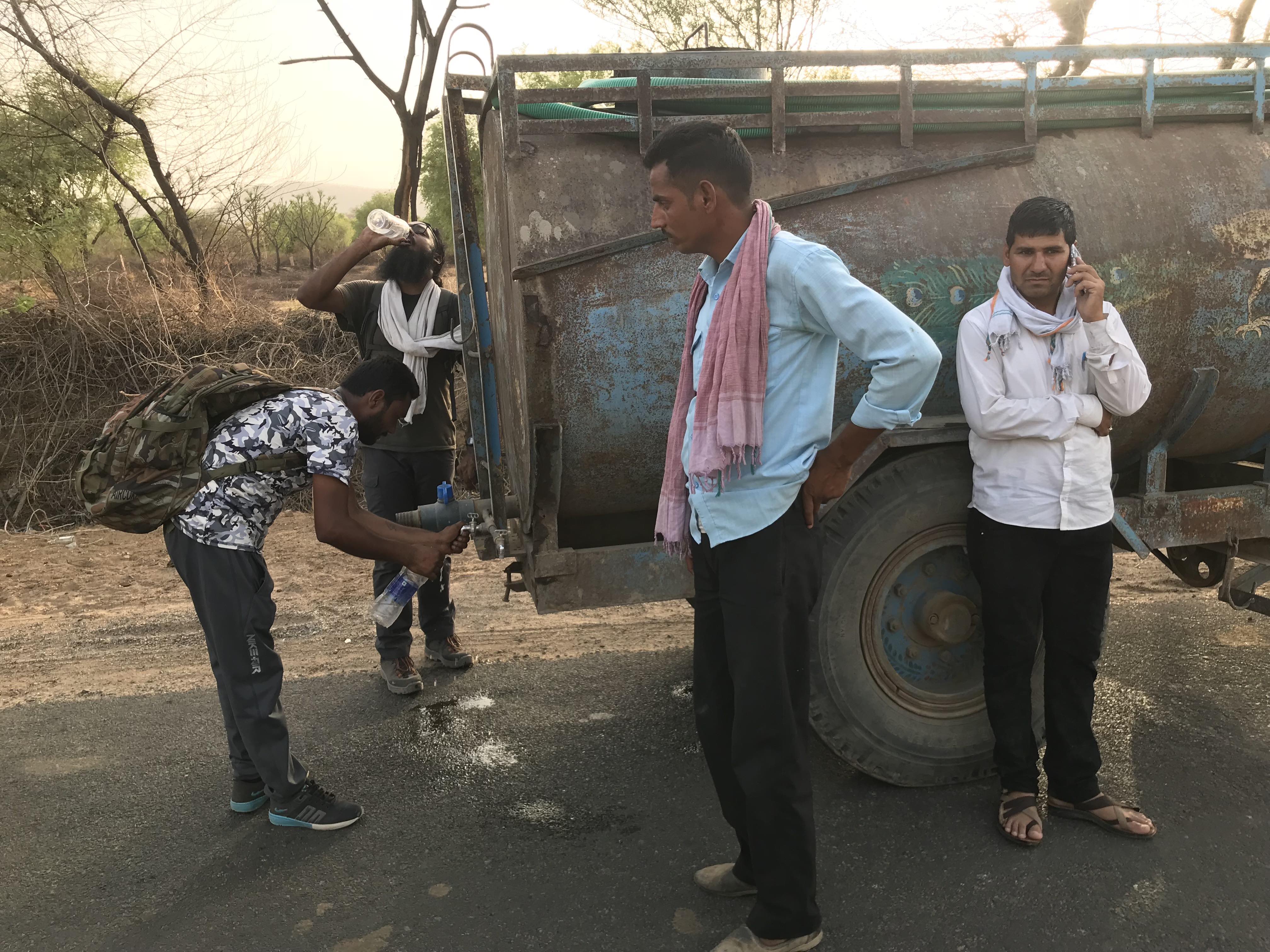
We are walking through the Thar Desert of India.
Our feet sink into sands the color of buffed leather. We shade up under sentinel khejri trees. By dusk we stagger exhausted into Harasar. What is Harasar? A remote village: an outpost of stone houses far from any city. Eight peacocks roost in a row atop the village’s eight electricity poles. We ask a farmer who is brushing a horse where to find Bubbles.
“Go to the fort,” he says, pointing.
Fort Harasar is five, perhaps six hundred years old. It was built by the Rajputs, the former overlords of the Thar—the warrior kings of Rajasthan. The last rays of sun gild the top of the high crumbling walls, which are slitted for muskets. The timbers of the main gate are polished smooth by the westerlies known as the loo, and studded with hand-forged nails. It is the type of colossal doorway through which mounted warriors once galloped, swinging doubled-edged khandas—scimitars. When we knock, however, we are answered by a middle-aged man with stud earrings. His smile is world-weary. His rakish sideburns are grey. Worn slippers tooled with silver cushion his feet. He has the long-boned frame of an athlete gone softly to seed. This is Bubbles.
“Care for a drink?” Bubbles asks, and it’s instantly clear he doesn’t mean water.

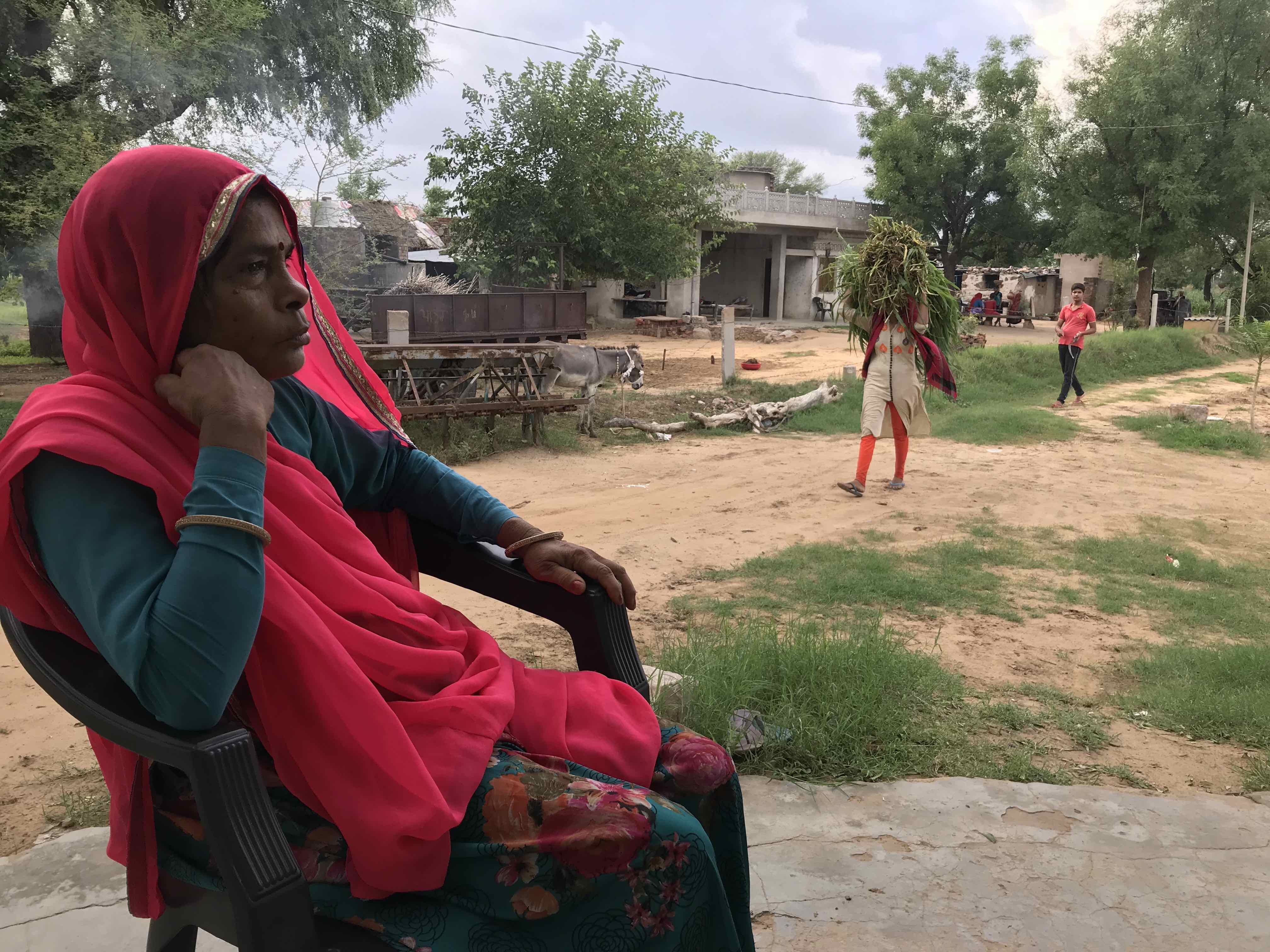
Padmaram Sharam Jat, 90, the oldest man in Harasar, recalls the days of feudal rule by Rajput nobility.
Arati Kumar Rao
Bubbles—Kanwar Vishvajit Singh—is a member of the old Rajput aristocracy. He is well known in the region. Harasar's fort is his family home.
Bubbles’s grandfather, Rao Bahadur Thakur Jeoraj Singh, was the last army minister to the maharajahs of the kingdom of Bikaner. Bubbles got his nickname from another relative, the last maharajah of Jaipur, an excitable polo player who was christened so by fellow cadets at Sandhurst, the British military academy. This was a long time ago. That antique world is gone—swept away like dust in a desert storm, vanished along with the colonial Raj. India’s 565 princely states lost their autonomy shortly after independence. Indira Gandhi hammered the final nail in their coffins, stripping them of their flags and royal stipends in 1971. At age 47, Bubbles doesn’t mourn any of this. He is too young. Instead he is a thoroughly modern gentleman with a certain roguish charm: a family black sheep. He disappointed his stern father by entering the trades—opening a restaurant and hotel in Bikaner—then squandered his youthful savings on supermodels in European discos.
“In person,” he says, fondly, “Kate Moss doesn’t look anything like her photographs.”
Padmaram Sharam Jat, 90, the oldest man in Harasar, recalls the days of feudal rule by Rajput nobility.
Arati Kumar Rao
Bubbles—Kanwar Vishvajit Singh—is a member of the old Rajput aristocracy. He is well known in the region. Harasar's fort is his family home.
Bubbles’s grandfather, Rao Bahadur Thakur Jeoraj Singh, was the last army minister to the maharajahs of the kingdom of Bikaner. Bubbles got his nickname from another relative, the last maharajah of Jaipur, an excitable polo player who was christened so by fellow cadets at Sandhurst, the British military academy. This was a long time ago. That antique world is gone—swept away like dust in a desert storm, vanished along with the colonial Raj. India’s 565 princely states lost their autonomy shortly after independence. Indira Gandhi hammered the final nail in their coffins, stripping them of their flags and royal stipends in 1971. At age 47, Bubbles doesn’t mourn any of this. He is too young. Instead he is a thoroughly modern gentleman with a certain roguish charm: a family black sheep. He disappointed his stern father by entering the trades—opening a restaurant and hotel in Bikaner—then squandered his youthful savings on supermodels in European discos.
“In person,” he says, fondly, “Kate Moss doesn’t look anything like her photographs.”

Kanwar Vishvajit Singh, also known as Bubbles, at home in the fortress.
Paul Salopek
At Fort Harasar we spend days recuperating from the heat.
We eat dawn breakfasts of eggs and toast alfresco in the fort’s large courtyard. There is a Great Dane named Boris, who sucks up all the oxygen from a room with his panting. There is a beagle named Shakira. The drawing room is decorated with century-old camel saddles and a new Union Jack. Its refrigerator chills cans of tonic for gin. Sepia photos of mustachioed royals in jodhpurs stare morosely from the thick walls.
Bubbles is the titular ruler of Harasar village. He wears this ceremonial role lightly. He donates to weddings. Local farmers consult him for advice about government housing grants. He is modest. He will not tell you that he once saved the city of Bikaner from destruction by bravely running through a stalled military convoy laden with tons of explosives, and driving each truck away from a spreading fire. (The story of his fame.) He talks instead about local birdlife. Like former nobility everywhere, he’s converting his castle into a boutique hotel.
“The man who built the fort got his head chopped off by Muslim raiders, “ he says, pitting himself self-mockingly against his ancestors. “They say his body stayed on his horse. He kept on fighting.”
Even by the hierarchical standards of Indian life, the martial Rajputs, who ruled northern India from about 800 A.D., were fanatically obsessed with the minutiae of class, breeding, and group purity. They practiced a form of sati, where the wives and concubines of kings were expected to commit mass suicide in flammable rooms rather than be captured by invaders.

Bubbles's grandfather, Rao Bahadur Thakur Jeoraj Singh (center), with Queen Elizabeth II on her visit to Rajasthan in 1961.
Paul Salopek
Rajputs sorted themselves into three hereditary divisions (vansh), below which forked a thicket of smaller branches (shakh), even smaller clan twigs (khamp), and tiny family twig-tips (nak ). It was all very complicated. Royal houses fought endlessly over who ranked higher or lower—or even whether one clan or another was genuinely Rajput. (Some Hindu Rajputs converted to Islam during the reign of the Moghuls.) This is one reason why there never was a large and unified Rajput empire in India. It is also why the Rajputs clicked so well with the British who later colonized them: Class-blinkered lords and barons running the British East India Company saw the princes of northern India as medieval English knights in turbans. Rajputs proudly occupied senior posts in the colonial army. They took nicknames that seemed plucked from Evelyn Waugh novels. A hidebound Rajput reincarnated from, say, the 19th century would probably feel most at home today in the rigid celebrity caste system of Hollywood.
“There’s a misconception that all these forts were built to exploit people, to get them to work for us,” Ranveer Rathor, a Rajput friend visiting Bubbles, says. “But back then things were different. There was no government. We took care of the people, and they took care of us.”
Bubbles summons the oldest man living in Harasar. He will remember the feudal days.
Gold earrings glint on the large, floppy earlobes of Padmaram Sharam Jat. The beak-nosed old man believes he is around 90. He had not set foot inside the fort until four years ago, when Bubbles began renovations. “We gave a quarter of our harvest to the lord,” he croaks loudly, deafened with age. “The lord gave us back butter, halvah, and roasted wheat on special days.”

Bubbles (blue shirt) peruses old family documents.
Paul Salopek
The two men joke. Bubbles displays faded ledger books. He discovered them inside rusting trunks during recent construction. In spidery script every loan and transaction with commoners is listed: “Katu Manu Kumar—owes 18 rupees 61 annas” says an 1868 entry. Bubbles ribs the old man. He says he is looking for outstanding debts. The old man grins.
How old is this reenactment? In India, it is 5,000 or 6,000 years old. As old as caste. In a very few places beyond, it is even older.
Peacocks caw before sunrise atop the ancient battlements of fort Harasar.
In the sleepy village outside, a corner shop sells bottles of cold Pepsi. Far beyond the village lanes, Banwaria nomads roam in carts pulled by camels. We saw one of their encampments walking in—ragged wanderers classified by the British Empire as a Criminal Tribe. The poorest and freest people of the Thar stood as their cook fires seesawed in the hot breeze. They watched us pass. They didn’t wave.