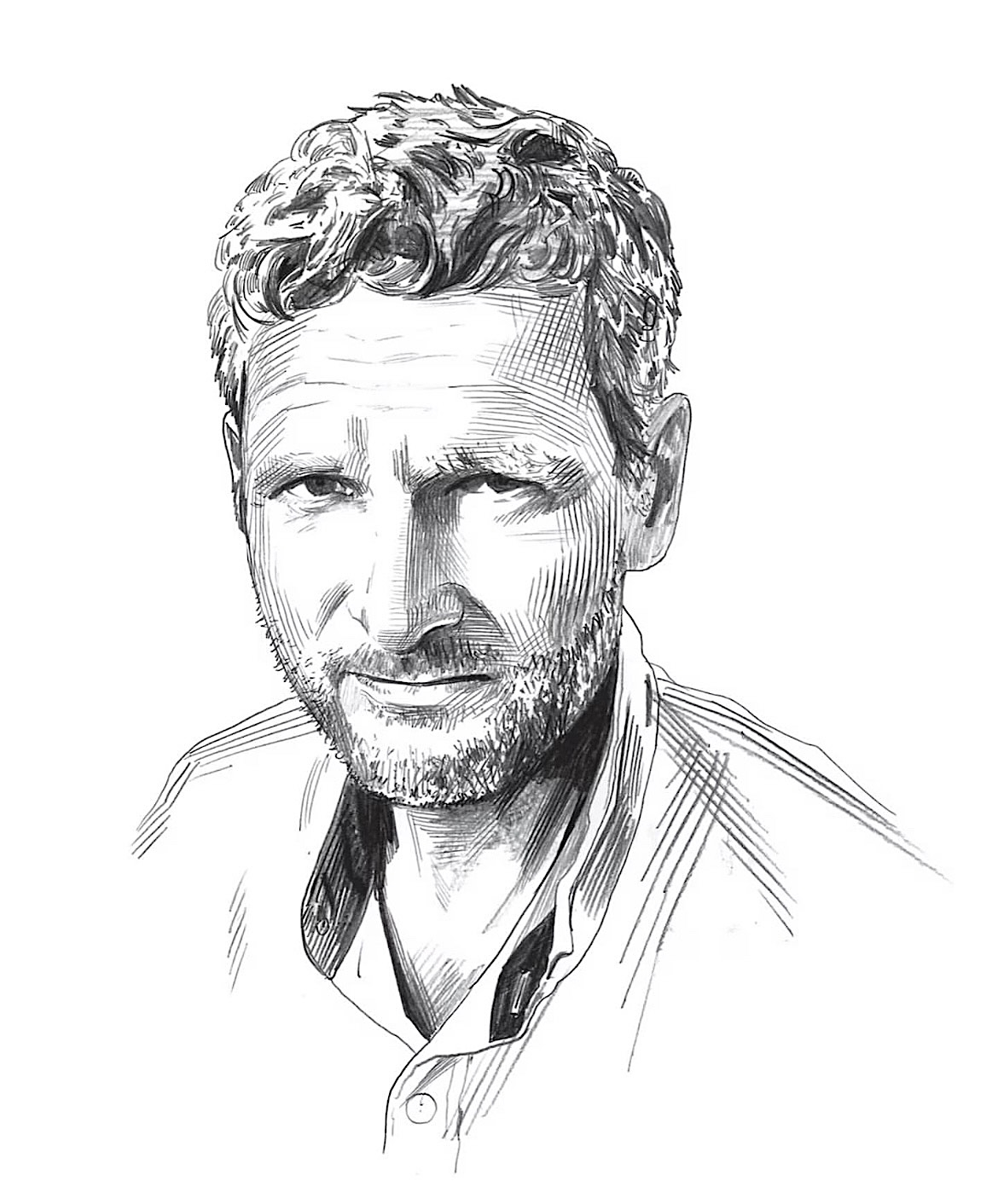
Look at Bretwood Higman.
Higman—or “Hig,” as friends call him—is a geologist. An adventurer. (His wife and he once trekked and paddled 6,400 kilometers between Seattle and the Aleutians.) An expert catastrophist. A character. A concerned citizen.
Nimble as a Dall sheep, the scientist bounds up a 900-meter scarp abutting Portage Glacier, a dazzling white tongue of ice suspended above Whittier, Alaska. “Pinch the rock!” he hollers down, encouragingly. “Don’t fall off!” Higman is 48. But his hiking boots date from the Pleistocene. (His even older sneakers, stowed in a borrowed car far below, are stitched together with fishing line.) He slithers like a limbo dancer under alder thickets girding the cliff faces. Trailing diamond sprays of ice, he glissades fearlessly across snowfields that plunge into blue infinity. A face sun-fried behind plastic-rimmed glasses. Shoulders caved under a backpack heavy as an anvil, crammed with lentils and radar sensors. A ragged Bolivian cap, found long ago beside some Andean trail, hibernates atop his head. He talks, this acrobat, nonstop.
“Hazard cascade,” Higman calls out. “Ever heard of it?”
I have not. And I don’t care. I am being murdered by gravity. My heart pounds out the Lord’s Prayer.
“One catastrophe sets off another,” Higman explains, balancing cheerfully atop a sheer blade of slate. “It’s a multitiered, unpredictable effect. A chain reaction of disasters.”

Student Krishna Divakarla, geologist Bretwood “Hig” Higman, and guide Phil Norris take in the receding terminus of Portage Glacier, near Anchorage, Alaska. The glacier has receded about four kilometers since the early 1900s, largely because of global warming.
Photograph by Paul Salopek
Does he mean our lunatic ascent? Or the epic landslide that’s waiting to explode underfoot? At least a hundred million tons of rock are sliding down the Chugach peaks surrounding Portage Glacier. Ridgelines are cracking apart. Massive ramparts of stone are slumping, in places alarmingly, by meters each year. When (not if) this mega-collapse at last occurs, the rockfalls will blast a tsunami across the glacial lake below. That giant wave could flip over tour boats, wipe out a visitor’s center, and flood a nearby highway tunnel that carries half the Internet cabling for Alaska. Thus: hazard cascade. Higman and his sidekick, a geophysical engineering student named Krishna Divakarla from the Colorado School of Mines, are the volunteer cavalry. They are planting homemade motion detectors on the quivering slopes.
Landslides are a natural feature, of course, in all the world’s vertical landscapes.
Across spans of millions of years, mountain ranges tear themselves apart through suicidal erosion. But lately, experts warn, the pace of disassembly has accelerated, stoked by the human-made climate crisis. Warming trends and surging water precipitation, especially in subpolar regions and at high altitudes, are melting the glacial ice and permafrost that once glued mountainsides in place. Imagine the buttresses of cathedrals dissolving.

Earth sciences student Krishna Divakarla observes cracks in the mountains hemming Portage Glacier, in Alaska. Some slopes are sliding downwards at the alarming pace of meters a year.
Photograph by Paul Salopek
In Chile in 2017, for example, historic rains uncorked a gargantuan landslide near a receding glacier. This calamity morphed into a mud flow kilometers long that smothered a village. Twenty-two people died. Last year in Switzerland, a crumbling mountain dropped millions of tons of rocks onto a fragile glacier. The glacier shattered and liquified, erasing an alpine community below that, fortunately, had been evacuated.
In the United States, thawing temperatures make Alaskan mountains the poster child of emerging landslide threats, says Higman.

Geologist Bretwood Higman displays a predictive computer model of the likely consequences of a landslide into Portage Lake, near Anchorage, Alaska. The shockwave from a collapsing mountainside would send a tsunami of water across the glacial lake, engulfing a visitors’ center, a highway, and the undersea cabling that carries about half of the state’s internet capacity.
Photograph by Paul Salopek
An independent researcher based in a converted yurt in the Kenai Peninsula village of Seldovia, Higman scours satellite imagery to identify potential landslide sites across the state. So far, he’s logged scores of at-risk locations. Many are in unpopulated regions where the danger to humans is low. But his survey is far from complete. And the conditions driving such geological instability continue to multiply. Recent disasters and near disasters highlight the stakes.
Geologist Bretwood Higman displays a predictive computer model of the likely consequences of a landslide into Portage Lake, near Anchorage, Alaska. The shockwave from a collapsing mountainside would send a tsunami of water across the glacial lake, engulfing a visitors’ center, a highway, and the undersea cabling that carries about half of the state’s internet capacity.
Photograph by Paul Salopek
An independent researcher based in a converted yurt in the Kenai Peninsula village of Seldovia, Higman scours satellite imagery to identify potential landslide sites across the state. So far, he’s logged scores of at-risk locations. Many are in unpopulated regions where the danger to humans is low. But his survey is far from complete. And the conditions driving such geological instability continue to multiply. Recent disasters and near disasters highlight the stakes.
In the Southeast Alaska town of Wrangell, a rain-gorged landslide killed six people in 2023. Fatal landslides also rolled through the towns of Haines, Sitka, and Ketchikan over the past decade. And last year, at 5:26 a.m. on August 10, a whole mountainside toppled into the tideline of the shrunken Sawyer Glacier, not far from the Alaskan capital, Juneau. The impact jetted a tsunami a staggering 500 meters up the walls of the fjord. A wave of seawater three stories high then barreled down the fjord’s channel, scything away spruce groves for tens of kilometers downstream. Miraculously, no cruise ships were sightseeing at the popular tourist spot when the disaster struck.
“As destructive as they are, the hardest part of geo-hazards is convincing government agencies to monitor them,” says Higman. “Here’s the deal. When you start monitoring, you assume responsibility for the outcome. And nobody wants that.”
Yet from the vantage point of a scientist whose office typically consists of an airy cliffside, to which he adheres with minute portions of his epidermis, the ultimate challenge isn't about assigning blame. (Higman also rejects the hubris of told-you-so foresight: "We don't know why some slopes seem to threaten for centuries and never fail, while others sneak up on us.") Instead, he insists that society as a whole must decide how to live within the shadow of ticking landslides—part of a strange, new, human-modified world of growing unpredictability and risk.
As it stands, a small federal program does fund landslide research in Alaska. But at the actual scenes of many geological time bombs such as Portage Glacier, whose complex hazard cascade Higman ranks at the top of his imminent danger list, the public remains largely on its own.
“We simply don’t have resources for warning systems,” a glum U.S. Forest Service ranger told Higman at the Begich, Boggs Visitor Center, near the Portage Glacier, a popular weekend destination for tourists from Anchorage. She cited massive federal layoffs and budget cuts under the Trump administration.
Computer models suggest that the ranger and her dwindling staff might have four minutes, maximum, to flee a wall of lake water blasted out by a landslide.
“Some people say the costs of warnings aren’t really worth it, given the odds,” Higman says. “But that’s not true at all.” Consider, he says, what even ordinary citizens can do.
Geologist Bretwood Higman monitors landslide threats in Alaska.
Out of Eden Walk
And what Higman does, with the government’s blessing, is this: He and student Divakarla paddle inflatable rafts for six kilometers across windy Portage Lake. They suspend extra equipment by rope from a cliff, out of claw-reach of curious grizzlies. Then they quadricep-pump their way under heavy loads up a

Moving mountains: Cracks in the surface soils of the mountains hemming Alaska’s Portage Glacier reveal webs of frail, taut root systems—stretched to breaking. Some slopes are sliding downwards at the pace of meters a year.
Photograph by Paul Salopek
vertical kilometer of stone to take the pulse of a doomed mountain. Hallucinating from exhaustion, I follow. I can dimly hear Higman chatting above me on the climb. One of his heroes, he says, is Tilly Smith, the 10-year-old schoolgirl who saved at least a hundred souls on a Thai beach by correctly interpreting an ebbing surfline as the approach of the murderous 2004 Indian Ocean tidal wave.
Moving mountains: Cracks in the surface soils of the mountains hemming Alaska’s Portage Glacier reveal webs of frail, taut root systems—stretched to breaking. Some slopes are sliding downwards at the pace of meters a year.
Photograph by Paul Salopek
vertical kilometer of stone to take the pulse of a doomed mountain. Hallucinating from exhaustion, I follow. I can dimly hear Higman chatting above me on the climb. One of his heroes, he says, is Tilly Smith, the 10-year-old schoolgirl who saved at least a hundred souls on a Thai beach by correctly interpreting an ebbing surfline as the approach of the murderous 2004 Indian Ocean tidal wave.
“Crazy weed,” Hig says, pointing out wild herbs while I catch my breath. “Pixie eyes.”
I see the plants’ roots yanked taut as guitar strings inside deep new cracks gaping in the mountaintop soil.

A homemade motion detector. Bretwood “Hig” Higman plants them as early-warning sensors in mountains prone to landslides.
Photograph by Paul Salopek
Higman and Divakarla place their improvised motion sensors in the fragmenting bedrock. A machinist neighbor in Higman’s village builds the cheap instruments from circuit boards and mason jars. Higman buys their repurposed e-cigarette batteries at Anchorage head shops. That night in the tent, after the lentils, he tells me how landslides sometimes can be predicted via subsonic sounds emitted by the stressed Earth. Landslides sing for days or hours, then fall silent before the worst happens. Falling into sleep, I place my ear against the mountain.