“What are you photographing, Soichi?”
“People.”
“Random people?”
“Yes, any people. When I see a person, I must take a picture.”
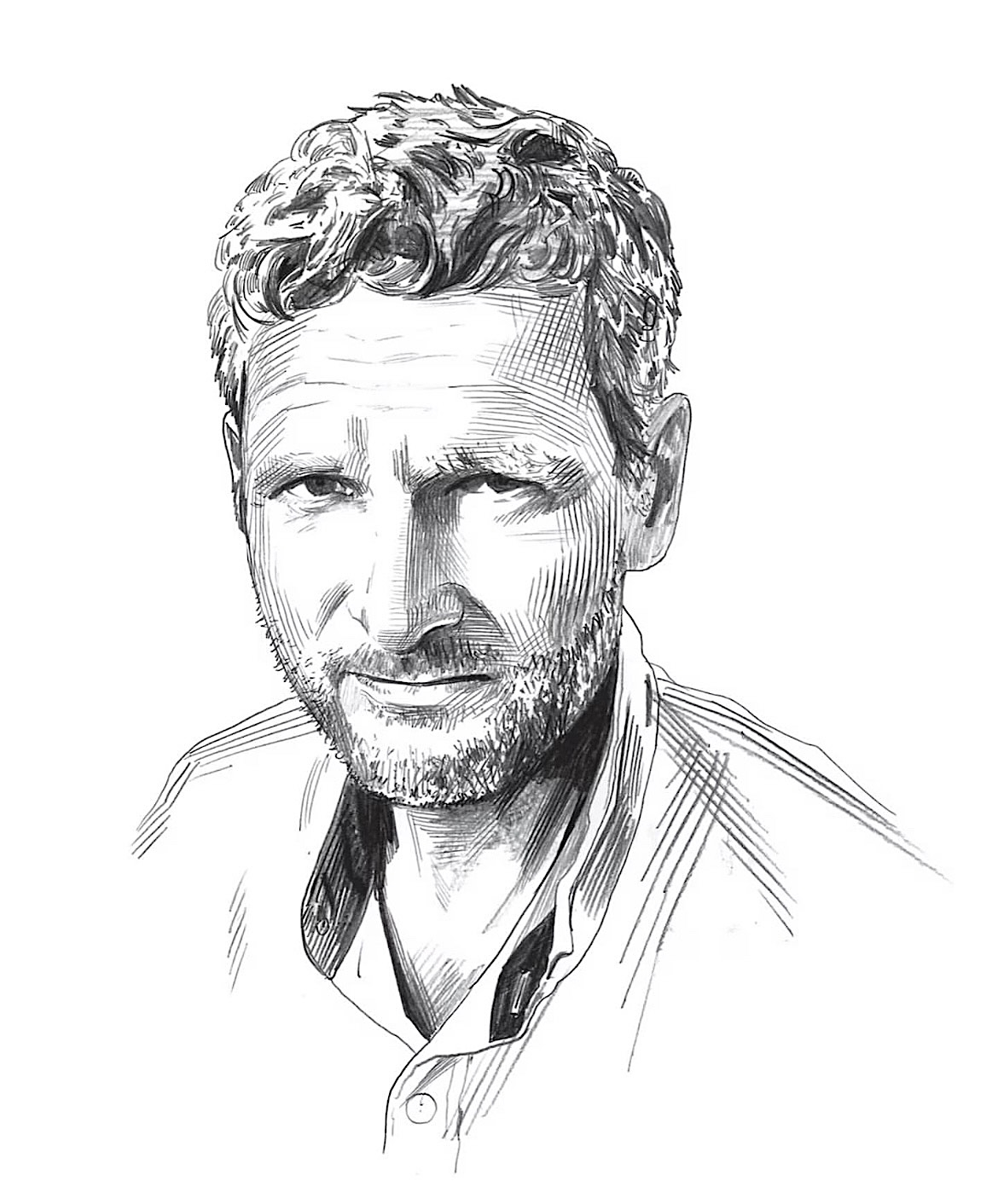
Soichiro “Soichi” Koriyama is my walking partner in Japan. He is a seasoned and worldly documentary photographer, a man in energetic middle age, a storyteller with a raucous laugh and a quick step. He is on an unlikely mission: To record every human being we encounter along our 1,400-kilometer walking route through rural Japan. Whenever Koriyama spots a villager—an old farmer bent over an onion patch, a couple walking their dog, a woman hanging bed sheets—he raises his camera. He snaps the shutter without breaking stride. He shoulders his camera and marches on with the determined step of the soldier he once was.
Koriyama’s objective puzzles me. It seems oddly arbitrary.
Why would anyone, I wonder, collect the likenesses of innumerable strangers? Also, it seems too gargantuan a task. And as it turns out, it is indeed difficult. But not for the reasons I suspect: That cataloguing an endless parade of faces surely will be impossible, too exhausting. In fact, the problem is quite the opposite! We hike for hours through the main island of Honshu, Koriyama and I, without meeting a single soul. We slog past ghostly rice fields. We ramble through tile-roofed hamlets that are silent as museum displays. We stroll down the middle of country roads eerily empty of traffic. Shops are locked up, their windows dark and dusty. Now and again, an abandoned farmhouse appears with its front door ajar; inside, through the gloom, we can see weeds sprouting atop tables and television sets. Only then does Koriyama’s strange project make sense: He is memorializing a dying countryside. He is a hunter seeking to capture proof of life, to honor the last human holdouts in a landscape of loneliness that appears to have been evacuated by some epic calamity. By war or plague. By the Rapture. One day, we walk 43 kilometers. We pace off this distance with few breaks for 12 sweaty hours, from early morning until deep into the night, traversing village after village. We spot three fellow Homo sapiens.

An elderly woman inches past a closed shopping center in Fukuoka, Japan. The country’s rapidly aging demographics are even more accentuated in rural regions, where farm villages may have a handful of residents no younger than 60.
Photograph by Soichiro Koriyama
The radical depopulation of Japan’s countryside is an old story.
Starting in the 1950s, rural Japanese families began exporting their children to work and study in cities. Life was hard on pre-mechanized farms. Japan’s “economic miracle,” which saw the national GDP explode 10-fold between the 1960s and the 1980s, was built largely on rural to urban migration. Entire villages turned out at train stations to cheer on their youngsters departing for Tokyo and Osaka.
“We were happy to send our children to university,” says an 83-year-old baker named Keiko, who still rises at dawn to steam her rice cakes in the all-but-abandoned village of Marue, near Kyoto. “But it was a trap. They never came back.”
Multiply the fate of deserted little Marue by hundreds. By thousands. Over the past 60 years, Japan’s rural population has shriveled from a majority of 62 percent to a relict 8 percent. (By comparison, the rural population of the post-industrialized United States is 17 percent; in agricultural Papua New Guinea, it stands at 86 percent.)
Japan’s rapidly graying population worsens the desolation of its countryside.
A trek through Japan's countryside can be a lonely experience.
Out of Eden Walk
Japan is the oldest society on the planet. A staggering third of its citizens are now over 65, thanks to tumbling birth rates and longer lifespans typical of many affluent countries. In Japan, however, this aging trend has been accompanied by an unprecedented reassortment of humanity: The young pool overwhelmingly in vibrant cities. (The larger Tokyo metroplex bursts with nearly 38 million people, and is growing still.) In the rewilding hinterlands, meanwhile, virtually every person Koriyama and I meet is elderly. We manage to find and chat with a handful of farmers. The youngest is 76.
Grasping the toll of such demographics via statistics—or the smear of rooftops and trees seen blurred through a bullet train window—is one thing. Absorbing it up close, week after week, on foot, is another matter altogether. Far from the temples, shopping malls, national parks, hyper-developed pilgrim trails, and urban attractions drawing millions of global tourists to Japan, Koriyama and I inch though a backcountry that is by turns unsettling and weirdly beautiful, melancholy and shocking.
“There is no guesthouse ahead,” Koriyama sighs, frowning down at his phone.
So it goes for days in rural Yamaguchi prefecture.

Vending machines are among the last artifacts of economic activity in some parts of the depopulated Japanese countryside.
Photograph by Soichiro Koriyama

Many empty houses line country lanes in southern Honshu, Japan's main island.
Photograph by Soichiro Koriyama
Our digital maps promise a busy, inhabited world of small towns and farming villages. Yet at boot level, we discover a panorama of silences. We walk past hundreds of household gardens gone to weed. We see fishermen’s’ nets rotting dockside in tiny ports. Kudzu vines smother unused bus stops. Inert school playgrounds ring with absences.
Because of this—grocery stores are so few and far between—we begin to haul food in our backpacks. Lodging is rare. We contemplate camping out behind roadside hedges. Rural Japan begins to recall my earlier treks amid vast and uninhabited places. Like walking from well to well through the moonlike deserts of Saudi Arabia. Only in Japan our blue-dotted Google routing threads through a fully built landscape. And our “wells” are vending machines that, in lieu of eateries, discharge bottles of soda and cold water for 130 yen.
“7-Eleven!” Koriyama cries, announcing the bonanza of a convenience store within walkable reach.
Even more surreal than this general air of neglect are municipalities still struggling to maintain their infrastructure, thanks to billions of yen from government revitalization grants designed to fight rural depopulation. In these regions we pad, alone, atop immaculately paved and swept village lanes. New pocket parks beckon us with picnic tables and benches. Yet not a dog barks in these post-apocalyptic green spaces. The motionless villages, sustaining perhaps two or five or a dozen people, are preserved intact, as if under bell jars.
“Nobody wants to do this kind of work anymore,” says Kunihiro Nishida, 48, a grizzled road worker affixing climbing ropes to a cliffside in Tottori prefecture. Nishida is clearing a landslide. Blocked with granite rubble, a coastal road is going back to nature. “For young people,” he snorts, “it’s easier to work in an office in Kyoto.”
Nishida is friendly and curious. So are most of the denizens of a fading rural Japan. They are stoics.

A Jizu statue stands guard outside a nearly abandoned village in Yamaguchi prefecture. The shrines are protectors of children and travelers—both in short supply today in Japan's countryside.
Photograph by Soichiro Koriyama
The few marooned survivors we stumble across speak of their emptied fields and villages with little or no self-pity, as though their isolation were an act of nature, like the inexorably warming climate. A grandmother smiles and waves to us. A grandpa swinging a weedwhacker shouts out, Ohayō! One aged farmer is cleaning an ancestor’s tomb when we approach him, the first human we enounter in half a day. He is so shy, so unused to company, that he inches out of sight, backing behind the head-high grave marker while graciously answering our queries.
On the day that we tread 43 lonesome kilometers through Yamaguchi prefecture, seeking scarce shelter, I receive news of the death of a distant friend. The deceased was an artist. A better man than myself. And so that night, in the only sanctuary available in this utterly derelict stretch of Japan, a cubicle the size of two yoga mats rented to itinerant laborers, I permit myself to weep. The manager of the makeshift roadhouse taps on my plywood door early in the morning. With infinite courtesy, he offers the finest condolences possible, informing me gently that my cubbyhole is booked for the next few hours, and I must vacate. With praise, he urges us to be strong. To walk on. Koriyama snaps his photo.