“Hey. Found one!”
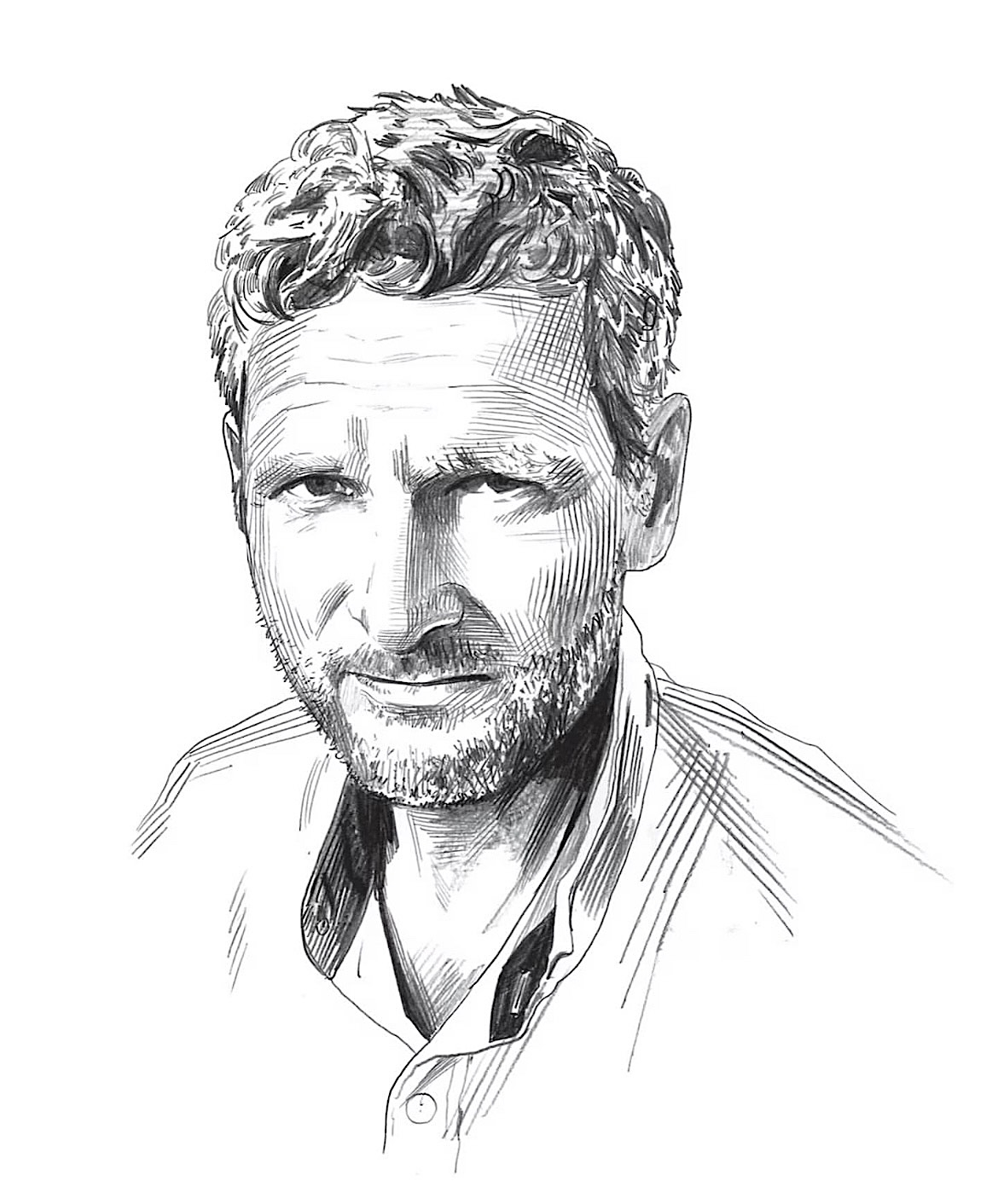
Meet Rowan Sharman, my walking partner in wild Alaska.
Age: 28. Alaska born. Analytical by nature—hence a mechanical engineer by trade. By upbringing: wilderness connoisseur. Thin as a pin and tougher than a two-penny nail, Sharman is my companion on a 650-kilometer trek down Alaska’s beautiful, largely uninhabited, and storm-walloped Outer Coast. He stands under a cold white sun on a trackless gray beach, holding up a small blue-green sphere. The orb is roughly the size of a baseball—translucent, gleaming, mysterious.
It is a crystal fishnet float. Likely hand-blown from melted sake bottles sometime early in the 20th century, it was lost overboard in the Sea of Japan and has wafted halfway across the planet atop the North Pacific Current to rest snugly in Sharman’s open palm. Sharman grew up collecting such “glass balls.” Indeed, he is a gatherer of many of the 10,000 random curiosities belched up by the icy waves in the Gulf of Alaska.
“Want it?” Sharman hollers into a ripping wind, offering me his find.
I don’t. And I can see how my answer disappoints my friend.
I have been walking across the world for years. My house is typically a small canvas rucksack. It has no windowsills. It has finite shelf space. Where could I possibly store such gathered treasures? In fact, while pacing off more than 27,000 kilometers of trail, largely through populated rural spaces, I’ve learned exactly the opposite lesson: to simplify, to economize, to shun souvenirs, to shed material cargo for collected ideas. Typically, I carry a maximum of 10 or 11 personal items on my back. Yet now, in Alaska, I stagger under the novelty of punishing weight. My brand-new expedition pack bulges with 30 kilos of food and survival equipment. I haul 88 separate articles of camping and rafting gear, all punched into waterproof bags. The backpack itself requires a user’s manual. It features nine adjustable straps. How to manage such complex burdens? At civil war with my kit, I already have lost or misplaced tent pegs, a coil of string, gloves, my reading glasses. (“I’m going to start marking all your stuff with orange surveyor’s tape,” mutters Sharman.) Add glass balls? Impossible—no matter how beautiful.
And so:
Sharman strides the wrack line of Alaska’s vast intertidal wilderness, slightly hunched and hyper-alert like some great egret, scanning the dark strands of kelp coiled there like the pipes of a tuba. He snoops among the mazes of driftwood logs, rummaging for the sea’s dropped prizes. I, on the other hand, hew to the unpromising ramps of sand nearby, the barrens next to the crash of freezing surf. I’m clocking kilometers, poking through the tide pools of memory.
Inward and outward: two forms of beachcombing.
Finders keepers, if you want: Curiosities of all kinds wash up on Alaska’s wild Outer Coast.
Out of Eden Walk
We start our journey at the boggy delta of the Copper River. We aim our gaze south toward Glacier Bay National Park.
Our amphibious journey—mostly on foot, but also paddling small pack rafts across silty glacial rivers—will span seven weeks. We pitch tents on the Outer Coast’s mosaic of habitats. Mud flats. Terminal moraines. Rye grass meadows. Eternal ribbons of beach. It rains a lot. The terrestrial ecosystem is temperate rainforest. For shelter, we trek the mossy bear highways tucked just inside the edge of coastal spruce forest. Soaring trees toe the shoreline with astonishing linearity, like a built palisade, just beyond the reach of salt spray. We see virtually no other humans. Just their washed-up stuff.
Tonnages of flotsam (objects lost accidentally at sea, and still subject to legal claim) and jetsam (junk cast overboard, up for grabs) are replenished constantly in the Gulf of Alaska.
Last year alone, volunteers scooped 25,000 kilos of drifted marine garbage from a single Outer Shore site—remote Kayak Island. As it happens, Kayak Island was among the earliest scenes of European beachcombing recorded in the far North Pacific. In the summer of 1741, Vitus Bering’s shore party stumbled across the food cache of a hapless Eyak or Sugpiaq hunter. They promptly collected it. Thirty-seven years later, Captain James Cook blew ashore. Cook buried a glass bottle containing two silver pennies and a note claiming imperial ownership of the island before he was himself collected by Hawaiians on another distant beach. History, like oceanic wreckage, tends to float in circles.
Sharman and I encounter the following artifacts strewn along our path:
We climb literal hillocks of washed-up fishermen’s tackle, such as Russian buoys stenciled with Cyrillic letters. We find unopened cases of medicine from China, the pills long dissolved by seawater. (“Solar Lifeboat First Aid Kit.”) Monstruous barges from the Lower 48, each as long as 20-story buildings are tall, and cut loose during fierce storms, rust in the swells of dunes like monuments of apocalypse. There are marooned bamboo crab traps set in Korea. Next to them: an intact can of 7 Up from points unknown. (“Lost its fizz,” Sharman sniffed after opening it.) A cement truck—parked exactly in the middle of nowhere—decomposes at tideline, where it bogged down delivering its final load to a vanished helipad. Frosty winds roll an inflated basketball down a desolate beach. A huge DC-4 cargo plane hangs, upside-down, from seaside spruces. (Those winds again.) Sharman’s finds more than a dozen of the gem-like glass floats that bobbed over from Japan. This list, needless to say, is partial.
Nature’s marine castoffs are for me more interesting.

Wind flotsam: A large cargo plane tossed into trees at Cape Yakataga on the Lost Coast of Alaska.
Photograph by Paul Salopek
The Outer Coast of Alaska is a whale boneyard. We tally several dead humpbacks, both whole and in fragments, most chewed on by bears and wolves. (A profiteering beachcomber is rumored to scour the beaches in a bush plane, seeking valuable and illegal ambergris from sperm whales.) We see jewel-like keyhole limpet shells tossed onto the shingle, and thousands of rotting salmon carcasses. A fresh yellowfin tuna, enticed beyond its tropical range by global warming, appears washed up on icy sands. The land also gives back to the sea. At the La Perouse tideline glacier, colossal tree trunks erode from shrinking ice. Soon, they’ll roll into the waves. Possibly sprouted long before human beings set foot on the continent, they might even float.
We walk on. In our distinct ways, we scavenge between earth and water.
The icy tides deliver and haul away their waterlogged surprises. Sharman remains on the hunt. I march the sidewalk of sand next to the ceaseless traffic of rollers.
Thousands of Dungeness exoskeletons appear near the Tlingit village of Yakutat, the sole human community on the Outer Coast. Crab shells litter deserted kilometers of beach. Hormones, temperature, and salinity trigger the synchronized molt. The animals rapidly absorb seawater, crack open, shed their familiar cramped armor, and swell in body mass by half or more. In a moment of sweet self-pity, I imagine a submerged city of crustaceans offshore, stalked by rejuvenated crabs in supple new skins.
And I crunch their old selves underfoot. It is like brittle confetti. Barnacled carapaces. Faded. Scarred with last year’s wounds. The scattering of handlike claws somehow conjures the hands of my people. A woman sitting in a park, slowly withdrawing her hands from between mine. The bandaged hand of a soldier in the Namib Desert who’d shot himself squarely through the palm to escape combat. (“Dói?” I stupidly asked. “Dói,” he nodded, deadpan.) My father’s hands, long gone, spattered with canvas paint.
“Why walk so fast?” Sharman asks, puzzled. “You’re racing, man.”
Am I?
I’m just beachcombing out of my sixth decade of life. There are horizons to go before reaching faraway Tierra del Fuego. I guess I’m in a hurry.

Arthropod birthday suit: a Dungeness crab molt. Thousands of old shells washed up on the same day on Alaska’s Outer Coast, the result of synchronized shedding.
Photograph by Paul Salopek