“Where are you walking?” the Afar nomads ask.
“North. To Djibouti.” (We do not say Tierra del Fuego. It is much too far—it is meaningless.)
“Are you crazy? Are you sick?”
In reply, Ahmed Alema Hessan—wiry and energetic, the ultimate go-to man, a charming rogue, my guide and protector through the blistering Afar Triangle—doubles over and laughs. He leads our micro-caravan: two skinny camels. I have listened to his guffaw many times already. This project is, to him, a punch line—a cosmic joke. To walk for seven years! Across three continents! Enduring hardship, loneliness, uncertainty, fear, exhaustion, confusion—all for a rucksack’s worth of ideas, palaver, scientific and literary conceits. He enjoys the absurdity of it. This is fitting. Especially given our ridiculous launch.
We broke camp this morning in darkness at Bouri, Alema’s smoky home—a village of hackers, of coughers—at the western foot of the Great Rift Valley, in the arid northeast of Ethiopia.
I awoke and saw snow: thick, dense, choking, blinding. Like plankton at the bottom of a sea, swirling white in the beam of my headlamp. It was the dust. Hundreds of village animals churned up a cloud as fine as talc. Goats, sheep, cows, donkeys, and camels—but, sadly, not our camels.

John Stanmeyer-VII
The cargo animals I had requisitioned last October (a key arrangement in a project that has consumed thousands of hours of planning) were nowhere to be found. Their drivers were absent, too. They never showed up. So we sat in the dust, waiting. The sun rose. It began to grow hot. To the east, across the Rift, which is widening by the year by a quarter of an inch, lay our first border: Djibouti.
Are you crazy? Are you sick? Yes? No? Maybe?
The sky above is the color of polished lead.
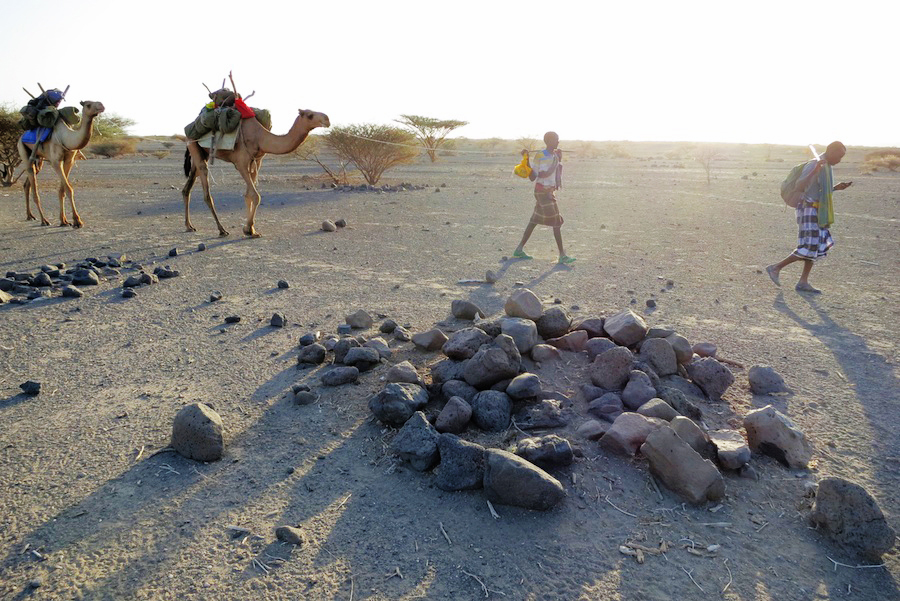
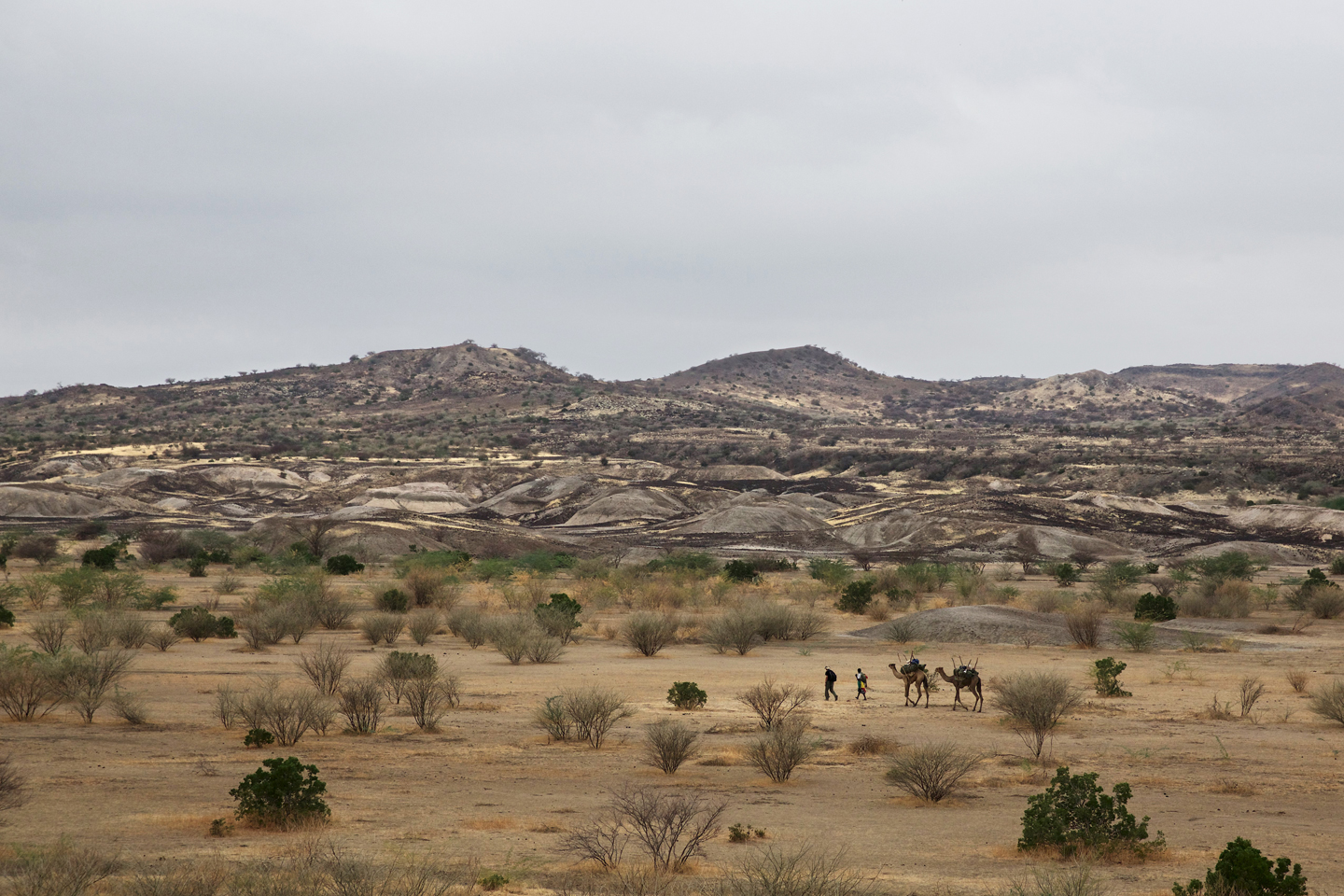
The Afar Triangle is dreaded as a waterless death march, as a moonscape. Temperatures of 120°F. Saltpans so bright they burn the eyes out. Yet today it rained. And Alema and I have no waterproof tents. We have an Ethiopian flag, which Alema wraps himself in. We lead the two camels ourselves. (Whose are they? I’m not sure. Alema procured them Afar-style, off the cuff.) We inch across an acacia plain darkened to the color of chocolate by the warm raindrops. We tread on a photographic negative. The camels’ moccasin-like feet pull up the frail crust of moisture, leaving behind white circles of dry dust.

Paul Salopek
Alema is tired.
He forgot his new walking shoes from America. And his flashlight. And his hat—and the cell phone. So he got a lift back to his village yesterday, hitching a ride from our second camp, in Aduma, to retrieve these vital items. He has jogged all the way back to catch up. And now he complains, laughing, of a rash in a private place.
This absent-mindedness is understandable. It is impossible to remember every detail on a walk of this order, this length, this scope. It feels like an afternoon’s stroll. I have planned for many months and forgotten things myself. Nylon stuff sacks, for instance, Because of this, my airplane luggage, a city slickers’ rig with plastic rollers and collapsible handle, is strapped to a camel’s back.

Loading up for the trek from Bouri village to the Ethiopia-Djibouti border.
John Stanmeyer-VII
The scientists of the Middle Awash Project invite us to begin our walk at Herto Bouri, a symbolic mile zero in the Rift, which is among the richest human boneyards in the world. This is the famous fossil site where three of likely the world’s oldest human beings have been found. Homo sapiens idaltu. Gone for some 160,000 years. A robust, big-faced ancestor—us, but not precisely us.
The Middle Awash Project researchers, led by Tim White, Berhane Asfaw, and Giday Woldegebriel, have uncovered some of the most important hominid fossils of our day in Ethiopia, including Ardipithecus ramidus, a 4.4 million-year-old bipedal ape. (I will be writing more about these prospectors soon.) My guide Alema, 60, is their veteran fossil hunter.
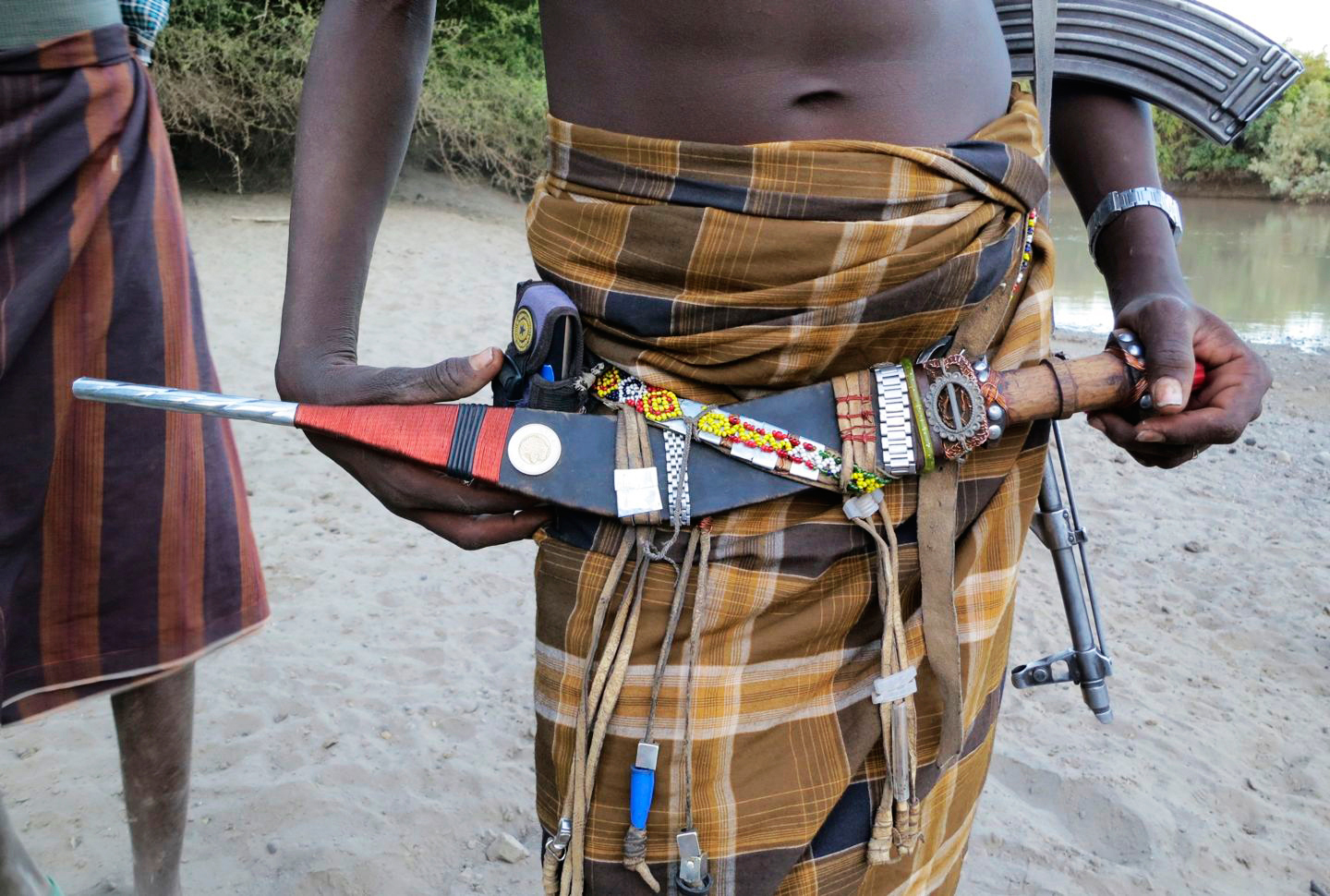
Raised in a nomad culture feared for its warriors, Alema speaks three languages—Afar, Amharic, and a profane English patois gleaned from the Middle Awash scientists. He is a paleontologist in his own right. He exclaims “wow” and “crazy, man” and “jeezus,” while identifying the Rift’s key geological strata. He is the balabat, or traditional leader, of the Bouri Modaitu clan of the Afar. His cell phone holds the numbers of Ethiopian grandees and French academics. With an eighth-grade education, he bridges more worlds inside his head than a Leonardo, more time than an Einstein. He is phenomenon.
We are camped at Aduma when the Middle Awash scientists find us. They have come to show us an archaeological site.
“These tools are still a little early for the people you’re following,” says Yonatan Sahle, an Ethiopian researcher. “But their technology was basically as advanced. They made throwing points that allowed them to outcompete the other hominids they encountered outside Africa.”
We lean over a stone point resting on the gravel where its maker dropped it about 80,000 years or ago. We look up.

Middle Stone Age point, Afar region, Ethiopia.
Paul Salopek
An Afar woman screams bloody murder in the desert. She waves her arms. Where did she come from? Is she warning us off her hill? Is she mad? No. She marches up to a team member dozing on the ground. She gives him a sharp kick. She hefts a stone—a Middle Stone Age tool, perhaps—and threatens to brain him. The collection of a debt? A matter of the heart?
I hear the victim laughing. I know this laugh. It is the man who, over the next six weeks, will guide me to Djibouti, and the Red Sea.