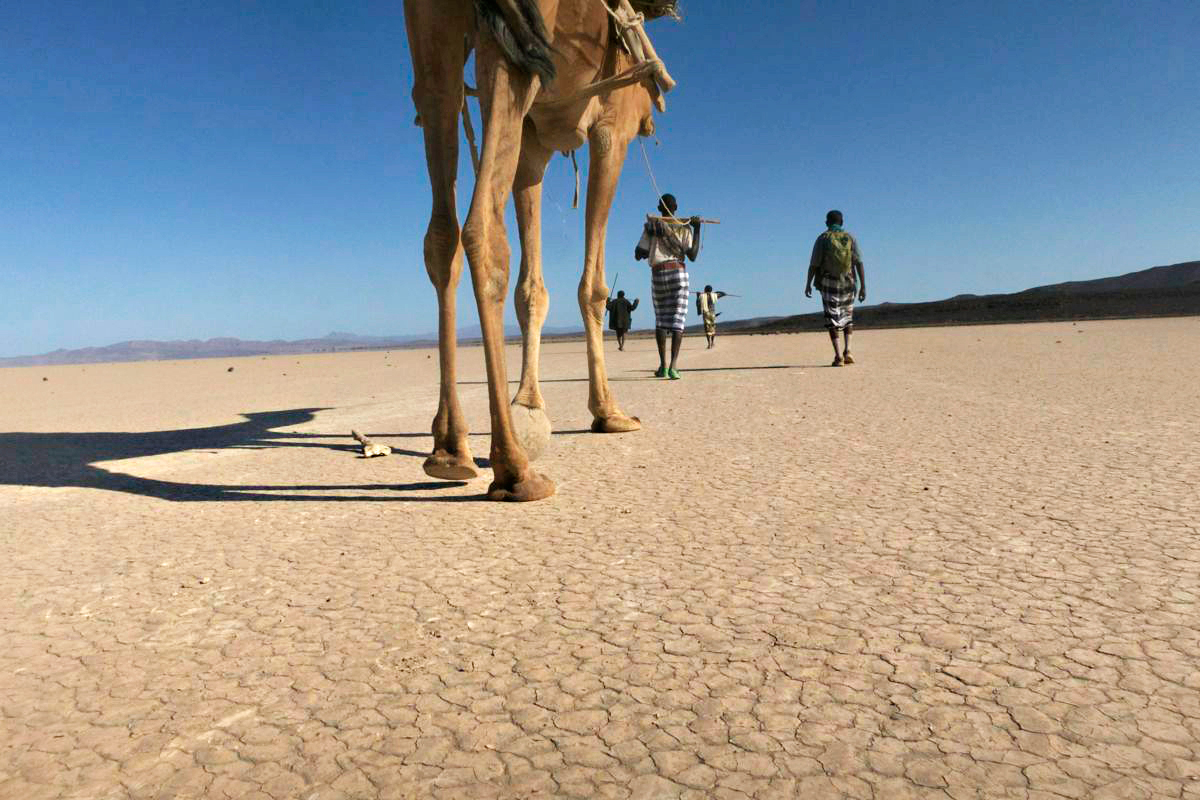
Moving north and then east, we abandon the desert and stub our toes on the anthropocene—the age of modern humans.
Asphalt appears: the Djibouti-Ethiopia road, throbbing with trucks. We inch through a series of gritty towns. Dust and diesel. Bars. Shops with raw plank counters. Garlands of tin cups clink in the wind outside their doors.
Then, near Dubti: a sea (no, a wall) of sugar cane. Miles of industrial irrigation. Canals. Diversion dams. Bulldozed fields. Ahmed Alema Hassan, my infallible guide, becomes lost. As we search for a way through the cane, night envelops us, and we end up pulling the weary camels in a gigantic circle. “Wow, man!” Alema says in surrender. “No way! Too much change!”
This is the Tendaho sugar plantation, a multimillion-dollar Ethiopian-Indian project that is making the Afar Triangle bloom. Fifty thousand migrant workers will soon toil here, tending 120,000 acres of desert that has been scraped, shaped, molded, and flooded by the Awash River to sweeten the world’s coffee, its tea. Eventually, it could make Ethiopia the sixth largest sugar producer in the world. It will help break the country’s dependence on foreign aid: a good thing.
But progress is rarely shared equally for those involved. There are winners and losers in every improvement scheme. Here, one of the losers is a bright young Afar woman—a girl, really, though her poise is very old. She is wrapped in a red dress. She stands by a new levee. She is collecting water from what used to be the Awash River.
“The company moved us off our land,” she tells us, waving her arm at the cane. “We get a little work, us Afars, but it is always the lowest work. Watchmen. Shovel work.”
A typical sugar plantation salary: $20 a month. The girl says police were sent into local nomad communities to chase out the diehards who refused to move. Shots were exchanged. People bled on both sides.
How old is this story? It is one of the oldest stories in the world.
What are the exact names of the Sioux removed from the Black Hills of the Dakotas to accommodate gold miners? Who knows? Who are the people who surrender their traditional livelihoods today—Irish farmers forced out of business by market policies in Europe, or Mexican ranchers shunted aside by highways—always for some common cause? It is impossible to keep track now. Humanity is remaking the world in a radical and accelerating cycle of change that strips away the memory of place as well as topsoil. Our era’s breathtaking changes flatten collective memory, disrupt precedence, sever lines of responsibility. (What so disconcerts us about suburbia? Not only its placelessness but a void of time; we crave a past in our landscapes.)
Dubti is a bustling green frontier. Hardworking men and women from all over Ethiopia are flocking there, bringing new hopes, tastes, voices. A new plantation housing complex will shelter 3,000 families. In the heat waves of distance, an Afar drives his goats past the boxy buildings: a living ghost in a landscape of deepening amnesia.

Ethiopian police watch anthropocene video, Afar Triangle.
Paul Salopek
In Dishoto, another truck stop town, I recharge my laptop at a police station. The officers are all outsiders, non-Afar. They are friendly, curious, generous. They ply Alema and me with tea. (It is dense with sugar.) Our conversation is derailed by Ethiopian TV. The policemen stare at nation-building music videos: pop tunes played over video loops of strip mining, road building. We thank them. We walk on.
A Czech novelist, Milan Kundera, once wrote: The struggle of man against power is the struggle of memory against forgetting.
The Afar girl’s name is Dahara. She is 15.