There is something comforting about traveling with large animals. Their honest bigness, their extraordinary power, when moving in tandem with your own punier step, can buck up your spirits on the trail. It seems as if animals, too, have thrown in their lot with your journey. An absurd conceit. (Nobody ever asked a beast of burden its opinion about carrying our loads.) But the sense of cross-species solidarity is hard to shake.

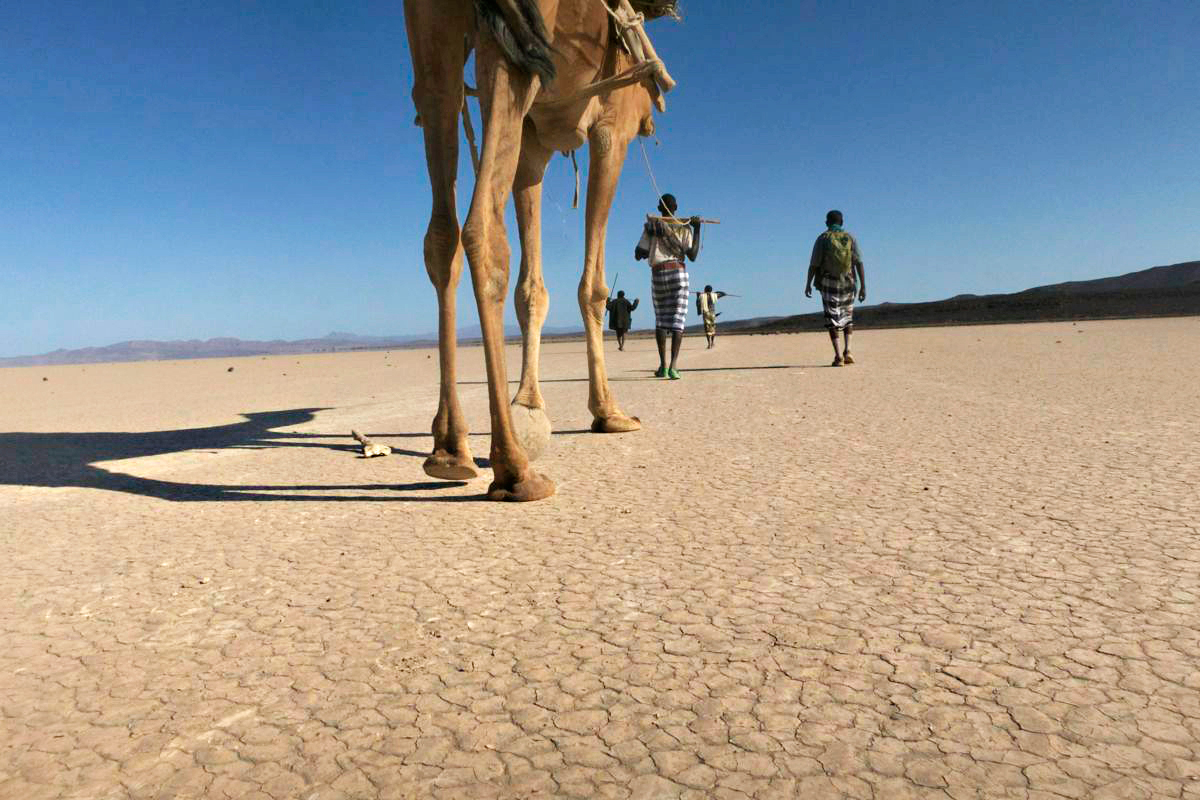
Camels heading home after grazing.
John Stanmeyer-VII
In the case of camels, which can easily weigh a ton, a surprising fragility adds poignancy to the partnership. Camels may be able to endure thirst for three or four days. Most can lug 500 pounds of deadweight. But they are picky eaters and the soles of their feet, which are smooth as a bald tire, slip on mud and grow sore on sharp rocks.
At night, our two camels scissor down to the ground with a pneumatic softness, and kneel close—sometimes, within arm’s reach. They roll in the dust like horses. (This can be startling in the dark.) And they chew their cud. Endlessly. This habit generates a strange noise. It sounds like footsteps on gravel. I started awake last night because of it. Our larger camel, Suma a’tuli, wasn’t chomping too noisily—it was because he had stopped.
Click here to hear a camel chewing the cud.