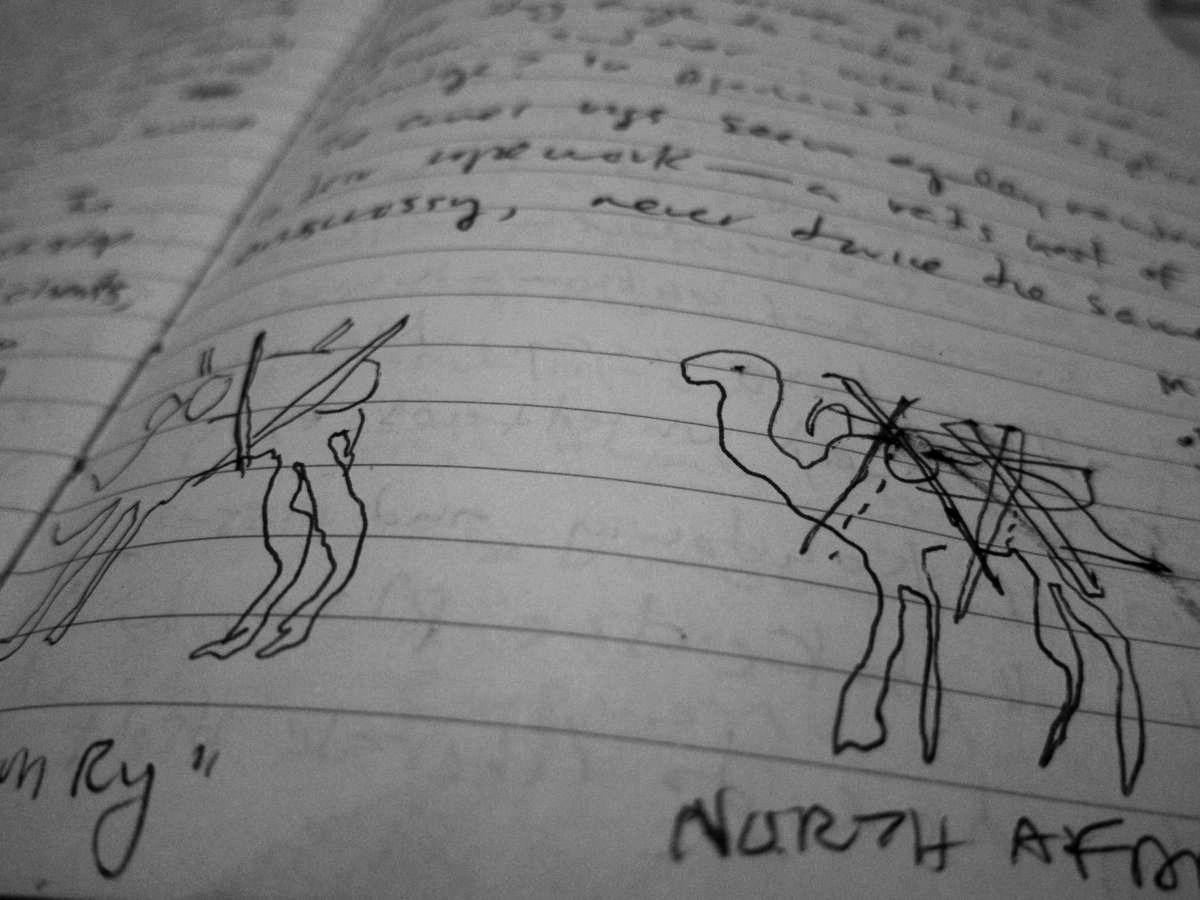
What does it take to live-tweet a camel from a sandy footpath in Ethiopia? A lot more than just a smartphone in your pocket. Journalist and National Geographic Fellow Paul Salopek is about to leave behind his dromedary companions and needs to lighten his pack. Can you help? Leave your suggestions in the comments.
Electronic oases will be rare on Salopek’s seven-year walk to trace the global migration of our human ancestors. Paul is carrying a lot of electronics, and his solar panels aren’t doing the job, especially when his power inverter overheats in the desert sun.
The image above shows what Paul carries in his pack right now, with the help of camels. On foot, he’ll need to lighten the load. Can you help him improve communications while also cutting weight?

Ahmed Alema Hessan leads Paul Salopek’s modest caravan through the Great Rift Valley in Ethiopia.
Paul Salopek
Paul writes:
As a writer and journalist, I gather and record information — text, audio, still photos, video — and use it to tell people’s stories. So I use the basic tools of a foreign correspondent: laptop, still/video camera, digital sound recorder, and the means to share it all online — a satellite data terminal and voice handset. It transmits data at near-dialup speed: 40-60 KB/S. I also carry a local cell phone with interchangeable SIM cards. But for long stretches of the walk so far, I have had access to no local cell signals.
There are four requirements for any telecommunications package on my journey:
Portability: At the moment, I am using camels to assist with travel. (Mainly for carrying water between wells in a hyper-arid region of the Horn of Africa.) But soon I won’t be able to rely on this extra muscle power. So weight is the overriding limiting factor. I need to limit my complete comms kit to about 10 lb.
Power Efficiency: I can’t carry power-thirsty electronics because I am spending long periods (days, weeks) unplugged from conventional power grids. I am carrying solar panels. But so far they haven’t proved very useful in recharging most of my equipment. I think the problem is the DC inverter I’m using; it sucks up the trickle of energy that’s produced with its fan. The only things it charges have direct DC plug-in cables. (could this work for my Macbook Air too?) I could use suggestions for better solar solutions, or alternate power sources, including experimental ones.
Ruggedness: Fragility is a liability. Whatever travels with me goes in a rucksack. I don’t have space or energy to cart around shockproof cases.
Simplicity Any equipment that requires fussing is a non-starter.

Iron axe, dagger, spare turban, pre-used water bottle, snuff, matches: The equipment carried by camel guide Mohamed Aidahis in the Afar Triangle of Ethiopia.
Paul Salopek
To get an idea of the ideal kit bag for nomadism, check out what Paul’s cameleers are carrying.
What would you suggest?
Leave your suggestions in the comments. While we all probably have opinions on what digital camera to use (I would love to see him take a Lytro) the more interesting challenge has to do with power and communications. Here’s what I wrote back to Paul:
Paul, although I love the romance in the idea of power generating shoes, thermoelectric generators like the tPod might offer helpful night-time power.
The power inverter seems unnecessarily redundant. If you can bypass the inverter, you can also lighten your pack of some of the other cables and power bricks that you carry. Let’s ask around about alternatives.
That satellite terminal looks pretty huge. Let’s see if we can find something smaller.
How would you advise?
J. Nathan Matias develops technologies for civic participation, media analytics, and creative learning at the MIT Media Lab and Center for Civic Media. He also co-facilitates @1book140, The Atlantic’s Twitter book club.
Iron axe, dagger, spare turban, pre-used water bottle, snuff, matches: The equipment carried by camel guide Mohamed Aidahis in the Afar Triangle of Ethiopia.
Paul Salopek
To get an idea of the ideal kit bag for nomadism, check out what Paul’s cameleers are carrying.
What would you suggest?
Leave your suggestions in the comments. While we all probably have opinions on what digital camera to use (I would love to see him take a Lytro) the more interesting challenge has to do with power and communications. Here’s what I wrote back to Paul:
Paul, although I love the romance in the idea of power generating shoes, thermoelectric generators like the tPod might offer helpful night-time power.
The power inverter seems unnecessarily redundant. If you can bypass the inverter, you can also lighten your pack of some of the other cables and power bricks that you carry. Let’s ask around about alternatives.
That satellite terminal looks pretty huge. Let’s see if we can find something smaller.
How would you advise?
J. Nathan Matias develops technologies for civic participation, media analytics, and creative learning at the MIT Media Lab and Center for Civic Media. He also co-facilitates @1book140, The Atlantic’s Twitter book club.