Hyenas slouched through camp last night.
Their footsteps: a soft, rhythmic padding, like the slap of an index finger against the palm. They emitted deranged chuckles, terrible gurgles—a cross between a purr and a bark. I lifted my head from the ground. But I could not see them. The moon was down. The night was black. There was no fire to frighten them off: We had built no fire. Instead, we had slogged eight miles north of our route along the Awash River’s muddy banks, blundering through dense screens of thornscrub, exhausted, tormented by mosquitoes, until we threw ourselves down to sleep. Only there was no sleep. Because of yanguli, the hyena.
Ahmed Alema Hessan, my guide, blamed it all on the Issa: the Somali-speaking nomads who are the old enemies of the Afar—eternal bogeymen, cattle rustlers, “invaders” drifting up from the south and east, from the austere deserts of Djibouti and Somalia. Their raiding parties derailed our progress, forced us to march deep into the night. The Issa shoot the Afar. The Afar retaliate. How much of this ancient pastoral war is real, how much is imagined, inflated, a mere shard of larger tragedies like climate change, displacement by irrigation projects, droughts—it is impossible to say. It is all so ingrained, so implacable, so mythologized.
“At first in 1930 I had disapproved of the incessant killing by the [Afar], but fairly soon I accepted this as the way they lived, and I never felt any desire to see them brought under alien control and civilized.”

Portrait of two Afar (Asaimara Danakil) warriors, standing, wearing knives across their waists from which hang leather tassels denoting how many men each has killed. The man on the left is Hamdo Ouga, a young Asaimara chief who was killed by warriors of the rival Adoimara Danakil tribe a few days after this photograph was taken. Copyright Pitt Rivers Museum, University of Oxford
As our tiny caravan re-walks the pathways of early humans out of Africa, our trail crosses, now and again, the ghostly boot-prints of the man who wrote that chilly sentence, Sir Wilfred Thesiger—British iconoclast, writer, and photographer: a lone wolf, a man out of time, the last of the gentlemen explorers.
Thesiger, who died very old in 2003, with the cartilage in both knees worn out from walking, was a nail-thin aristocrat with a broken nose and a shock of coarse jet hair. He made his name in the middle of the last century, trekking vast distances barefooted among the Bedouin of Saudi Arabia. (He almost perished of thirst while traversing the Empty Quarter not once, but twice.) He roamed with Bakhtiari nomads in Iran. He explored the last unmapped patches of Afghanistan. Yet his legacy isn’t adventuring. It is his art.
His books on the twilight of pre-industrial societies—Arabian Sands, Marsh Arabs, Visions of a Nomad—are beautifully written without being sentimental. They offer nuanced portrayals of a now vanished world, benedictions to traditional societies at the cusp of drastic changes. And his black-and-white photos of nomadic people, some of them frankly homoerotic, glow with a tenderness that he rarely displayed in person. Thesiger chose to play the hard man. He despised modernity. Well into his 80s, he lived alone, in a rural slum, in the Kenyan desert. “An abomination” was his term for cars.
The solitary Englishman launched his extraordinary wandering career here, where khaki-colored sandstorms strip the land to the bone, in the Afar Triangle of Ethiopia. (He’d been born, the son of an English diplomat, in a mud hut in Addis Ababa.)
In 1934, at the age of 23, leading a camel train and armed bodyguards supplied by his friend, Emperor Haile Selassie, this former champion boxer at Eton set out for the Red Sea through the territory of the hostile Danakil, as the Afar were then known. Along the way, he collected birds, barricaded his tent against midnight attacks by warriors, and wrote dutiful letters to his mother. “Everything was going simply splendidly … secured hostages for good behavior off each headman.”

View of Wilfred Thesiger’s expedition party setting out from the Awash Station at the start of his 1933-4 Awash expedition. Copyright Pitt Rivers Museum, University of Oxford
He also perpetuated the legend of the Afar as some of the most warlike nomads in the world:
“A man child at any age, even at the breast, counts as a kill. They invariably castrate their victim, even if still alive, if it is possible to do so.”
Thesiger’s book about that journey, The Danakil Diary, bristles with this sort of prurience. He was very young. He saw what he came to see. He largely omitted historical context: The Afar belonged to a sprawling Muslim pastoral and trading empire; they had been at bitter war, off and on, for many generations with encroaching neighbors, including Christian Orthodox Ethiopia. Thesiger was an armed and uninvited guest. He marched through a militarized culture.
“As I looked around the clearing at the squatting warriors,” he gushed some 80 years ago of his first encounter with the Sultan of Aussa, the xenophobic king of the Afars, “… I knew that this moonlight meeting in unknown Africa with a savage potentate who hated Europeans was the realization of my boyhood dreams.”
Thesiger would feel at home today in much of northeast Ethiopia.
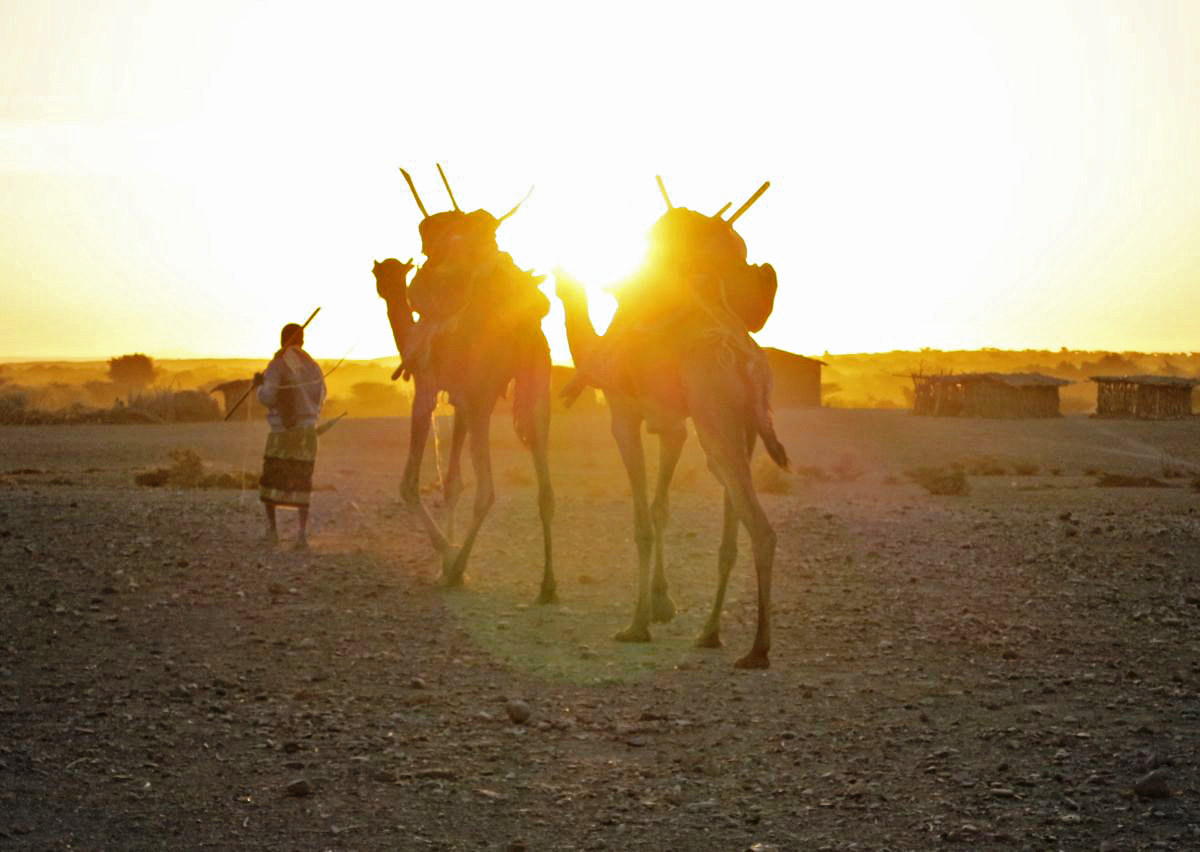
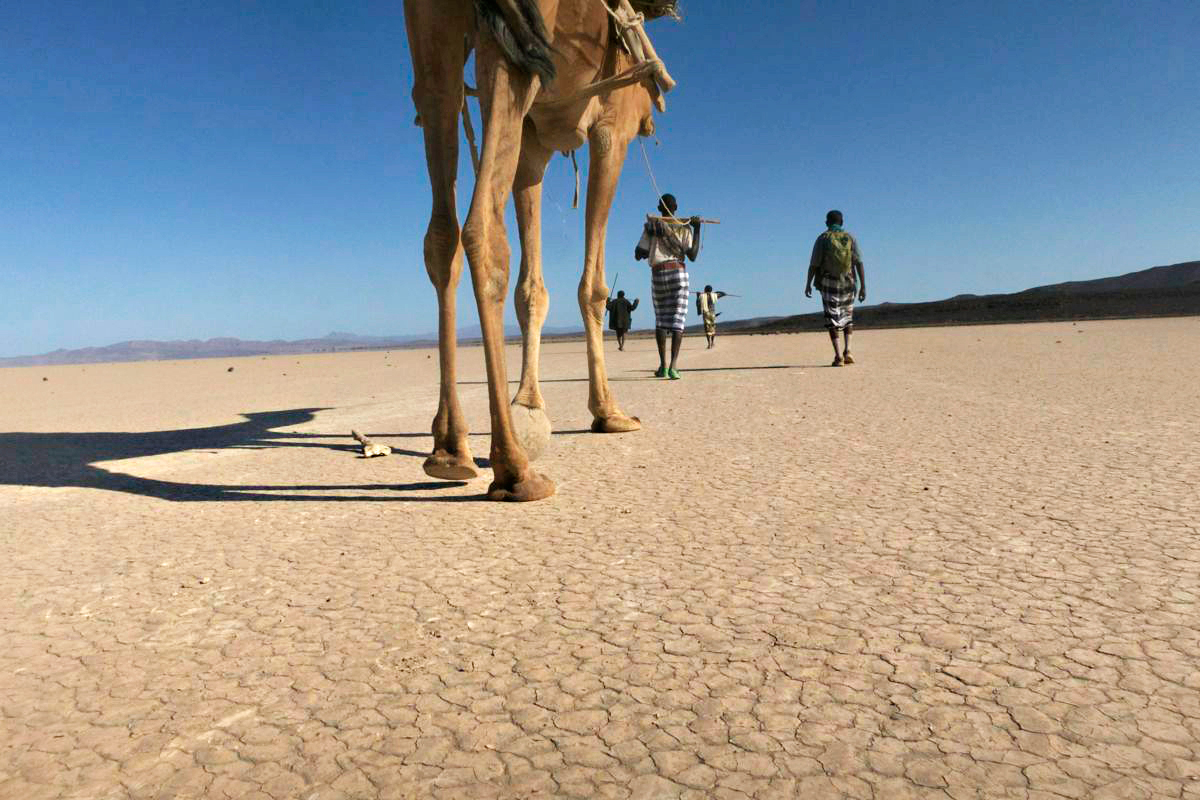
Mount Ayelu, a perfect volcanic cone, still juts from the Rift Valley floor. It is the translucent blue of wood smoke. And our camels, like Thesiger’s, have acquired personalities: big Suma a’tuli is a Sufi stoic; small, bullheaded A’urta makes his unhappiness known, shaking off his loads. At night the old explorer would have been comforted by the clank of sooty cook-pots, the banter around our campfires. Miraculously, wildlife remains: ostriches glow, limned in golden light, on the sunset plains. And I, too, aim to meet the elusive king of the Afars.
So we break camp. We walk on.
Past open canopy forests of acacia. Past the domed huts of Afars who stand and stare. (“A strange feeling, being watched continuously …”) Past men using bronze-age-looking adzes, chopping at the dwindling trees, making charcoal. Past a sprinkle of green market gardens of corn, watermelon, onion. To fabled Asaita—once called Aussa, the traditional capital of the Afar sultanate. An oasis town. Its narrow alleyways crown a black mesa of stone on a remote bend of the Awash River. The king’s home. Almost 30 miles of walking in a single day.
“Hello? Hello?” I shout into my satellite phone, dialing the current Afar sultan “Is His Excellency in?”
His Excellency Hanfareh Ali Mirah: heir of a royal line dating back to the 1730s, grandnephew of the ruler who gave Thesiger a gift of one dozen skins of milk, two of ghee, and two bullocks. (A bribe to send the explorer on his way.) I have been trying to reach His Excellency for weeks, months. Caked in dirt, I stand on a rooftop in Asaita with the phone pressed to my ear. (This where people sleep.) My Afar sarong, or shire, is crusted with dried sweat. I stink of camel and smoke. I have been subsisting on the nomad’s unleavened barley bread. Drinking goat milk.
“Please call back tonight after eight,” a retainer says.
I do. But the sultan—a professional diplomat, a modern politician who moves about constantly in a SUV, a settler of land disputes, a donor of emergency food supplies, scholarships—is not available after eight. He is never available. There will be no ghee, no oxen for me. The last time I ring he is far away from Afar land. Where is he? He is in France. In Europe.