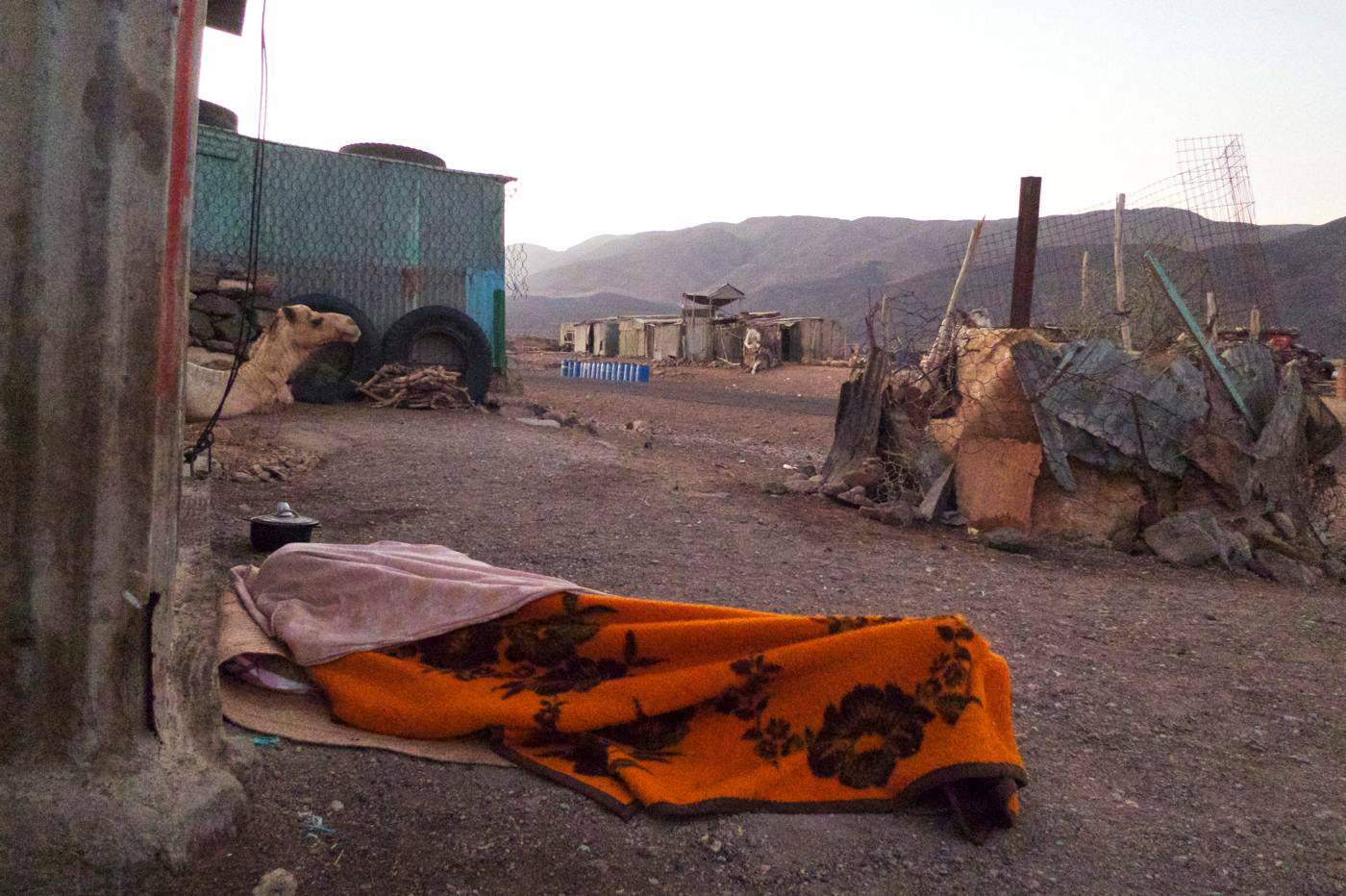
We camp in a brewery.
It does not look like any brewery I have ever seen before: a small oasis of doum palms, crawling with Afar men—lanky young boys, doddering grandfathers—who wander about, hacking at the trees with knives. An oasis of mad butchers.

The source of the brew—doum palms.
Paul Salopek
Many of the young trees are decapitated, hacked down to nubs, to stumps. Beneath the open gashes hang cups made of old plastic water bottles. These catch the palms’ nectar, which oozes out slowly, melancholically, in a frothy drool. This viscous sap will be fermented for one week with the fruit of the palm itself. The end product looks like lemonade. It tastes sweet, fizzy. Each tree will surrender perhaps five gallons.

The cut that quenches thirst—slicing doum palms to make palm wine.
Paul Salopek
Hidden in this howling wilderness: a brewery of palm wine.
“It is very nutritious, even for children,” explains my camel guide Houssain Mohamed Houssain, who buys a large bottle or six for us. “You can put it in their sorghum cereal. It’s full of vitamins. That way, they don’t get malaria. The mosquitos bite them, but they don’t get the disease!”

Cameleer Ibrahim Hagaita brings survival rations of palm wine along for the trail.
Paul Salopek
An elixir Humphrey Bogart would approve of.