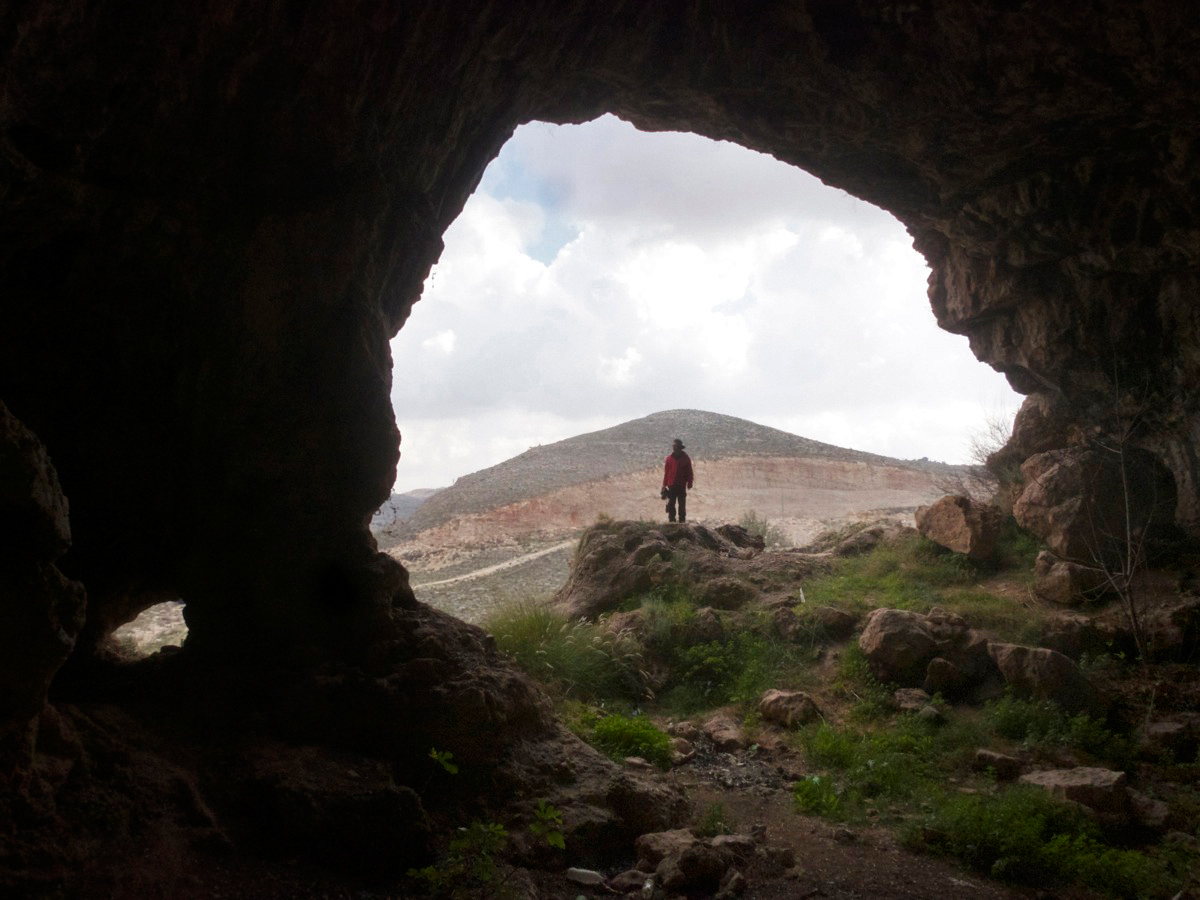
We walk past caves that were blackened by fire like eye sockets daubed with kohl. Some are inhabited by modern troglodytes—by homeless Bedouin. (“It’s not so bad. We pay no taxes!”) We ricochet down the seam of a great, dry, snaking wadi that fans out onto the stifling basement of the Jordan Valley. Down seesawing trails worn two millennia ago by the sandals of incense traders. Down past the watery blue shade of junipers. Past the brittle grey shade of acacias. Beyond every hue and taxonomy of shade until there is no shade at all. At sunset we reenter the desert, a field of dunes, walking in a broth of yellow light. We are at sea level, some 3,000 feet below the brow of the Great Rift.

Stale bread: camel fodder in the parched Jordan Valley.
Paul Salopek
We sleep at a camp of Bedul herdsmen, seminomads who feed their camels on gunnysacks of stale bread (there had been no grass this year). I run my sun-varnished hands over the animals’ strange necks, immensely flexible and strong, triangular in cross section. The camels tread with pensive steps, like monks vowed to silence.

Crossing the dunes one shadow length at a time.
Paul Salopek
The next morning the hooves of our two little mountain mules sink deep into sand the color of polished bronze. After five miles we see the camps of tomato pickers, Syrians, refugees from the war. Their cities have been destroyed. A woman steps out of a tent and waves at us. She beckons us. Inside the tent she slips behind a hanging sheet. She changes into her best dress, bright pink with metallic stripes. She is gloriously pregnant. Her beauty would gentle horses. She boils us tea with wild thyme.
Eight miles to the northeast, in a craggy wilderness called Wadi Feynan, we tether the mules and climb a scarp to an archaeological site. It is 11,700 years old. It is some sort of temple. This is remarkable—almost unheard of. Its builders would have been hunters of wild game, footloose ramblers like the first humans who drifted through from Africa: not urbanites, not hewers of stone. These were the silent, pre-dawn centuries at the cusp of the Neolithic Revolution. Before the rise of agriculture. Before the faintest glint of organized religion. Before the beginning of the end of the bulk of human history—the age of nomads.
We stare across the Jordan Valley. Nearby, on a slope of ochre rock, slump more ruins. Walls of stone. Mills. Mounds of slag that shine dark as pencil lead. These are perhaps the world’s first smelters, at least 6,000 years old. The mine openings look like manholes. During Roman times this desert sky was blackened by dozens of forges, by vanished forests’ worth of burned charcoal. Christian slaves died by the thousands working the mines. A primordial gulag. Wadi Feynan is a contender for humankind’s first industrial revolution. It was sparked by the accidental discovery, perhaps in some hunter’s campfire, of the melting point of copper. This is a threshold of temperature that changed the world. It is a specific number that should be memorized by schoolchildren. The four digits, recorded in degrees, rightfully should appear, embossed in copper, on a famous monument. We stand at a frontier in human consciousness. Wadi Feynan divides everything we know today from everything that has been forgotten.
We build a squaw fire. We put on some tea. We stare into the fire.
I miss my own two camels, left behind in the old nomad horizons of the Hejaz. There will be no nomads again. Not for a long time. Not until the distant steppes of Central Asia.