“How did you find our mule?” I ask Deniz Kilic.
“Taxi driver.”
“You asked a taxi driver where to buy a cargo mule?”
“I have never bought a mule before. I know nothing about mules. Where do you buy a mule? Who knows? So I asked my taxi driver driving me in from the airport. I said to him, ‘Don’t laugh. This is serious. Where do I buy a mule?’”
Kilic is my walking partner in Asia Minor.
We meet in Mersin, a large industrial port in southeastern Turkey. I have just disembarked from a ferry from Cyprus. And Kilic has agreed, based on two emails and one long-distance phone call, to join my traverse of Anatolia—600 to 700 miles on foot across the sprawling Asiatic heartland of Turkey.
“Crazy people”—he says—“attract other crazy people.”
Kilic is a professional tour guide, a compulsive world traveler. (Joined by his wife, Elif, he has driven motorbikes through 29 countries.) He is from Bodrum, a resort town in Turkey’s cosmopolitan European fringe. But he is proud of the rustic glories of Anatolia, the little visited eastern peninsula that makes up more than 90 percent of his country. The Trojans, immortalized by Homer in the Iliad, were Anatolians, Kilic informs me. The historic Santa Claus was an Anatolian too. (The fourth-century patron saint of children and pawnbrokers stood five feet tall and had a broken nose.) The world’s Indo-European languages may be rooted in Anatolia. Anatolian nomads might well have invented agriculture. Their history is complex, bottomless, Kilic says: We will stub our toes daily on artifacts. Moreover, Anatolians are the true Turks—a tough steppe people of varied origins. Kilic is their advocate. He is a man of granite opinions. Of limitless ingenuity. He suffers fools badly: He calls them “geniuses.”
“Walking in August will be miserable! What genius planned this?”
“I did.”
“Nice.”

New subcontinent, new walkers—guide Deniz Kilic and Kirkatir (“Grey Mule”) on the Cilician Plain.
Paul Salopek
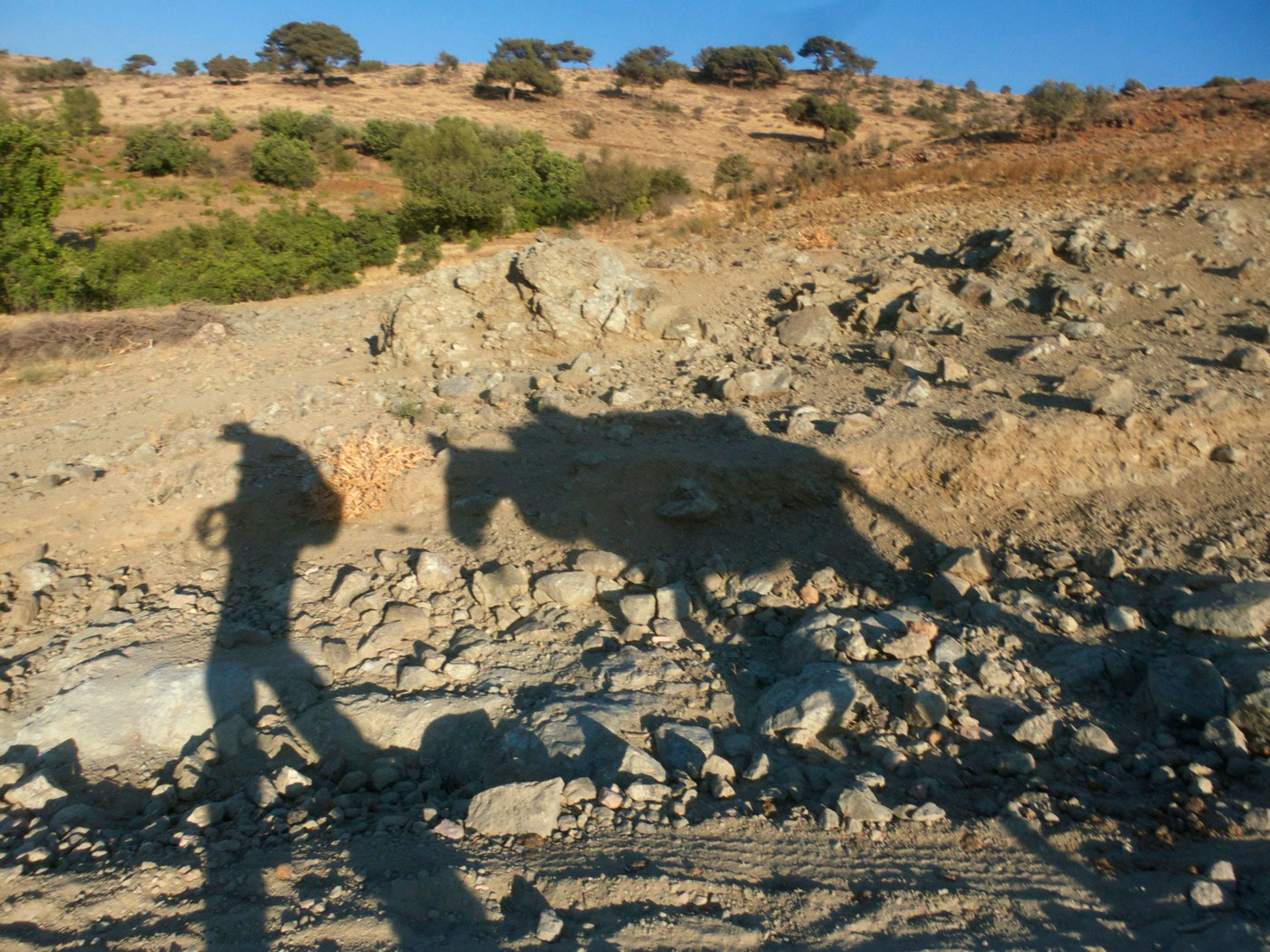
We tug the mule over farm roads. (According to her $350 bill of sale, she is prehistoric: 22 years old. More about this creature later.) We trudge into amber sunrises toward the dusty Iranian Plateau. We stir the quivering heat waves of molten afternoons. We climb the pleated foothills of the Taurus Mountains. We slog through fields of dried sunflowers. Past hand-pumped wells. Down to the sweltering Cilician Plain, perhaps the oldest continuously farmed landscape in the world. We sleep on village roofs.
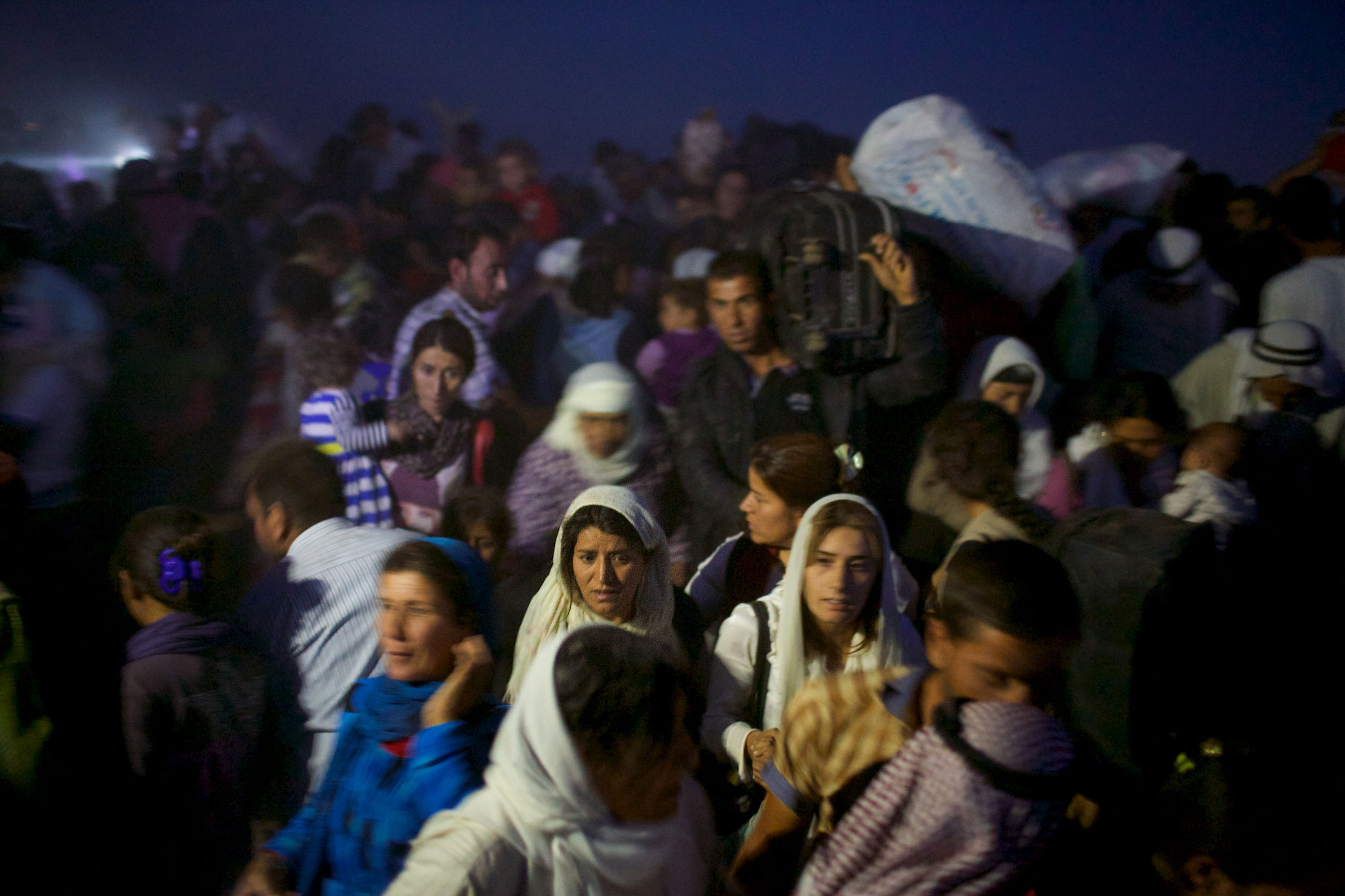
Millions of families still dream outdoors in southeastern Turkey.
Summer days are a furnace. The earth sizzles underfoot. The humidity of the nearby Mediterranean is smothering: It clogs the lungs; it drenches the skin with sweat. Yet at dusk, on the flat roofs of farmers’ homes, loom hidden refuges: a wisp of breeze, a dip in temperature, a refreshing oasis. Anatolians are like birds. They return to roost atop their houses after laboring in their fields. They recline on baize mattresses 20 or 30 feet above ground. (Houses in rural Turkey are typically two or three stories tall.) They sip tea and stare out across their old, old world through a clutter of water tanks, television antennas and airy clotheslines. On rooftops, they picnic on yoghurt, meatballs, and watermelon. They converse and make love under starlight. Neighbors one house away perform these exact same rituals. This practice, a remnant of open-air life, of camping while settled, has survived in Anatolia since our Stone Age youth. It is an echo of hunting and gathering—from the Pleistocene trails that I follow out of Africa.

Rooftop dawn in Kartal: Kilic sleeps in atop a villager’s house.
Paul Salopek
“The villages are dying out,” a farmer named Sami Gortuk says. “The government gives us subsidized fuel. It gives us cheap seeds. It gives us loans for tractors. But our children are moving to jobs in Mersin, to Adana.”
The young abandon the sky in Anatolia. Only the poor sleep al fresco in the city.
Wearing baggy peasant pants and clogs, Gortuk and his wife, Hayirli, bring our mule a bucket of ground oats. They lead us to their roof. They set out bowls of fasulye, a bean and tomato stew. They unspool power cords to recharge our electronic devices. We are total strangers. This generosity, this impulsive kindness, is repeated everywhere along our route. Rural Anatolians are the most hospitable people on Earth.
This is a cheering surprise, given the blood-steeped soil.

The ancient Fertile Crescent is still fertile. Eggplant harvest near Hebilli.
Paul Salopek
The plains of eastern Turkey are not simply a strategic corridor between Asia and Europe. They are a hinge of history. Civilizations have swiveled violently back and forth atop this plateau for more than 6,000 years. Armed migrations, invasions, conquests, incursions, retreats—books on Anatolia contain numbing variations on this: “and a new wave of Indo-European raiders swept over the land.”
Because that land is so fertile. Because it ramps westward to four seas: the Black, the Aegean, the Marmara, the Mediterranean. Because much of Anatolia is flat and impossible to defend.
“[T]he fields of one community came into contact with those of another,” writes Robert D. Kaplan in The Revenge of Geography: What the Map Tells Us About Coming Conflicts and the Battle Against Fate. “[C]hronic war emerged, as there was no central authority to settle boundary disputes, or to apportion water in times of shortage.”
The Akkadians and Assyrians claimed the prize of Anatolia. So did the Hittites, aboriginal Anatolians whose 3,500-year-old legal code, etched on clay tablets, includes the bylaw: “If anyone bites off the nose of a free person, he shall pay 40 shekels of silver.” Then the Phrygians invaded, and then the Scythians, Greeks, Neo-Assyrians, Persians, Armenians, Macedonians, Seleucids, Parthians, and Sassanid Persians. The Romans marched in over stone roads to the Euphrates. Christianity turned them into Byzantines. Then came Arab armies bearing the green banner of Islam. The conquering Seljuks (and their Sultanate of Rum) were overrun in turn by bandy-legged cavalrymen galloping in from the east—the Mongols. Later, the Ottomans cobbled together nearly 600 years of continuous rule. Their aging, multiethnic Sultanate—the “sick man of Europe”—cracked apart in the wake of WWI. The Europeans gobbled up the pieces of Anatolia, but the Turks fought back. Modern Turkey was born here in brutal spasms of ethnic cleansing (Christian Armenians, Greeks, Assyrians were massacred and driven out; Muslim Bosnians, Albanians, and Bulgarians fleeing similar fates beyond Ottoman borders streamed in). Only 90 years ago, a radical Turkish general with a fondness for tuxedos—Mustafa Kemal Ataturk—yanked the fledging country into modernity. He banned sharia, abolished the Caliphate, gave women the vote, and forced Turkish men, on pain of prison, to exchange their fezzes for Western fedoras. (The Hat Law of 1925.)

Heaven is up—on farmers’ rooftops to escape the Anatolian summer heat. Near Adana.
Paul Salopek
The Out of Eden Walk, too, will swing on Anatolia’s ancient hinge. For the next two years, maybe three, I will trek eastward to China.
We navigate using village minarets, Deniz Kilic and I.
Blinded by the midday sun, we echolocate our way ahead using the heat-distorted calls to prayer that moan in the steamy distances.
We stagger past 1,900-year-old Corinthian plinths being used as backyard coffee tables. Past new OPET gas stations with “Chat Cola” in their fogged-glass coolers. Past worn limestone mosques that had been churches for half a millennium, and before that, synagogues. Over beaches strewn with a mile of broken Iron Age potsherds. Under the fleeting shadows of KC-135 jets launched from the U.S. airbase at Incirlik. (They were arrowing towards Iraq.) And among hundreds of old Anatolian men sitting on wooden stools in village squares, slapping down numbered tiles in eternal games of okey.
“Why are you doing this?” one of them asked. He rotated his palms skyward in query.
“Why do you sit here day after day playing okey?” I said.
“I don’t know.”
“I don’t know, either,” I said. And he nodded.