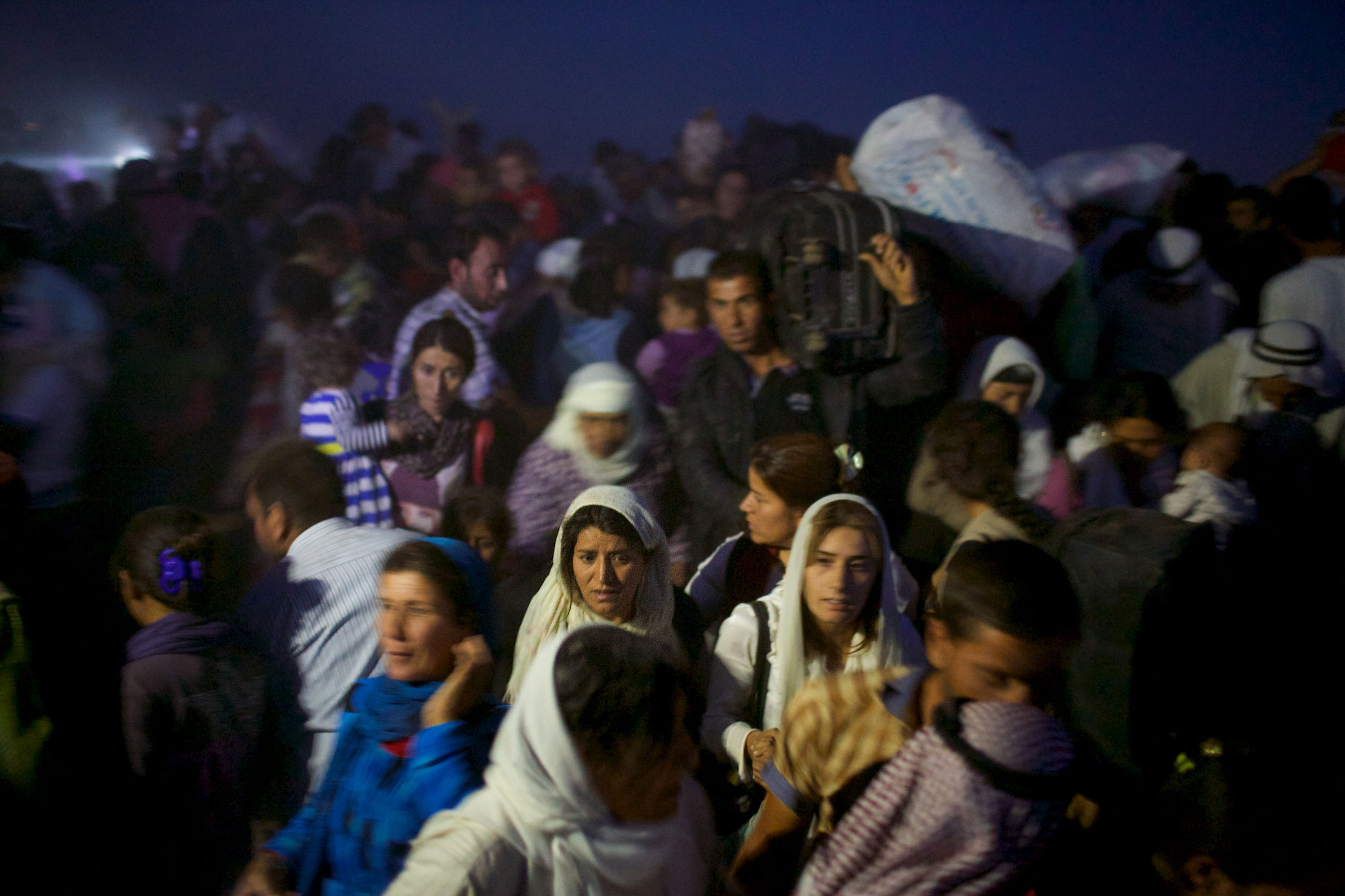
We walk into Tarsus, St. Paul’s hometown. A refurbished stone church here receives pilgrims from Italy: St. Paul’s Church. There is a café that serves Turkish coffee across from a pension: St. Paul Café. There are stone foundations of an old Roman house: St. Paul’s house (maybe). And there is St. Paul’s well. The well mixes Hellenistic, Roman, and even Islamic features. Busloads of faithful come to sip its water. They say it is curative.
“The water comes from the municipal supply,” Hakan Erkul says. “Who can say what miracles faith can cause?”

Italian pilgrims at St. Paul’s church in Tarsus.
Paul Salopek
Erkul is a friendly, thickset, sleepy-eyed man and an apostle himself—the lone tourism booster in Tarsus.
Aside from St. Paul, his city offers as an attraction a 9,000-year-old Neolithic tumulus poking up from its downtown. A World War I-era warship, the minelayer Nusret, sits dry-docked as a museum. (She performed gallantly at Gallipoli.) Cleopatra first met Marc Antony at the quay in Tarsus. A processional arch commemorates that historic seduction. Plutarch set the scene in 41 B.C.:
“[Cleopatra] came sailing up the river Cydnus in a barge with gilded stern and outspread sails of purple, while oars of silver beat time to the music of flutes and fifes and harps. She herself lay all along, under a canopy of cloth of gold, dressed as Venus in a picture, and beautiful young boys, like painted Cupids, stood on each side to fan her. Her maids were dressed like Sea Nymphs and Graces, some steering at the rudder, some working at the ropes.”

Captain in a box: mannequin aboard the World War I warship Nusret, enshrined in Tarsus.
Paul Salopek
When it comes to Tarsus wonders, however, Erkul’s favorite is possibly the largest and least known Roman temple in the world. The Donuktas ruin consists of poured concrete walls 1,800 years old, 150 yards long, 82 yards wide, and nearly 25 feet high. This strange cubist structure is just a foundation. It once supported columns six stories high. A bronze index finger is said to have been excavated at the site in the early 19th century. This colossal digit was more than five feet long. “We’re still looking for it,” Erkul reports.
A car junkyard abuts the temple. “People here don’t care about the past,” Erkul says, wincing. But it is hard to blame them. Tarsus is lousy with history. It is the Anatolian dilemma.
When we leave Tarsus, Erkul asks to join us for a day.
The man can walk. He was a boxing champion in Ankara. When I compliment him on his unbroken shark-fin nose, he presses it flat to the side of his face. It is like rubber. He has no septum. “Many operations,” he says. Erkul’s cell phone ring constantly. The ringtone is the gung-ho whistling soundtrack of a spaghetti Western. It startles our cargo mule.
Dogs lunge from the shrubbery as we plod by. They are Anatolian shepherds: Vicious, lank, and shaggy, they roar like bears.
My walking guide, Deniz Kilic, points a black plastic box at them and thumbs its big red panic button. The device is supposed to emit a distracting sound in a very low frequency only heard by dogs. I see no effect whatsoever. I think it is a placebo.
“Look close!” Kilic says. “Their facial expressions change!”

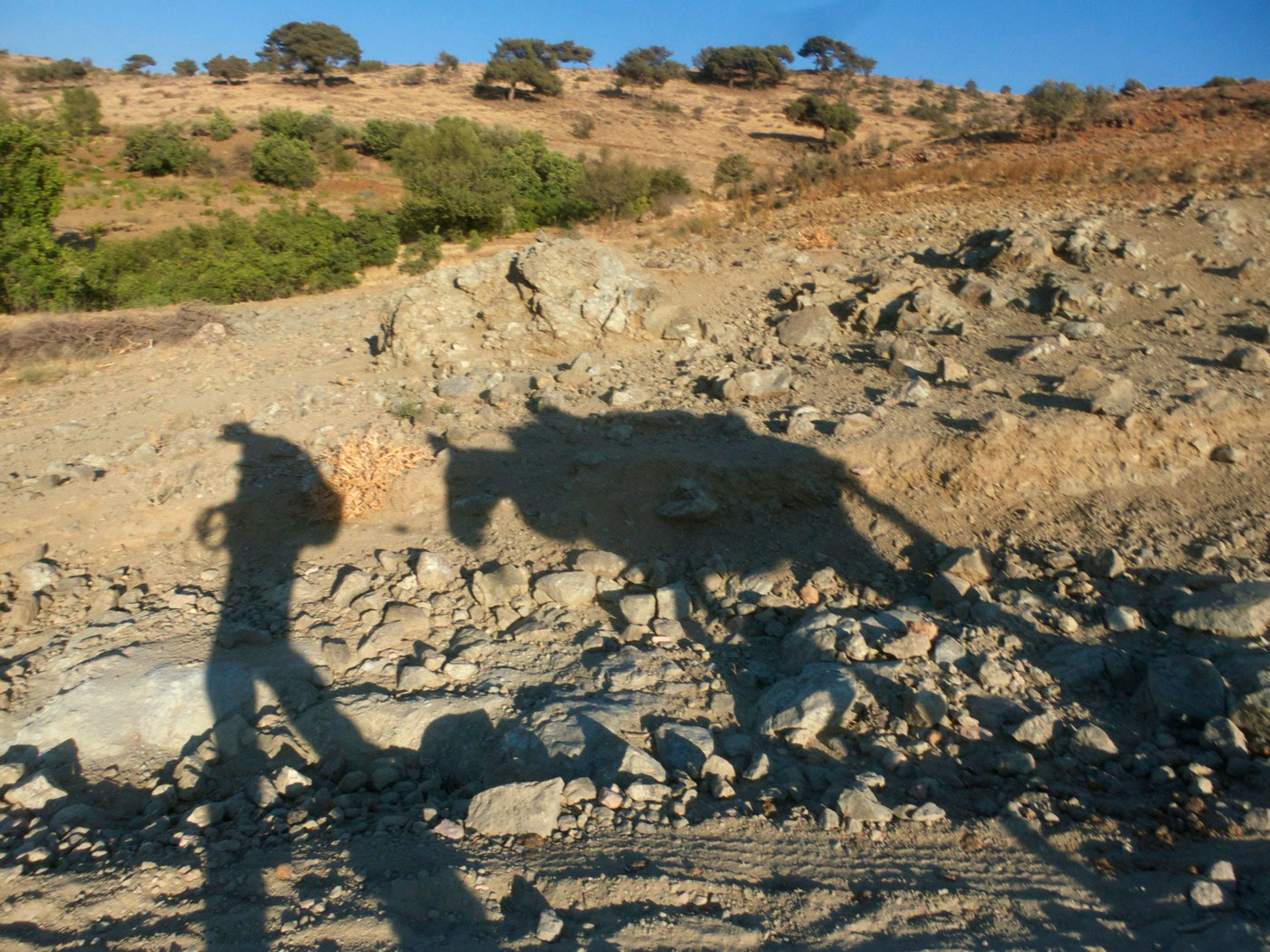
Walking east along the Roman road.
Paul Salopek
An hour later, we stumble onto a Roman road. It is exquisite and exquisitely empty. Sunset applies its gold leaf to the sky. We pass the ghost of St. Paul, ambling home from Antioch.